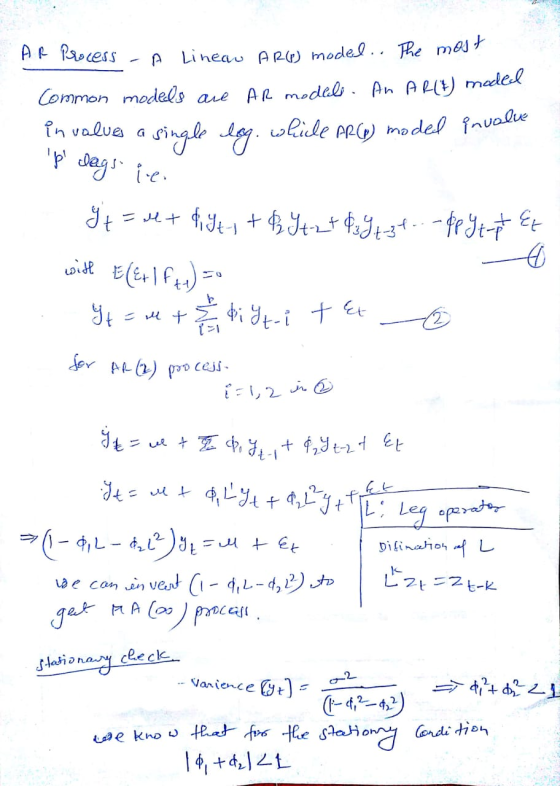
Write down the AR(2) model and prove whether it is stationary or not.
Write down the AR(2) model and prove whether it is stationary or not.
Homework Answers
Add Answer to:
Write down the AR(2) model and prove whether it is stationary or
not.
Based on correlogram, write down MA(q) or AR(p) model.
Based on correlogram, write down MA(q) or AR(p) model.
3. Suppose Δ1t follows the AR (1) model ΔΥ-30 + λίΔΙǐ-it . Show that Yt follows AR(2) model Deriv...
 3. Suppose Δ1t follows the AR (1) model ΔΥ-30 + λίΔΙǐ-it . Show that Yt follows AR(2) model Derive the AR (2) coefficients for y, as a function of Ao and λι
3. Suppose Δ1t follows the AR (1) model ΔΥ-30 + λίΔΙǐ-it . Show that Yt follows AR(2) model Derive the AR (2) coefficients for y, as a function of Ao and λι
3. Suppose Δ1t follows the AR (1) model ΔΥ-30 + λίΔΙǐ-it . Show that Yt follows AR(2) model Derive the AR (2) coefficients for y, as a function of Ao and λι
Write down a simple linear regression model. Then write down the associated optimization (minimisation) criteria used...
Write down a simple linear regression model. Then write down the associated optimization (minimisation) criteria used in Ordinary Least Squares (OLS).
3. Write the complete model for the flowing: (a) AR(P = 2)d=12 (b) MAQ = 2)d=12...
 3. Write the complete model for the flowing: (a) AR(P = 2)d=12 (b) MAQ = 2)d=12 (c) ARMA(P = 1,Q = 2).-12 (d) ARMA(P = 2,Q=0)d=12 (e) ARMA(p = 0,9 = 2) (P = 1,Q = 2)d-12 (f) SARIM A(p = 1, d = 19 = 1) (P = 1, D = 1,Q = 1).-12
(a) Use the complex exponential to prove the double angle formula cos2 -sin2 a cos(2.ar) ....
 (a) Use the complex exponential to prove the double angle formula cos2 -sin2 a cos(2.ar) . (b) Use the complex exponential to evaluate the indefinite integral sin(4t) dt.
(a) Use the complex exponential to prove the double angle formula cos2 -sin2 a cos(2.ar) . (b) Use the complex exponential to evaluate the indefinite integral sin(4t) dt.
(a) Use the complex exponential to prove the double angle formula cos2 -sin2 a cos(2.ar) . (b) Use the complex exponential to evaluate the indefinite integral sin(4t) dt.
(5 marks Consider the following general linear program (P). max{c Ar = b, x 2 0}....
 (5 marks Consider the following general linear program (P). max{c Ar = b, x 2 0}. пax- (a) Write down the dual (D) of this linear program. (b) Prove the Weak Duality Theorem directly for this particular (P) and (D)
ar answer has a unit symbol and the correct number of significant Solution: Write down the...
 ar answer has a unit symbol and the correct number of significant Solution: Write down the definition c Solve for mass. 0 | m = | 655. (255. mL) Put in the data given. m = (655. (255. mL) 10 L Convert units. 167.03... g Use the calculator. Round to the correct numb digits m 167.03 g
help c) Rewrite the following quantified logical formula as ar proposition in English. Then prove it....
 help
c) Rewrite the following quantified logical formula as ar proposition in English. Then prove it. 3ce R ((c> 2) A (c +2c - 15c = 0)
c) Rewrite the following quantified logical formula as ar proposition in English. Then prove it. 3ce R ((c> 2) A (c +2c - 15c = 0)
help
c) Rewrite the following quantified logical formula as ar proposition in English. Then prove it. 3ce R ((c> 2) A (c +2c - 15c = 0)
c) Rewrite the following quantified logical formula as ar proposition in English. Then prove it. 3ce R ((c> 2) A (c +2c - 15c = 0)
ar URSCH. In act prove that the identity map is the only ring isomorphism of 2....
 ar URSCH. In act prove that the identity map is the only ring isomorphism of 2. Let a and b be nonzero elements of the Unique Factorization Domain R. Prove that a and b have a least common multiple (cf. Exercise 11 of Section 1) and describe it in terms of the prime factorizations of a and b in the same fashion that Proposition 13 describes their greatest common divisor. 3. Determine all the representations of the integer 2130797 =...
+Risa 3. Write down a careful proof of the following. Theorem. Let (a,b) be a possibly...
 +Risa 3. Write down a careful proof of the following. Theorem. Let (a,b) be a possibly infinite open interval and let u € (a,b). Suppose that f: (a,b) function and that lim f(x)=LER Prove that for every sequence an u with an E (a,b), we have that lim f(ar) = L.
 3. Suppose Δ1t follows the AR (1) model ΔΥ-30 + λίΔΙǐ-it . Show that Yt follows AR(2) model Derive the AR (2) coefficients for y, as a function of Ao and λι
3. Suppose Δ1t follows the AR (1) model ΔΥ-30 + λίΔΙǐ-it . Show that Yt follows AR(2) model Derive the AR (2) coefficients for y, as a function of Ao and λι
3. Suppose Δ1t follows the AR (1) model ΔΥ-30 + λίΔΙǐ-it . Show that Yt follows AR(2) model Derive the AR (2) coefficients for y, as a function of Ao and λι
 3. Write the complete model for the flowing: (a) AR(P = 2)d=12 (b) MAQ = 2)d=12 (c) ARMA(P = 1,Q = 2).-12 (d) ARMA(P = 2,Q=0)d=12 (e) ARMA(p = 0,9 = 2) (P = 1,Q = 2)d-12 (f) SARIM A(p = 1, d = 19 = 1) (P = 1, D = 1,Q = 1).-12
 (a) Use the complex exponential to prove the double angle formula cos2 -sin2 a cos(2.ar) . (b) Use the complex exponential to evaluate the indefinite integral sin(4t) dt.
(a) Use the complex exponential to prove the double angle formula cos2 -sin2 a cos(2.ar) . (b) Use the complex exponential to evaluate the indefinite integral sin(4t) dt.
(a) Use the complex exponential to prove the double angle formula cos2 -sin2 a cos(2.ar) . (b) Use the complex exponential to evaluate the indefinite integral sin(4t) dt.
 (5 marks Consider the following general linear program (P). max{c Ar = b, x 2 0}. пax- (a) Write down the dual (D) of this linear program. (b) Prove the Weak Duality Theorem directly for this particular (P) and (D)
 ar answer has a unit symbol and the correct number of significant Solution: Write down the definition c Solve for mass. 0 | m = | 655. (255. mL) Put in the data given. m = (655. (255. mL) 10 L Convert units. 167.03... g Use the calculator. Round to the correct numb digits m 167.03 g
 help
c) Rewrite the following quantified logical formula as ar proposition in English. Then prove it. 3ce R ((c> 2) A (c +2c - 15c = 0)
c) Rewrite the following quantified logical formula as ar proposition in English. Then prove it. 3ce R ((c> 2) A (c +2c - 15c = 0)
help
c) Rewrite the following quantified logical formula as ar proposition in English. Then prove it. 3ce R ((c> 2) A (c +2c - 15c = 0)
c) Rewrite the following quantified logical formula as ar proposition in English. Then prove it. 3ce R ((c> 2) A (c +2c - 15c = 0)
 ar URSCH. In act prove that the identity map is the only ring isomorphism of 2. Let a and b be nonzero elements of the Unique Factorization Domain R. Prove that a and b have a least common multiple (cf. Exercise 11 of Section 1) and describe it in terms of the prime factorizations of a and b in the same fashion that Proposition 13 describes their greatest common divisor. 3. Determine all the representations of the integer 2130797 =...
 +Risa 3. Write down a careful proof of the following. Theorem. Let (a,b) be a possibly infinite open interval and let u € (a,b). Suppose that f: (a,b) function and that lim f(x)=LER Prove that for every sequence an u with an E (a,b), we have that lim f(ar) = L.
Most questions answered within 3 hours.
-
Where is the error in this code sequence?
String s1 = "Hello";
String s2 = "ello";...
asked 11 months ago -
Financial data for Joel de Paris, Inc., for last year
follow:
Joel de Paris, Inc.
Balance...
asked 11 months ago -
Consider this reaction:
Al2(SO4)3 (aq)+ BaCl3
(aq) Al2Cl6 (aq)- +
3BaSO4(s) . What is the...
asked 11 months ago -
Suppose that Savneet is considering increasing her
recent random sample from 20 car rentals to 40...
asked 11 months ago -
Trucks arrive at an unloading terminal at an average rate of 120
per hour.
Trucks arrive...
asked 11 months ago -
Why are methanol and ethanol completely soluble in water while
octanol is not very little soluble....
asked 11 months ago -
A facilities manager at a university reads in a research report
that the mean amount of...
asked 11 months ago -
When the CuSO4 is rehydrated by adding water to the anhydrous
compound, is this an endothermic...
asked 11 months ago -
A ray of sunlight is passing from diamond into crown glass; the
angle of incidence is...
asked 11 months ago -
A block of mass 0.249 kg is placed on top of a light, vertical
spring of...
asked 11 months ago -
how do the kidneys compensate in the presences of acidosis
a) trigger hyperventilate
b) reserve acid...
asked 11 months ago -
Question 501 pts
The rental rate of capital to the firm increases. Which of the
following...
asked 11 months ago