
Homework Answers
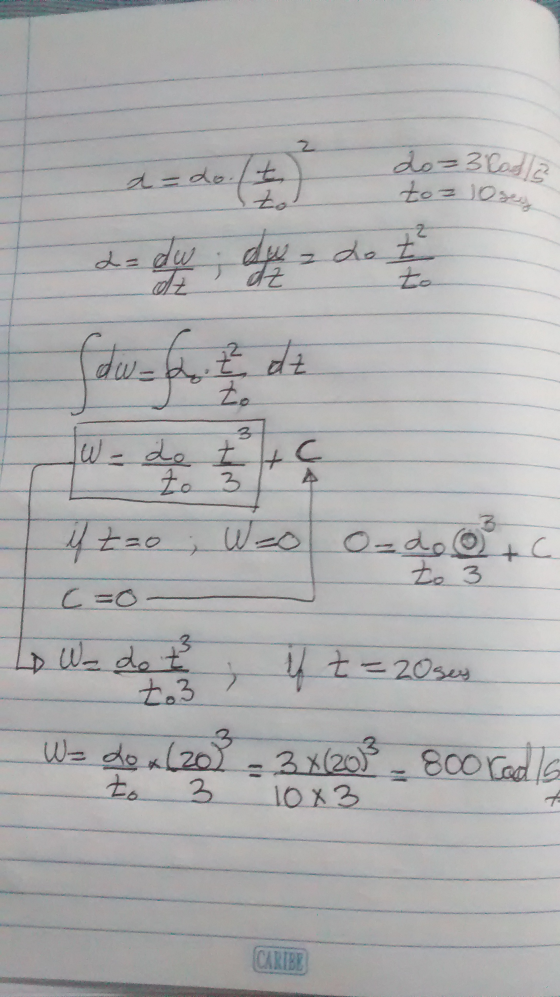
The angular acceleration is equal to the variation of angular velocity per unit time, this problem is only necessary to integrate the acceleration we obtain the expression for the angular velocity and is evaluated at t = 20s
Add Answer to:
Note: In this case the constant to does not mean the start time, just treat it...
A CD with a diameter of 12.0 cm starts from rest and with a constant angular...
A CD with a diameter of 12.0 cm starts from rest and with a constant angular acceleration of 1.0 rad/sec2 acquires an angular velocity of 5.0 rad/sec. The CD continues rotating at 5.0 rad/sec for 15.0 seconds and then slows to a stop in 12.0 second with a constant angular acceleration. What is the radial acceleration of a point 4.0 cm from the center at the time 2.0 seconds from the start? a. 0.28 m/s2 b. 0.16 m/s2 c. 0.30...
A rigid object, hinged at one end and initially at rest, is set into rotational motion....
 A rigid object, hinged at one end and initially at rest, is set into rotational motion. Its angular acceleration is given by the equation a = -b + ct where band care constants. Here b = 1.80 rad/s2, and c = 4.80 rad/s3. (a) Write an expression for the angular speed of the object in terms of the constants b, c, and time t. W = (b) Write an expression for the angular position of the object in terms of...
A fan blade starts at rest and begins moving with a constant angular acceleration of 2.00...
A fan blade starts at rest and begins moving with a constant angular acceleration of 2.00 rad/s2. The blade rotates through an angle of 285 radians in an 11.0 s interval that did not start at t = 0s. How long did it take the blade to reach the beginning of the 11.0-s interval? Answer must be in seconds.
A rigid object, hinged at one end and initially at rest, is set into rotational motion....
 A rigid object, hinged at one end and initially at rest, is set into rotational motion. Its angular acceleration is given by the equation a = -b + ct where b and c are constants. Here b = 2.20 rad/s2, and c = 3.90 rad/s3. (a) Write an expression for the angular speed of the object in terms of the constants b, c, and time t. (b) Write an expression for the angular position of the object in terms of...
A thin disk begins to rotate from rest with a constant angular acceleration. The disk takes...
A thin disk begins to rotate from rest with a constant angular acceleration. The disk takes 1.2 seconds to make its second complete revolution. Find: 1) the time (in sec) it took the disk to make its first revolution; 2) the angular acceleration (in rad/sec2) of the disk.
A rotating object starts from rest at t = 0 s and has a constant angular...
A rotating object starts from rest at t = 0 s and has a constant angular acceleration. At a time of t = 2.5 s the object has an angular displacement of 24 rad. What is its displacement θ at a time of t = 5.0 s?
An object has rotational inertia I. The object, initially at rest, begins to rotate with a constant angular acceleratio...
An object has rotational inertia I. The object, initially at rest, begins to rotate with a constant angular acceleration of magnitude a. What is the magnitude of the angular momentum L of the object after time t? Express your answer in terms of I, a, and t.
A wheel with radius 0.50 meters starts rotating at a constant angular acceleration of 0.5 rad/s^2....
 A wheel with radius 0.50 meters starts rotating at a constant angular acceleration of 0.5 rad/s^2. a) What is the angular velocity of the wheel after 15 seconds? b) The angle through which the wheel rotates during this time? c) The number of revolutions made by the wheel during this time? d) What is the linear velocity of the wheel after 20 seconds? e) What is linear acceleration of the wheel after 20 seconds? omega = omega_0 + alpha t...
A 36.2-cm diameter disk rotates with a constant angular acceleration of 2.8 rad/s2. It starts from...
 A 36.2-cm diameter disk rotates with a constant angular acceleration of 2.8 rad/s2. It starts from rest at t = 0, and a line drawn from the center of the disk to a point P on the rim of the disk makes an angle of 57.3° with the positive x-axis at this time. (a) Find the angular speed of the wheel at t = 2.30 s. rad/s (b) Find the linear velocity and tangential acceleration of P at t =...
How many revolutions does the object make during the first 4 s?
 In the Cartesian coordinates, a figure shows the angular-velocity versus time graph for a particle moving in a circle.y axis is the angular (rotational) speed (w) as "rad/second" and x axis is time (t) as "second".The motion is linear in the first two seconds as:10 rad/s at t=120 rad/s at t=2Then the angular (rotational) speed is constant (w=20 rad/s) for both t=3 and t=4.here's the graph: http://i.imgur.com/fOkTl.pngHow many revolutions does the object make during the first 4 s?
 A rigid object, hinged at one end and initially at rest, is set into rotational motion. Its angular acceleration is given by the equation a = -b + ct where band care constants. Here b = 1.80 rad/s2, and c = 4.80 rad/s3. (a) Write an expression for the angular speed of the object in terms of the constants b, c, and time t. W = (b) Write an expression for the angular position of the object in terms of...
 A rigid object, hinged at one end and initially at rest, is set into rotational motion. Its angular acceleration is given by the equation a = -b + ct where b and c are constants. Here b = 2.20 rad/s2, and c = 3.90 rad/s3. (a) Write an expression for the angular speed of the object in terms of the constants b, c, and time t. (b) Write an expression for the angular position of the object in terms of...
 A wheel with radius 0.50 meters starts rotating at a constant angular acceleration of 0.5 rad/s^2. a) What is the angular velocity of the wheel after 15 seconds? b) The angle through which the wheel rotates during this time? c) The number of revolutions made by the wheel during this time? d) What is the linear velocity of the wheel after 20 seconds? e) What is linear acceleration of the wheel after 20 seconds? omega = omega_0 + alpha t...
 A 36.2-cm diameter disk rotates with a constant angular acceleration of 2.8 rad/s2. It starts from rest at t = 0, and a line drawn from the center of the disk to a point P on the rim of the disk makes an angle of 57.3° with the positive x-axis at this time. (a) Find the angular speed of the wheel at t = 2.30 s. rad/s (b) Find the linear velocity and tangential acceleration of P at t =...
Most questions answered within 3 hours.
-
Where is the error in this code sequence?
String s1 = "Hello";
String s2 = "ello";...
asked 10 months ago -
Financial data for Joel de Paris, Inc., for last year
follow:
Joel de Paris, Inc.
Balance...
asked 10 months ago -
Consider this reaction:
Al2(SO4)3 (aq)+ BaCl3
(aq) Al2Cl6 (aq)- +
3BaSO4(s) . What is the...
asked 10 months ago -
Suppose that Savneet is considering increasing her
recent random sample from 20 car rentals to 40...
asked 10 months ago -
Trucks arrive at an unloading terminal at an average rate of 120
per hour.
Trucks arrive...
asked 10 months ago -
Why are methanol and ethanol completely soluble in water while
octanol is not very little soluble....
asked 10 months ago -
A facilities manager at a university reads in a research report
that the mean amount of...
asked 10 months ago -
When the CuSO4 is rehydrated by adding water to the anhydrous
compound, is this an endothermic...
asked 10 months ago -
A ray of sunlight is passing from diamond into crown glass; the
angle of incidence is...
asked 10 months ago -
A block of mass 0.249 kg is placed on top of a light, vertical
spring of...
asked 10 months ago -
how do the kidneys compensate in the presences of acidosis
a) trigger hyperventilate
b) reserve acid...
asked 10 months ago -
Question 501 pts
The rental rate of capital to the firm increases. Which of the
following...
asked 10 months ago