

Homework Answers

Add Answer to:
I posted my work with it.. not sure where I went wrong if I
did
70....
Question 3: (10 marks) Figure below shows a collision between three balls of clay. The three...
 Question 3: (10 marks) Figure below shows a collision between three balls of clay. The three hit simultaneously and stick together. A. What are the speed and direction of the resulting blob of clay? (7 marks) B. What is the energy lost during this collision? (3 marks) 408 45° 4.0 m/s 3.0 m/s 30 g 2.0 m/s 20 g
Question 3: (10 marks) Figure below shows a collision between three balls of clay. The three...
 Question 3: (10 marks) Figure below shows a collision between three balls of clay. The three hit simultaneously and stick together A. What are the speed and direction of the resulting blob of clay? (7 marks) B. What is the energy lost during this collision? (3 marks) 40 g 3.0 m/s 30 g 2.0 m/s 20 g Page 44
(Figure 1) shows a collision between three balls of clay. The three hit simultaneously and stick...
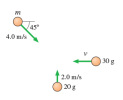 (Figure 1) shows a collision between three balls of
clay. The three hit simultaneously and stick together. Assume that
m = 55 g and v = 2.1 m/s .
Part A- What is the speed of the resulting blob of
clay?
Part B- What is the movement direction of the resulting
blob of clay?
450 4.0 m/s 30 g 12.0 m/s Ó 20g
(Figure 1) shows a collision between three balls of
clay. The three hit simultaneously and stick together. Assume that
m = 55 g and v = 2.1 m/s .
Part A- What is the speed of the resulting blob of
clay?
Part B- What is the movement direction of the resulting
blob of clay?
450 4.0 m/s 30 g 12.0 m/s Ó 20g
Review | Constants Periodic Table (Figure 1) shows a collision between three balls of clay. The...
 Review | Constants Periodic Table (Figure 1) shows a collision between three balls of clay. The three hit simultaneously and stick together. Assume that m = 45 g and v = 3.5 m/s Part A What is the speed of the resulting blob of clay? Express your answer with the appropriate units. Figure < 1 of 1 > QJ45 uA 3 ? 4.0 m/s V= Value Units 30 g Submit Request Answer 2.0 m/s 20 g Part B
Figure p9.55 shows a collision between three balls of clay.The three hit simultaneously and stick together. What are th...
 Figure p9.55 shows a collision between three balls of clay.The
three hit simultaneously and stick together. What are the speedand
direction of the resulting blob of clay?
Figure p9.55 shows a collision between three balls of clay.The
three hit simultaneously and stick together. What are the speedand
direction of the resulting blob of clay?
i got a take home test and wanted to get my work double checked 8. (15...
 i got a take home test and wanted to get my work double
checked
8. (15 points) A new amusement park ride has a 500 kg boat with wheels compressing a spring (k 7200 N/m) a distance of 3.0 m at the top of a 16.0 m tall hill. When the spring is released, the boat travels from rest down the hill, straight through a pool of water that applies a constant 2000 N of friction for 50 m then...
i got a take home test and wanted to get my work double
checked
8. (15 points) A new amusement park ride has a 500 kg boat with wheels compressing a spring (k 7200 N/m) a distance of 3.0 m at the top of a 16.0 m tall hill. When the spring is released, the boat travels from rest down the hill, straight through a pool of water that applies a constant 2000 N of friction for 50 m then...
please answer with showing work Section 2: Calculation Questions (8 pts. each part) 1. A block...
 please answer with showing work
Section 2: Calculation Questions (8 pts. each part) 1. A block with mass of m, = 5 kg is sliding across a frictionless table when it strikes a second mass with me = 3 kg, that is initially at rest. After the collision, the two masses stick and move off together with a speed of v= 1.5 m/s. The two masses then slide off the table and fall together 2 meters to the ground. a)...
please answer with showing work
Section 2: Calculation Questions (8 pts. each part) 1. A block with mass of m, = 5 kg is sliding across a frictionless table when it strikes a second mass with me = 3 kg, that is initially at rest. After the collision, the two masses stick and move off together with a speed of v= 1.5 m/s. The two masses then slide off the table and fall together 2 meters to the ground. a)...
1- A block slides along a frictionless surface at 2.4 m/s. A second 3.5-kg block, sliding...
1- A block slides along a frictionless surface at 2.4 m/s. A second 3.5-kg block, sliding at a faster 7.5 m/s, collides with the first from behind and sticks to it. The final velocity of the combined blocks is 4.6 m/s. What was the mass of the first block? 2-A 15 g ball of clay traveling west at 4 m/s collides with a 50 g ball of clay traveling 30° north of east at 3.5 m/s. What is the speed...
i have the correct answers listed below.. please show the work for how to get those...
 i
have the correct answers listed below.. please show the work for
how to get those answers!
After Before Nail (pivot) (a) (b) Figure 10.26 The disk hits the stick at one end and adheres to it, and they rotate together pivoting around the nail. Angular momentum is conserved for this inelastic collision because the surface is friction less and the unbalanced external force at the nail exerts no torque Suppose the disk in Figure 10.26 has a mass of...
i
have the correct answers listed below.. please show the work for
how to get those answers!
After Before Nail (pivot) (a) (b) Figure 10.26 The disk hits the stick at one end and adheres to it, and they rotate together pivoting around the nail. Angular momentum is conserved for this inelastic collision because the surface is friction less and the unbalanced external force at the nail exerts no torque Suppose the disk in Figure 10.26 has a mass of...
Not sure what I did wrong but here’s also my work Bob has just finished climbing...
 Not sure what I did wrong but here’s also my work
Bob has just finished climbing a sheer cliff above a beach, and wants to figure out how high he climbed. All he has to use, however, is a baseball, a stopwatch, and a friend on the beach below with a long measuring tape. Bob is a pitcher and he knows that the fastest he can throw the ball is about vo 34.1 m/s. Bob starts the stopwatch as he...
Not sure what I did wrong but here’s also my work
Bob has just finished climbing a sheer cliff above a beach, and wants to figure out how high he climbed. All he has to use, however, is a baseball, a stopwatch, and a friend on the beach below with a long measuring tape. Bob is a pitcher and he knows that the fastest he can throw the ball is about vo 34.1 m/s. Bob starts the stopwatch as he...
 Question 3: (10 marks) Figure below shows a collision between three balls of clay. The three hit simultaneously and stick together. A. What are the speed and direction of the resulting blob of clay? (7 marks) B. What is the energy lost during this collision? (3 marks) 408 45° 4.0 m/s 3.0 m/s 30 g 2.0 m/s 20 g
 Question 3: (10 marks) Figure below shows a collision between three balls of clay. The three hit simultaneously and stick together A. What are the speed and direction of the resulting blob of clay? (7 marks) B. What is the energy lost during this collision? (3 marks) 40 g 3.0 m/s 30 g 2.0 m/s 20 g Page 44
 (Figure 1) shows a collision between three balls of
clay. The three hit simultaneously and stick together. Assume that
m = 55 g and v = 2.1 m/s .
Part A- What is the speed of the resulting blob of
clay?
Part B- What is the movement direction of the resulting
blob of clay?
450 4.0 m/s 30 g 12.0 m/s Ó 20g
(Figure 1) shows a collision between three balls of
clay. The three hit simultaneously and stick together. Assume that
m = 55 g and v = 2.1 m/s .
Part A- What is the speed of the resulting blob of
clay?
Part B- What is the movement direction of the resulting
blob of clay?
450 4.0 m/s 30 g 12.0 m/s Ó 20g
 Review | Constants Periodic Table (Figure 1) shows a collision between three balls of clay. The three hit simultaneously and stick together. Assume that m = 45 g and v = 3.5 m/s Part A What is the speed of the resulting blob of clay? Express your answer with the appropriate units. Figure < 1 of 1 > QJ45 uA 3 ? 4.0 m/s V= Value Units 30 g Submit Request Answer 2.0 m/s 20 g Part B
 Figure p9.55 shows a collision between three balls of clay.The
three hit simultaneously and stick together. What are the speedand
direction of the resulting blob of clay?
Figure p9.55 shows a collision between three balls of clay.The
three hit simultaneously and stick together. What are the speedand
direction of the resulting blob of clay?
 i got a take home test and wanted to get my work double
checked
8. (15 points) A new amusement park ride has a 500 kg boat with wheels compressing a spring (k 7200 N/m) a distance of 3.0 m at the top of a 16.0 m tall hill. When the spring is released, the boat travels from rest down the hill, straight through a pool of water that applies a constant 2000 N of friction for 50 m then...
i got a take home test and wanted to get my work double
checked
8. (15 points) A new amusement park ride has a 500 kg boat with wheels compressing a spring (k 7200 N/m) a distance of 3.0 m at the top of a 16.0 m tall hill. When the spring is released, the boat travels from rest down the hill, straight through a pool of water that applies a constant 2000 N of friction for 50 m then...
 please answer with showing work
Section 2: Calculation Questions (8 pts. each part) 1. A block with mass of m, = 5 kg is sliding across a frictionless table when it strikes a second mass with me = 3 kg, that is initially at rest. After the collision, the two masses stick and move off together with a speed of v= 1.5 m/s. The two masses then slide off the table and fall together 2 meters to the ground. a)...
please answer with showing work
Section 2: Calculation Questions (8 pts. each part) 1. A block with mass of m, = 5 kg is sliding across a frictionless table when it strikes a second mass with me = 3 kg, that is initially at rest. After the collision, the two masses stick and move off together with a speed of v= 1.5 m/s. The two masses then slide off the table and fall together 2 meters to the ground. a)...
 i
have the correct answers listed below.. please show the work for
how to get those answers!
After Before Nail (pivot) (a) (b) Figure 10.26 The disk hits the stick at one end and adheres to it, and they rotate together pivoting around the nail. Angular momentum is conserved for this inelastic collision because the surface is friction less and the unbalanced external force at the nail exerts no torque Suppose the disk in Figure 10.26 has a mass of...
i
have the correct answers listed below.. please show the work for
how to get those answers!
After Before Nail (pivot) (a) (b) Figure 10.26 The disk hits the stick at one end and adheres to it, and they rotate together pivoting around the nail. Angular momentum is conserved for this inelastic collision because the surface is friction less and the unbalanced external force at the nail exerts no torque Suppose the disk in Figure 10.26 has a mass of...
 Not sure what I did wrong but here’s also my work
Bob has just finished climbing a sheer cliff above a beach, and wants to figure out how high he climbed. All he has to use, however, is a baseball, a stopwatch, and a friend on the beach below with a long measuring tape. Bob is a pitcher and he knows that the fastest he can throw the ball is about vo 34.1 m/s. Bob starts the stopwatch as he...
Not sure what I did wrong but here’s also my work
Bob has just finished climbing a sheer cliff above a beach, and wants to figure out how high he climbed. All he has to use, however, is a baseball, a stopwatch, and a friend on the beach below with a long measuring tape. Bob is a pitcher and he knows that the fastest he can throw the ball is about vo 34.1 m/s. Bob starts the stopwatch as he...
Most questions answered within 3 hours.
-
Where is the error in this code sequence?
String s1 = "Hello";
String s2 = "ello";...
asked 10 months ago -
Financial data for Joel de Paris, Inc., for last year
follow:
Joel de Paris, Inc.
Balance...
asked 10 months ago -
Consider this reaction:
Al2(SO4)3 (aq)+ BaCl3
(aq) Al2Cl6 (aq)- +
3BaSO4(s) . What is the...
asked 10 months ago -
Suppose that Savneet is considering increasing her
recent random sample from 20 car rentals to 40...
asked 10 months ago -
Trucks arrive at an unloading terminal at an average rate of 120
per hour.
Trucks arrive...
asked 10 months ago -
Why are methanol and ethanol completely soluble in water while
octanol is not very little soluble....
asked 10 months ago -
A facilities manager at a university reads in a research report
that the mean amount of...
asked 10 months ago -
When the CuSO4 is rehydrated by adding water to the anhydrous
compound, is this an endothermic...
asked 10 months ago -
A ray of sunlight is passing from diamond into crown glass; the
angle of incidence is...
asked 10 months ago -
A block of mass 0.249 kg is placed on top of a light, vertical
spring of...
asked 10 months ago -
how do the kidneys compensate in the presences of acidosis
a) trigger hyperventilate
b) reserve acid...
asked 10 months ago -
Question 501 pts
The rental rate of capital to the firm increases. Which of the
following...
asked 10 months ago