Fundamental of power electronics: In a certain application, an unregulated dc input voltage can vary between...
Fundamental of power electronics:
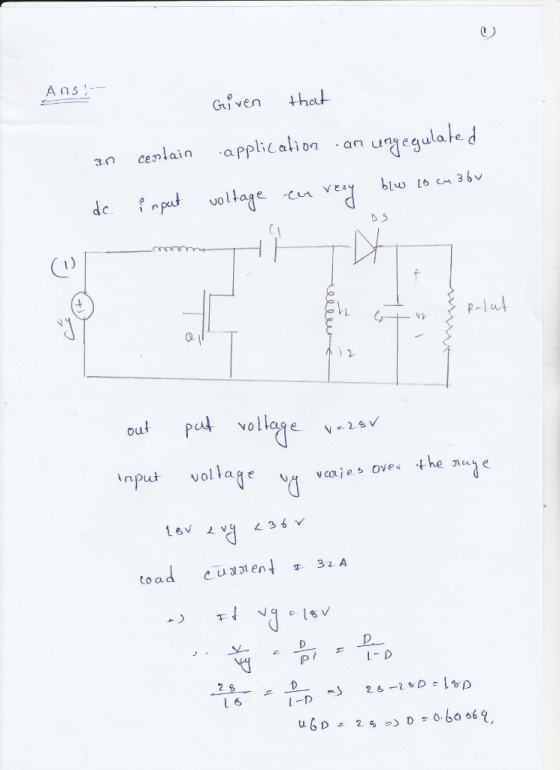
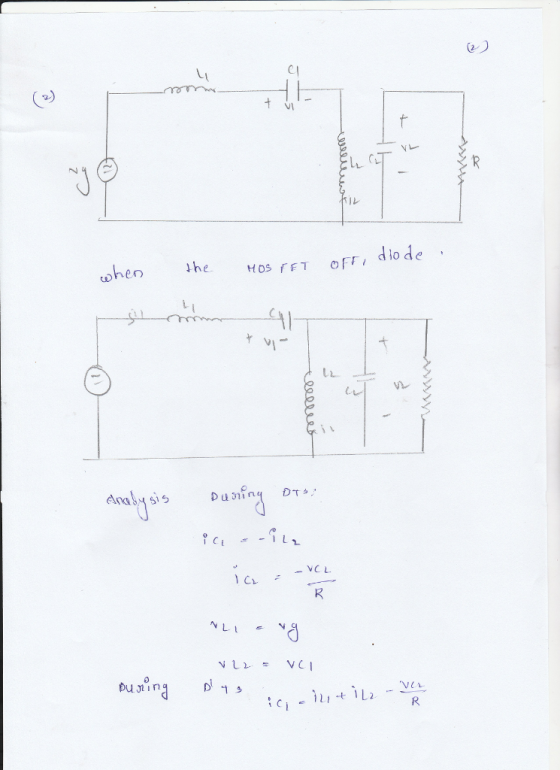
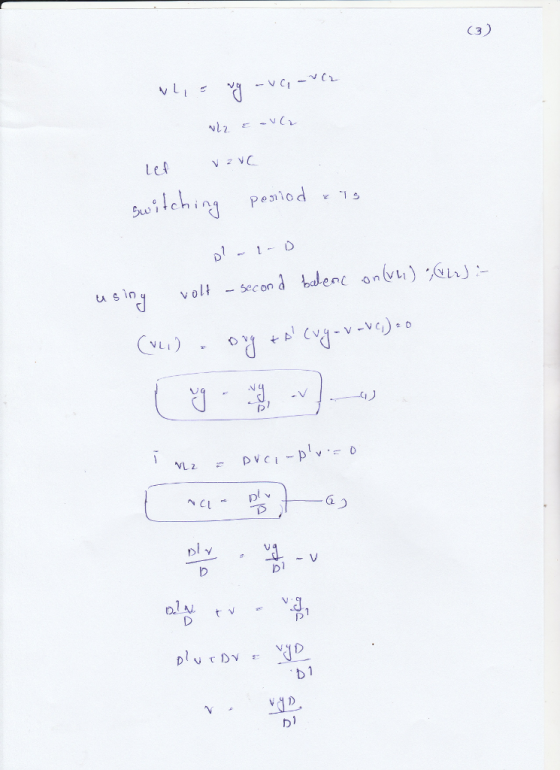
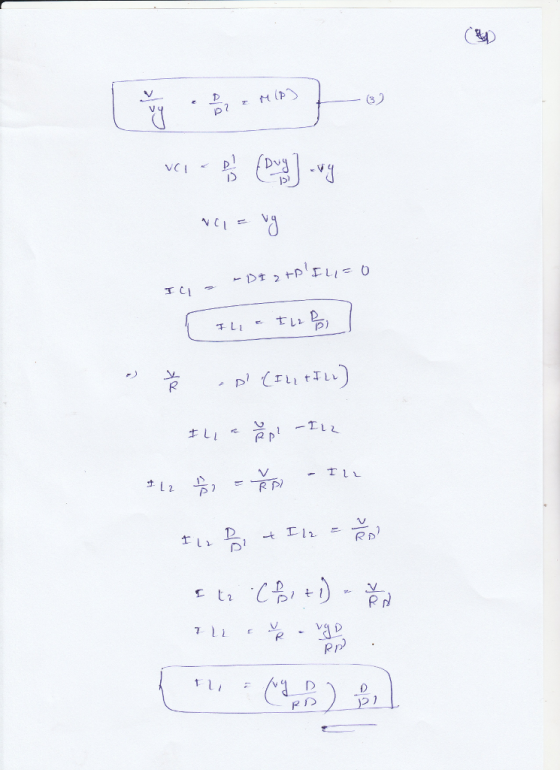
In a certain application, an unregulated dc input voltage can vary between 18 and 36 V. It is desired to produce a regulated output of 28 V to supply a 2 A load. control circuit automatically adjust D to maintain the constant output voltage and current. All ideal components. Hence, a converter is needed that is capable of both increasing and decreasing the voltage. Since the input and output voltages are both positive, converters that invert the voltage polarity (such as the basic buck-boost converter) are not suited for this application.
(1) Sketch the waveforms of the transistor voltage Vds and transistor current IT or (Id for drain current) and give expressions for their peak values. find the numerical maximum value on the sketch for Vds and IT (Id). ignore the effect ripple.
(2) Derive the expression for switching frequency at the converter operates between the CCM and DCM at the boundary. the answer is in term of D, Vin, L1, L2, iL1, iL2. you may assume L1=L2.
Homework Answers
Add Answer to:
Fundamental of power electronics:
In a certain application, an unregulated dc input voltage can
vary between...
18 marks load with a power of 25.6 W.The cy f is 40kHz. sign a buck-boost converter to produce an output voltage of 16V a put voltage ripple must not exceed 1%. The dc input voltage is 24V. Th e swit...
 18 marks load with a power of 25.6 W.The cy f is 40kHz. sign a buck-boost converter to produce an output voltage of 16V a put voltage ripple must not exceed 1%. The dc input voltage is 24V. Th e switching frequen 121 a) the duty ratio b) Find the size of the inductor so that the maximum inductor current c) the size of the capacitor d) Assume L=1 00μH and the switching frequency fis variable. 141 121 Lma 10A...
Design a DC-DC boost converter, shown below, that converts an unregulated supply of 12.0 Vak into a load voltage of...
 Design a DC-DC boost converter, shown below, that converts an unregulated supply of 12.0 Vak into a load voltage of 30.0 Ve and load current of 0.25 A. The switching frequency of the transistor is 100 kHz. The transistor has an on-resistance of 0.15 Ω and the diode drops 0.7 V when it is conducting. The voltage ripple (Av) is taken as 20 mVpp The circuit has 80% conversion efficiency. Find the DC input-current (Iden), duty-cycle (D), inductance (L), power-dissipation...
Problems,,,,,
 1 2
+
–
i(t)
C R
L
iT i(t)
iD
+
–
L C R
1. Analysis and design of a buck-boost converter: A buck-boost converter is illustrated in Fig. 1(a),
and a practical implementation using a transistor and diode is shown in Fig. 1(b).
+
(a)
Vg
v
Figure 1 Buck–boost converter
of Problem 1: (a) ideal converter
circuit, (b) implementation using
MOSFET and diode.
–
Q1
D1
(b) +
Vg
v
Page 2
iL
(t) + vL...
1 2
+
–
i(t)
C R
L
iT i(t)
iD
+
–
L C R
1. Analysis and design of a buck-boost converter: A buck-boost converter is illustrated in Fig. 1(a),
and a practical implementation using a transistor and diode is shown in Fig. 1(b).
+
(a)
Vg
v
Figure 1 Buck–boost converter
of Problem 1: (a) ideal converter
circuit, (b) implementation using
MOSFET and diode.
–
Q1
D1
(b) +
Vg
v
Page 2
iL
(t) + vL...
A Buck-boost converter has an output voltage 100 V, output power 60 W and input voltage...
A Buck-boost converter has an output voltage 100 V, output power 60 W and input voltage 12 V. Switching frequency is 15 kHz. Calculate duty ratios for the switch and the diode. Find values for the inductor L and capacitor C, when the allowed output voltage ripple is ±0.15 % and the inductor current ripple is ±1 % (of the average value). If the on-time of the switch has an inaccuracy of ±50 ns, what is the new output voltage...
Please, need help to do this. the mode is DCM mode. Problem 2.1 Sketch the current and voltage waveforms of: the in...
 Please, need help to do this. the mode is DCM mode.
Problem 2.1 Sketch the current and voltage waveforms of: the inductor current ((t)), the inductor voltage (v(t)) the input current (is(t)), the output diode current (ip2(t)), and the output capacitor current (ico(t)), for at least one full period T when the Buck-Boost converter is operating in Discontinuous conduction Mode (DCM). Assume that the converter is lossless, or 100% efficient, that is: The switch ON-resistance is on, and both the...
Please, need help to do this. the mode is DCM mode.
Problem 2.1 Sketch the current and voltage waveforms of: the inductor current ((t)), the inductor voltage (v(t)) the input current (is(t)), the output diode current (ip2(t)), and the output capacitor current (ico(t)), for at least one full period T when the Buck-Boost converter is operating in Discontinuous conduction Mode (DCM). Assume that the converter is lossless, or 100% efficient, that is: The switch ON-resistance is on, and both the...
Is N N Vo V's Vo Vs LOAD LOAD Figure 1 It has been shown in...
 Is N N Vo V's Vo Vs LOAD LOAD Figure 1 It has been shown in lectures that from the equality of power generation and power consumption, and as far as the average input/output voltages and currents are concerned, the buck and boost converters' operation in CCM (continuous current mode) are similar to the operation of the ideal AC transformers. So these converters may be considered as "ideal DC transformers". A buck converter operates with a duty cycle D 0.4,...
2. Renewable energy system requires a boost converter with input voltage variation of 18 V to 42 ...
 2. Renewable energy system requires a boost converter with input voltage variation of 18 V to 42 V (de) and gives output of 120 V at 0.6 kW. For the converter the switching frequency is set at 50 kHz. a) Find the operating duty cycle range for each switch of the converter0 marks b) 196 What is the inductor value which should keep inductor current variation below under all input voltages [30 marks] c) Find the capacitor value which should...
please elaborate as much as possible. Thank you in advance :) 2.1 Analysis and design of...
 please elaborate as much as possible. Thank you in advance
:)
2.1 Analysis and design of a buck-boost converter: A buck-boost converter is illustrated in Fig. 2.28(a), and a practical implementation using a transistor and diode is shown in Fig. 2.28(b Fig. 2.28 Buck-boost converter of Problem 2.1: (a) ideal converter circuit, (b) implementation using MOSFET and diode. i(t) (a) Find the dependence of the equilibrium output voltage Vand inductor current /on the duty ratio D, input voltage V. and...
please elaborate as much as possible. Thank you in advance
:)
2.1 Analysis and design of a buck-boost converter: A buck-boost converter is illustrated in Fig. 2.28(a), and a practical implementation using a transistor and diode is shown in Fig. 2.28(b Fig. 2.28 Buck-boost converter of Problem 2.1: (a) ideal converter circuit, (b) implementation using MOSFET and diode. i(t) (a) Find the dependence of the equilibrium output voltage Vand inductor current /on the duty ratio D, input voltage V. and...
2.9 To reduce the switching harmonics present in the input current of a certain buck converter,...
 2.9 To reduce the switching harmonics present in the input current of a certain buck converter, an input filter consisting of inductor Li and capacitor Ci is added as shown in Fig. 2.32. Such filters are commonly used to meet regulations limiting conducted electromagnetic interference (EMI). For this problem, you may assume that all inductance and capacitance values are sufficiently large, such that all ripple magni- tudes are small CI Fig. 2.32 Addition of L-C input filter to buck converter,...
A buck converter is used to have low output voltage from the high input source to...
 A buck converter is used to have low output voltage from the high input source to low output voltage. The estimated power output is at 25 kW with the switching frequency of 25 kHz. Design the buck converter as by finding and following specifications consider the ripple of the output is set at 1% (i) Calculate the duty ratio of the buck converter (1 mark) (ii) Determine the minimum requirement for the inductor and the capacitor (5 marks) (iii) Determine...
 18 marks load with a power of 25.6 W.The cy f is 40kHz. sign a buck-boost converter to produce an output voltage of 16V a put voltage ripple must not exceed 1%. The dc input voltage is 24V. Th e switching frequen 121 a) the duty ratio b) Find the size of the inductor so that the maximum inductor current c) the size of the capacitor d) Assume L=1 00μH and the switching frequency fis variable. 141 121 Lma 10A...
 Design a DC-DC boost converter, shown below, that converts an unregulated supply of 12.0 Vak into a load voltage of 30.0 Ve and load current of 0.25 A. The switching frequency of the transistor is 100 kHz. The transistor has an on-resistance of 0.15 Ω and the diode drops 0.7 V when it is conducting. The voltage ripple (Av) is taken as 20 mVpp The circuit has 80% conversion efficiency. Find the DC input-current (Iden), duty-cycle (D), inductance (L), power-dissipation...
 Please, need help to do this. the mode is DCM mode.
Problem 2.1 Sketch the current and voltage waveforms of: the inductor current ((t)), the inductor voltage (v(t)) the input current (is(t)), the output diode current (ip2(t)), and the output capacitor current (ico(t)), for at least one full period T when the Buck-Boost converter is operating in Discontinuous conduction Mode (DCM). Assume that the converter is lossless, or 100% efficient, that is: The switch ON-resistance is on, and both the...
Please, need help to do this. the mode is DCM mode.
Problem 2.1 Sketch the current and voltage waveforms of: the inductor current ((t)), the inductor voltage (v(t)) the input current (is(t)), the output diode current (ip2(t)), and the output capacitor current (ico(t)), for at least one full period T when the Buck-Boost converter is operating in Discontinuous conduction Mode (DCM). Assume that the converter is lossless, or 100% efficient, that is: The switch ON-resistance is on, and both the...
 Is N N Vo V's Vo Vs LOAD LOAD Figure 1 It has been shown in lectures that from the equality of power generation and power consumption, and as far as the average input/output voltages and currents are concerned, the buck and boost converters' operation in CCM (continuous current mode) are similar to the operation of the ideal AC transformers. So these converters may be considered as "ideal DC transformers". A buck converter operates with a duty cycle D 0.4,...
 2. Renewable energy system requires a boost converter with input voltage variation of 18 V to 42 V (de) and gives output of 120 V at 0.6 kW. For the converter the switching frequency is set at 50 kHz. a) Find the operating duty cycle range for each switch of the converter0 marks b) 196 What is the inductor value which should keep inductor current variation below under all input voltages [30 marks] c) Find the capacitor value which should...
 please elaborate as much as possible. Thank you in advance
:)
2.1 Analysis and design of a buck-boost converter: A buck-boost converter is illustrated in Fig. 2.28(a), and a practical implementation using a transistor and diode is shown in Fig. 2.28(b Fig. 2.28 Buck-boost converter of Problem 2.1: (a) ideal converter circuit, (b) implementation using MOSFET and diode. i(t) (a) Find the dependence of the equilibrium output voltage Vand inductor current /on the duty ratio D, input voltage V. and...
please elaborate as much as possible. Thank you in advance
:)
2.1 Analysis and design of a buck-boost converter: A buck-boost converter is illustrated in Fig. 2.28(a), and a practical implementation using a transistor and diode is shown in Fig. 2.28(b Fig. 2.28 Buck-boost converter of Problem 2.1: (a) ideal converter circuit, (b) implementation using MOSFET and diode. i(t) (a) Find the dependence of the equilibrium output voltage Vand inductor current /on the duty ratio D, input voltage V. and...
 2.9 To reduce the switching harmonics present in the input current of a certain buck converter, an input filter consisting of inductor Li and capacitor Ci is added as shown in Fig. 2.32. Such filters are commonly used to meet regulations limiting conducted electromagnetic interference (EMI). For this problem, you may assume that all inductance and capacitance values are sufficiently large, such that all ripple magni- tudes are small CI Fig. 2.32 Addition of L-C input filter to buck converter,...
 A buck converter is used to have low output voltage from the high input source to low output voltage. The estimated power output is at 25 kW with the switching frequency of 25 kHz. Design the buck converter as by finding and following specifications consider the ripple of the output is set at 1% (i) Calculate the duty ratio of the buck converter (1 mark) (ii) Determine the minimum requirement for the inductor and the capacitor (5 marks) (iii) Determine...
Most questions answered within 3 hours.
-
Where is the error in this code sequence?
String s1 = "Hello";
String s2 = "ello";...
asked 10 months ago -
Financial data for Joel de Paris, Inc., for last year
follow:
Joel de Paris, Inc.
Balance...
asked 10 months ago -
Consider this reaction:
Al2(SO4)3 (aq)+ BaCl3
(aq) Al2Cl6 (aq)- +
3BaSO4(s) . What is the...
asked 10 months ago -
Suppose that Savneet is considering increasing her
recent random sample from 20 car rentals to 40...
asked 10 months ago -
Trucks arrive at an unloading terminal at an average rate of 120
per hour.
Trucks arrive...
asked 10 months ago -
Why are methanol and ethanol completely soluble in water while
octanol is not very little soluble....
asked 10 months ago -
A facilities manager at a university reads in a research report
that the mean amount of...
asked 10 months ago -
When the CuSO4 is rehydrated by adding water to the anhydrous
compound, is this an endothermic...
asked 10 months ago -
A ray of sunlight is passing from diamond into crown glass; the
angle of incidence is...
asked 10 months ago -
A block of mass 0.249 kg is placed on top of a light, vertical
spring of...
asked 10 months ago -
how do the kidneys compensate in the presences of acidosis
a) trigger hyperventilate
b) reserve acid...
asked 10 months ago -
Question 501 pts
The rental rate of capital to the firm increases. Which of the
following...
asked 10 months ago