Which of the following is true about indicators? Question 20 options: They are weak acids or...
Which of the following is true about indicators? Question 20 options: They are weak acids or bases. They are as accurate as a pH meter. They maintain their colors across the range of pH values for which they are used. all of the above
Homework Answers
answer = all of the above
all indicators are either weak acid or weak base.
they are as accurate as pH meter
they remain their colour across the range of pH values for which they are used.
Add Answer to:
Which of the following is true about indicators? Question 20
options: They are weak acids or...
QUESTION 18 The conjugate bases of strong acids have negligible basicity. True False QUESTION 19 Buffered...
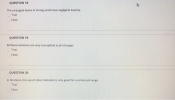 QUESTION 18 The conjugate bases of strong acids have negligible basicity. True False QUESTION 19 Buffered solutions are very susceptible to pH changes. True False QUESTION 20 In titrations, the use of color indicators is only good for a certain pH range. True False
5 A)Which of the following statements is true? The pH of pure water at room temperature...
5 A)Which of the following statements is true? The pH of pure water at room temperature is 7.2. Buffers are weak acids and bases that are used biologically to maintain the pH of a system. The dissociation constant equation can be used to determine the ionization state of acids and bases in solution. The equilibrium constant of a reaction can be used to accurately assess the state of linked reactions in cells. 5 B) Why is phosphoric acid such a...
Which of the following is a true statement about the Lewis definition of acids and bases? Select the correct answer below: The Lewis definition of acids and bases is based on donating or accepting an electron pair.
 Which of the following is a true statement about the Lewis definition of acids and bases? Select the correct answer below: The Lewis definition of acids and bases is based on donating or accepting an electron pair. O The Lewis definition of acids and bases is based on the production of HO or OH ions in water solutions O The Lewis definition of acids and bases is based on donating or accepting a proton. O none of the above MORE...
Use the Table 7.1, estimate the pH of following solutions. The colors of the 4 indicators...
 Use the Table 7.1, estimate the pH of following solutions. The colors of the 4 indicators in the solution are given. Explain your answer a. Solution A 2. 3. Make studie acid s you g your pre-l thymol blue: yellow methyl orange: yellow methyl red: orange bromothymol blue: yellow Range of pH b. Solution B thymol blue: yellow methyl orange: yellow methyl red: yellow bromothymol blue: blue Range of pH Row C: methyl red Row D: bromthymol blue 4. Swirl...
1. Which of the following is not true of amino acids? a) Your intestines do not...
 1. Which of the following is not true of amino acids? a) Your intestines do not absorb proteins, only the amino acids released by hydrolysis of these proteins. b) A normal, natural, unprocessed diet does not contain proteins, only the free amino acids. c) Amino acids are NEEDED for making your proteins. d) Amino acids are NEEDED for making the nitrogenous bases of your nucleic acids. e) In you, amino acids are not stored as protein. 2. Which of the...
1: Which statement is not true? 2 3 All Bronsted-Lowry acids are Arrhenius acids 5 6...
 1: Which statement is not true? 2 3 All Bronsted-Lowry acids are Arrhenius acids 5 6 All of the above statements are true All Arrhenius bases are Bronsted-Lowry bases 8 9 All Bronsted Lowry bases are Arrhenius bases All Arrhenius acids are Bronsted-Lowry acids. 11 12 15 Question 13 (1 point) For phosphoric acid, H,PO, the Kais = TH,PO.TH/ [H3PO4 1H.PO
1. Given the following peptide, which of the following statements is true? Question options: a) The...
 1. Given the following peptide, which of the following
statements is true?
Question options:
a) The N-terminal residue is leucine.
b)This peptide contains 4 amino acid residues.
c) The peptide contains a total of 6 ionizable groups.
d) The net charge of this peptide at pH 7 is +1 Locate any
peptide bond along the backbone of the given peptide.
e) The bond between the C (of the C=O) and the N (of the N-H) of
a peptide bond has...
1. Given the following peptide, which of the following
statements is true?
Question options:
a) The N-terminal residue is leucine.
b)This peptide contains 4 amino acid residues.
c) The peptide contains a total of 6 ionizable groups.
d) The net charge of this peptide at pH 7 is +1 Locate any
peptide bond along the backbone of the given peptide.
e) The bond between the C (of the C=O) and the N (of the N-H) of
a peptide bond has...
Question 1 (1 point) Which of the following statements about acids is NOT true? a) An...
 Question 1 (1 point) Which of the following statements about acids is NOT true? a) An acid increases the concentration of hydronium in solution. b) An acid is a proton donor. c) An example of an acid is HBr. d) An acid increases the concentration of protons in solution. e) An acid increases the concentration of hydroxide in solution. Question 2 (1 point) Which of the following changes in blood pH would you expect to observe in a hyperventilating patient,...
please correct Question 1 (1 point) Saved Certain acids are defined as weak acids which means...
 please correct
Question 1 (1 point) Saved Certain acids are defined as weak acids which means that a small percentage of acid molecules ionize in water. True False Question 2 (1 point) Saved Strong acids, like Hydrochloric acid, completely ionize in water. True False Question 3 (1 point) Saved The equivalence point of titration is also known as the stoichiometric point or end point. True False Question 4 (1 point) Saved Phenolphthalein is a pH indicator which turns bright pink...
please correct
Question 1 (1 point) Saved Certain acids are defined as weak acids which means that a small percentage of acid molecules ionize in water. True False Question 2 (1 point) Saved Strong acids, like Hydrochloric acid, completely ionize in water. True False Question 3 (1 point) Saved The equivalence point of titration is also known as the stoichiometric point or end point. True False Question 4 (1 point) Saved Phenolphthalein is a pH indicator which turns bright pink...
Which of the following statements is true of weak acids dissolved in water: They...
Which of the following statements is true of weak acids dissolved in water: They are completely ionized in water They are totally unionized in water They are partially ionized in water The dissociation constant is a function of pH QUESTION 13 Which of the following is a hydroxide ion? H3O+ OH- HOOH CH3OH2+ QUESTION 14 The following molecule is an example of which class...
 QUESTION 18 The conjugate bases of strong acids have negligible basicity. True False QUESTION 19 Buffered solutions are very susceptible to pH changes. True False QUESTION 20 In titrations, the use of color indicators is only good for a certain pH range. True False
 Which of the following is a true statement about the Lewis definition of acids and bases? Select the correct answer below: The Lewis definition of acids and bases is based on donating or accepting an electron pair. O The Lewis definition of acids and bases is based on the production of HO or OH ions in water solutions O The Lewis definition of acids and bases is based on donating or accepting a proton. O none of the above MORE...
 Use the Table 7.1, estimate the pH of following solutions. The colors of the 4 indicators in the solution are given. Explain your answer a. Solution A 2. 3. Make studie acid s you g your pre-l thymol blue: yellow methyl orange: yellow methyl red: orange bromothymol blue: yellow Range of pH b. Solution B thymol blue: yellow methyl orange: yellow methyl red: yellow bromothymol blue: blue Range of pH Row C: methyl red Row D: bromthymol blue 4. Swirl...
 1. Which of the following is not true of amino acids? a) Your intestines do not absorb proteins, only the amino acids released by hydrolysis of these proteins. b) A normal, natural, unprocessed diet does not contain proteins, only the free amino acids. c) Amino acids are NEEDED for making your proteins. d) Amino acids are NEEDED for making the nitrogenous bases of your nucleic acids. e) In you, amino acids are not stored as protein. 2. Which of the...
 1: Which statement is not true? 2 3 All Bronsted-Lowry acids are Arrhenius acids 5 6 All of the above statements are true All Arrhenius bases are Bronsted-Lowry bases 8 9 All Bronsted Lowry bases are Arrhenius bases All Arrhenius acids are Bronsted-Lowry acids. 11 12 15 Question 13 (1 point) For phosphoric acid, H,PO, the Kais = TH,PO.TH/ [H3PO4 1H.PO
 1. Given the following peptide, which of the following
statements is true?
Question options:
a) The N-terminal residue is leucine.
b)This peptide contains 4 amino acid residues.
c) The peptide contains a total of 6 ionizable groups.
d) The net charge of this peptide at pH 7 is +1 Locate any
peptide bond along the backbone of the given peptide.
e) The bond between the C (of the C=O) and the N (of the N-H) of
a peptide bond has...
1. Given the following peptide, which of the following
statements is true?
Question options:
a) The N-terminal residue is leucine.
b)This peptide contains 4 amino acid residues.
c) The peptide contains a total of 6 ionizable groups.
d) The net charge of this peptide at pH 7 is +1 Locate any
peptide bond along the backbone of the given peptide.
e) The bond between the C (of the C=O) and the N (of the N-H) of
a peptide bond has...
 Question 1 (1 point) Which of the following statements about acids is NOT true? a) An acid increases the concentration of hydronium in solution. b) An acid is a proton donor. c) An example of an acid is HBr. d) An acid increases the concentration of protons in solution. e) An acid increases the concentration of hydroxide in solution. Question 2 (1 point) Which of the following changes in blood pH would you expect to observe in a hyperventilating patient,...
 please correct
Question 1 (1 point) Saved Certain acids are defined as weak acids which means that a small percentage of acid molecules ionize in water. True False Question 2 (1 point) Saved Strong acids, like Hydrochloric acid, completely ionize in water. True False Question 3 (1 point) Saved The equivalence point of titration is also known as the stoichiometric point or end point. True False Question 4 (1 point) Saved Phenolphthalein is a pH indicator which turns bright pink...
please correct
Question 1 (1 point) Saved Certain acids are defined as weak acids which means that a small percentage of acid molecules ionize in water. True False Question 2 (1 point) Saved Strong acids, like Hydrochloric acid, completely ionize in water. True False Question 3 (1 point) Saved The equivalence point of titration is also known as the stoichiometric point or end point. True False Question 4 (1 point) Saved Phenolphthalein is a pH indicator which turns bright pink...
Most questions answered within 3 hours.
-
Where is the error in this code sequence?
String s1 = "Hello";
String s2 = "ello";...
asked 11 months ago -
Financial data for Joel de Paris, Inc., for last year
follow:
Joel de Paris, Inc.
Balance...
asked 11 months ago -
Consider this reaction:
Al2(SO4)3 (aq)+ BaCl3
(aq) Al2Cl6 (aq)- +
3BaSO4(s) . What is the...
asked 11 months ago -
Suppose that Savneet is considering increasing her
recent random sample from 20 car rentals to 40...
asked 11 months ago -
Trucks arrive at an unloading terminal at an average rate of 120
per hour.
Trucks arrive...
asked 11 months ago -
Why are methanol and ethanol completely soluble in water while
octanol is not very little soluble....
asked 11 months ago -
A facilities manager at a university reads in a research report
that the mean amount of...
asked 11 months ago -
When the CuSO4 is rehydrated by adding water to the anhydrous
compound, is this an endothermic...
asked 11 months ago -
A ray of sunlight is passing from diamond into crown glass; the
angle of incidence is...
asked 11 months ago -
A block of mass 0.249 kg is placed on top of a light, vertical
spring of...
asked 11 months ago -
how do the kidneys compensate in the presences of acidosis
a) trigger hyperventilate
b) reserve acid...
asked 11 months ago -
Question 501 pts
The rental rate of capital to the firm increases. Which of the
following...
asked 11 months ago