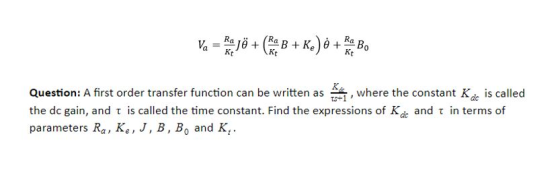
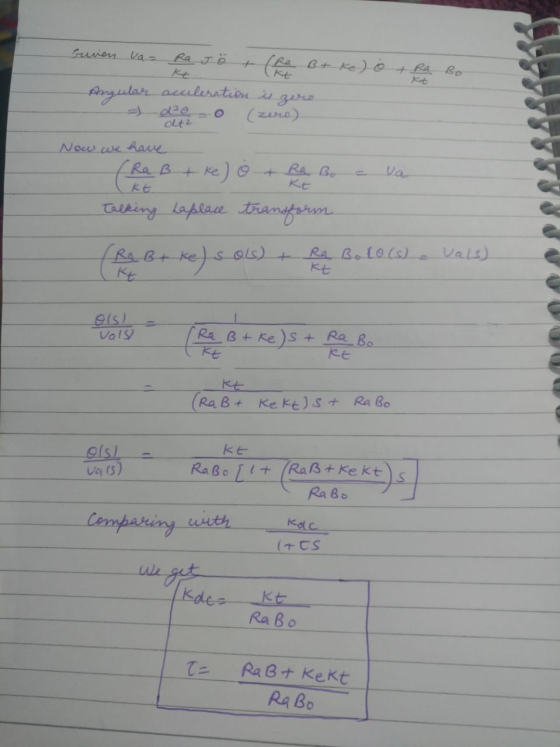
The angular acceleration is zero.
Homework Answers
Add Answer to:
The angular acceleration is zero.
Va = ka jë + ( B+Ke)ė + ka Bo Question:...
The answer is ws/va(s) = k/ (( LaS+Ra)(Js+B)+K^2) 7, Derive transfer function (a(s) = Angularvelocity of...
 The answer is ws/va(s) = k/ (( LaS+Ra)(Js+B)+K^2)
7, Derive transfer function (a(s) = Angularvelocity of a DC motor. (1) Aramture voltage Va (s) R. e) i, (C) i,o) v constant (permanent magnet) Armature Field J: inertia B: damping T: load
The answer is ws/va(s) = k/ (( LaS+Ra)(Js+B)+K^2)
7, Derive transfer function (a(s) = Angularvelocity of a DC motor. (1) Aramture voltage Va (s) R. e) i, (C) i,o) v constant (permanent magnet) Armature Field J: inertia B: damping T: load
Question 3: DC motors can be simplistically modeled as shown in Figure 5 MoTor back emf Vi: +1 Re...
 Question 3: DC motors can be simplistically modeled as shown in Figure 5 MoTor back emf Vi: +1 Resistor Ra Ia Figure 5: Simplified model of DC Motor (a) Write the three characteristic equations that determine the behavior of the DC motor. Denote torque constant and speed constant as Ka, K, respectively. (b) Motor parameters are the quantities that define the behavior of the motor. List the motor parameters from the described model. What are their units? (c) For given...
The Quanser motor to be used in Lab R6-R8 can be modeled in terms of the output angular velocity ...
 The Quanser motor to be used in Lab R6-R8 can be modeled in terms of the output angular velocity of the load ω1(t) and an input motor voltage yn(t): where r24 6.35 mm r72- 19 mm r120 32 mm Ta = 50 mm Tg = 90% m 69% K, = 70 /m = 4.61E-7 kg-m" m24-5g m72-30 g m120 83 g md 40 g kt-7.68E-3 N-m/A km-7.68E-3 V/(rad/s) Rm 2.62 Bm-0015 N-m/(rad/s) B. + η (4 points) Building on Problem...
Consider the rotational system with angular velocity "Ω(t)" and input torque "T(t)." TC From Newton's Law, the equation of motion is J Ω(t)-B. Ω(t) Now suppose that this input to...
 Consider the rotational system with angular velocity "Ω(t)" and input torque "T(t)." TC From Newton's Law, the equation of motion is J Ω(t)-B. Ω(t) Now suppose that this input torque is supplied by an electric motor Specifically, T(t) T(t) -Kamp Vin(t) where 1) "Vin is the input voltage supplied to the motor N-m 2) "Kamp" is the motor gain (this constant has units of Volt) So, the transfer function for this system is (s)Kamp The moment of inertia is known...
3 Angular Momentum and Spherical Harmonics For a quantum mechanical system that is able to rotate...
 3 Angular Momentum and Spherical Harmonics For a quantum mechanical system that is able to rotate in 3D, one can always define a set of angular momentum operators J. Jy, J., often collectively written as a vector J. They must satisfy the commutation relations (, ] = ihſ, , Îu] = ihſ, J., ſu] = ihỈy. (1) In a more condensed notation, we may write [1,1]] = Žiheikh, i, j= 1,2,3 k=1 Here we've used the Levi-Civita symbol, defined as...
could you please solve a and b? Chapier 2i. Note: you needn't derive Kepler's laws-but do...
 could you please solve a and b?
Chapier 2i. Note: you needn't derive Kepler's laws-but do mention when you are using them, an describe the physical concepts involved and the meanings behind the variables. u) Consider two stars Mi and M; bound together by their mutual gravitational force (and isolated from other forces) moving in elliptical orbits (of eccentricity e and semi-major axes ai and az) at distances 11 in n and r from their center of mass located at...
could you please solve a and b?
Chapier 2i. Note: you needn't derive Kepler's laws-but do mention when you are using them, an describe the physical concepts involved and the meanings behind the variables. u) Consider two stars Mi and M; bound together by their mutual gravitational force (and isolated from other forces) moving in elliptical orbits (of eccentricity e and semi-major axes ai and az) at distances 11 in n and r from their center of mass located at...
winkngs spring i(t) v(t) st VEE Figure 1: (a)Solenoid with retu spring. (b) Equivalent lumped electrical cireuit (...
 winkngs spring i(t) v(t) st VEE Figure 1: (a)Solenoid with retu spring. (b) Equivalent lumped electrical cireuit (e) Equivalent mechanical diagram Figure 1(a) illustrates a solenoid with a return spring The voltage e(t) across the winding, causes a current it) to flow through the winding. which in turn generates a magnetic field The magnetic field induces a force f(t) on the plunger mass, . The magnitude of this force is related to the current in the windings via the solenoid's...
1. (30pt) LC Circuit and Simple Harmonic Oscillator (From $23.12 RLC Series AC Circuits) Let us...
 1. (30pt) LC Circuit and Simple Harmonic Oscillator (From $23.12 RLC Series AC Circuits) Let us first consider a point mass m > 0 with a spring k> 0 (see Figure 23.52). This system is sometimes called a simple harmonic oscillator. The equation of motion (EMI) is given by ma= -kr (1) where the acceleration a is given by the second derivative of the coordinate r with respect to time t, namely dr(t) (2) dt de(t) (6) at) (3) dt...
Please use the formulate sheet and show all steps to make sure the question is worth...
 Please use the formulate sheet and show all steps to make sure
the question is worth any points
a) The initial ratio of deuterium (D) to hydrogen (H) in a planet's atmosphere was 175000; however, the present ratio is 1/1500 and the initial and final abundances of D are 5 x 10° atoms per m3 and 9 x 10⁶ atoms per m2, respectively. What fraction of deuterium has been lost, and what fraction of hydrogen has been lost in this...
Please use the formulate sheet and show all steps to make sure
the question is worth any points
a) The initial ratio of deuterium (D) to hydrogen (H) in a planet's atmosphere was 175000; however, the present ratio is 1/1500 and the initial and final abundances of D are 5 x 10° atoms per m3 and 9 x 10⁶ atoms per m2, respectively. What fraction of deuterium has been lost, and what fraction of hydrogen has been lost in this...
help please? this was the only other information given REPORT SHEET Determination of the Solubility-Product Constant...
 help please?
this was the only other information given
REPORT SHEET Determination of the Solubility-Product Constant for a Sparingly Soluble Salt EXPERIMENT 8 A. Preparation of a Calibration Curve Initial (Cro121 0.0024 M Absorbance 5 mL Volume of 0.0024 M K Cro Total volume 1. I mL 100 mL 2. 100ML 3. 10 mL 100ml 4. 15 mL 100 ML Molar extinction coefficient for [CrO2) [Cro,2) 2.4x100M 12x1044 2.4810M 3.6810M 0.04) 2037.37 0.85 1.13 2. 3. Average molar extinction coefficient...
help please?
this was the only other information given
REPORT SHEET Determination of the Solubility-Product Constant for a Sparingly Soluble Salt EXPERIMENT 8 A. Preparation of a Calibration Curve Initial (Cro121 0.0024 M Absorbance 5 mL Volume of 0.0024 M K Cro Total volume 1. I mL 100 mL 2. 100ML 3. 10 mL 100ml 4. 15 mL 100 ML Molar extinction coefficient for [CrO2) [Cro,2) 2.4x100M 12x1044 2.4810M 3.6810M 0.04) 2037.37 0.85 1.13 2. 3. Average molar extinction coefficient...
 The answer is ws/va(s) = k/ (( LaS+Ra)(Js+B)+K^2)
7, Derive transfer function (a(s) = Angularvelocity of a DC motor. (1) Aramture voltage Va (s) R. e) i, (C) i,o) v constant (permanent magnet) Armature Field J: inertia B: damping T: load
The answer is ws/va(s) = k/ (( LaS+Ra)(Js+B)+K^2)
7, Derive transfer function (a(s) = Angularvelocity of a DC motor. (1) Aramture voltage Va (s) R. e) i, (C) i,o) v constant (permanent magnet) Armature Field J: inertia B: damping T: load
 Question 3: DC motors can be simplistically modeled as shown in Figure 5 MoTor back emf Vi: +1 Resistor Ra Ia Figure 5: Simplified model of DC Motor (a) Write the three characteristic equations that determine the behavior of the DC motor. Denote torque constant and speed constant as Ka, K, respectively. (b) Motor parameters are the quantities that define the behavior of the motor. List the motor parameters from the described model. What are their units? (c) For given...
 The Quanser motor to be used in Lab R6-R8 can be modeled in terms of the output angular velocity of the load ω1(t) and an input motor voltage yn(t): where r24 6.35 mm r72- 19 mm r120 32 mm Ta = 50 mm Tg = 90% m 69% K, = 70 /m = 4.61E-7 kg-m" m24-5g m72-30 g m120 83 g md 40 g kt-7.68E-3 N-m/A km-7.68E-3 V/(rad/s) Rm 2.62 Bm-0015 N-m/(rad/s) B. + η (4 points) Building on Problem...
 Consider the rotational system with angular velocity "Ω(t)" and input torque "T(t)." TC From Newton's Law, the equation of motion is J Ω(t)-B. Ω(t) Now suppose that this input torque is supplied by an electric motor Specifically, T(t) T(t) -Kamp Vin(t) where 1) "Vin is the input voltage supplied to the motor N-m 2) "Kamp" is the motor gain (this constant has units of Volt) So, the transfer function for this system is (s)Kamp The moment of inertia is known...
 3 Angular Momentum and Spherical Harmonics For a quantum mechanical system that is able to rotate in 3D, one can always define a set of angular momentum operators J. Jy, J., often collectively written as a vector J. They must satisfy the commutation relations (, ] = ihſ, , Îu] = ihſ, J., ſu] = ihỈy. (1) In a more condensed notation, we may write [1,1]] = Žiheikh, i, j= 1,2,3 k=1 Here we've used the Levi-Civita symbol, defined as...
 could you please solve a and b?
Chapier 2i. Note: you needn't derive Kepler's laws-but do mention when you are using them, an describe the physical concepts involved and the meanings behind the variables. u) Consider two stars Mi and M; bound together by their mutual gravitational force (and isolated from other forces) moving in elliptical orbits (of eccentricity e and semi-major axes ai and az) at distances 11 in n and r from their center of mass located at...
could you please solve a and b?
Chapier 2i. Note: you needn't derive Kepler's laws-but do mention when you are using them, an describe the physical concepts involved and the meanings behind the variables. u) Consider two stars Mi and M; bound together by their mutual gravitational force (and isolated from other forces) moving in elliptical orbits (of eccentricity e and semi-major axes ai and az) at distances 11 in n and r from their center of mass located at...
 winkngs spring i(t) v(t) st VEE Figure 1: (a)Solenoid with retu spring. (b) Equivalent lumped electrical cireuit (e) Equivalent mechanical diagram Figure 1(a) illustrates a solenoid with a return spring The voltage e(t) across the winding, causes a current it) to flow through the winding. which in turn generates a magnetic field The magnetic field induces a force f(t) on the plunger mass, . The magnitude of this force is related to the current in the windings via the solenoid's...
 1. (30pt) LC Circuit and Simple Harmonic Oscillator (From $23.12 RLC Series AC Circuits) Let us first consider a point mass m > 0 with a spring k> 0 (see Figure 23.52). This system is sometimes called a simple harmonic oscillator. The equation of motion (EMI) is given by ma= -kr (1) where the acceleration a is given by the second derivative of the coordinate r with respect to time t, namely dr(t) (2) dt de(t) (6) at) (3) dt...
 Please use the formulate sheet and show all steps to make sure
the question is worth any points
a) The initial ratio of deuterium (D) to hydrogen (H) in a planet's atmosphere was 175000; however, the present ratio is 1/1500 and the initial and final abundances of D are 5 x 10° atoms per m3 and 9 x 10⁶ atoms per m2, respectively. What fraction of deuterium has been lost, and what fraction of hydrogen has been lost in this...
Please use the formulate sheet and show all steps to make sure
the question is worth any points
a) The initial ratio of deuterium (D) to hydrogen (H) in a planet's atmosphere was 175000; however, the present ratio is 1/1500 and the initial and final abundances of D are 5 x 10° atoms per m3 and 9 x 10⁶ atoms per m2, respectively. What fraction of deuterium has been lost, and what fraction of hydrogen has been lost in this...
 help please?
this was the only other information given
REPORT SHEET Determination of the Solubility-Product Constant for a Sparingly Soluble Salt EXPERIMENT 8 A. Preparation of a Calibration Curve Initial (Cro121 0.0024 M Absorbance 5 mL Volume of 0.0024 M K Cro Total volume 1. I mL 100 mL 2. 100ML 3. 10 mL 100ml 4. 15 mL 100 ML Molar extinction coefficient for [CrO2) [Cro,2) 2.4x100M 12x1044 2.4810M 3.6810M 0.04) 2037.37 0.85 1.13 2. 3. Average molar extinction coefficient...
help please?
this was the only other information given
REPORT SHEET Determination of the Solubility-Product Constant for a Sparingly Soluble Salt EXPERIMENT 8 A. Preparation of a Calibration Curve Initial (Cro121 0.0024 M Absorbance 5 mL Volume of 0.0024 M K Cro Total volume 1. I mL 100 mL 2. 100ML 3. 10 mL 100ml 4. 15 mL 100 ML Molar extinction coefficient for [CrO2) [Cro,2) 2.4x100M 12x1044 2.4810M 3.6810M 0.04) 2037.37 0.85 1.13 2. 3. Average molar extinction coefficient...
Most questions answered within 3 hours.
-
Where is the error in this code sequence?
String s1 = "Hello";
String s2 = "ello";...
asked 10 months ago -
Financial data for Joel de Paris, Inc., for last year
follow:
Joel de Paris, Inc.
Balance...
asked 10 months ago -
Consider this reaction:
Al2(SO4)3 (aq)+ BaCl3
(aq) Al2Cl6 (aq)- +
3BaSO4(s) . What is the...
asked 10 months ago -
Suppose that Savneet is considering increasing her
recent random sample from 20 car rentals to 40...
asked 10 months ago -
Trucks arrive at an unloading terminal at an average rate of 120
per hour.
Trucks arrive...
asked 10 months ago -
Why are methanol and ethanol completely soluble in water while
octanol is not very little soluble....
asked 10 months ago -
A facilities manager at a university reads in a research report
that the mean amount of...
asked 10 months ago -
When the CuSO4 is rehydrated by adding water to the anhydrous
compound, is this an endothermic...
asked 10 months ago -
A ray of sunlight is passing from diamond into crown glass; the
angle of incidence is...
asked 10 months ago -
A block of mass 0.249 kg is placed on top of a light, vertical
spring of...
asked 10 months ago -
how do the kidneys compensate in the presences of acidosis
a) trigger hyperventilate
b) reserve acid...
asked 10 months ago -
Question 501 pts
The rental rate of capital to the firm increases. Which of the
following...
asked 10 months ago