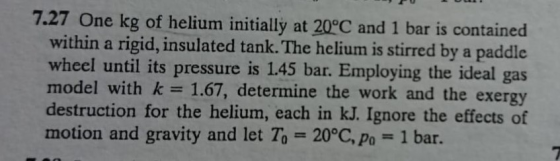
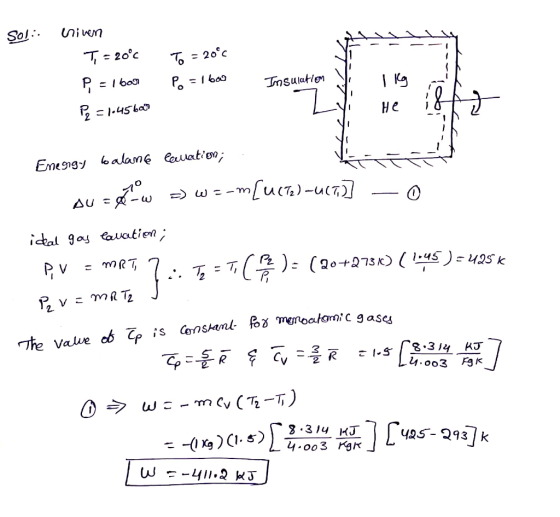
I need those answers ===> W = -411.2 kJ, Ed = 339.2 kJ
Homework Answers
![The exeggy destruction is F. = Too [o is amt of entropy produced] Now, as = s( 50) + 5 =) = m(89-9) [reg) uny- (iun do] wzo [](http://img.homeworklib.com/questions/b81c5000-c659-11ea-9c77-7170e4a04397.png?x-oss-process=image/resize,w_560)
Add Answer to:
I need those answers ===> W = -411.2 kJ, Ed =
339.2 kJ
7.27 One kg of...
write more details as you can,please thank you 7.22 A rigid, insulated tank contains 0.6 kg...
 write more details as you can,please
thank you
7.22 A rigid, insulated tank contains 0.6 kg of air, initially at 200 kPa, 20°C. The air is stirred by a paddle wheel until its pressure is 250 kPa. Using the ideal gas model with c, = 0.72 kJ/kg . K, determine, in kJ, (a) the work, (b) the change in exergy of the air, and (c) the amount of exergy destroyed. Ignore the effects of motion and gravity, and let To...
write more details as you can,please
thank you
7.22 A rigid, insulated tank contains 0.6 kg of air, initially at 200 kPa, 20°C. The air is stirred by a paddle wheel until its pressure is 250 kPa. Using the ideal gas model with c, = 0.72 kJ/kg . K, determine, in kJ, (a) the work, (b) the change in exergy of the air, and (c) the amount of exergy destroyed. Ignore the effects of motion and gravity, and let To...
Problem 3 A rigid, insulated tank filled with 0.6 kg of air is initially at 2...
 Problem 3 A rigid, insulated tank filled with 0.6 kg of air is initially at 2 bar, 20°C. The air is stirred by a paddle wheel until its pressure is 2.5 bar. The volume specific heat (Cv) is constant with 0.72 kJ/KgK. Let To = 20°C, po = 1 bar ATTENTION: You are NOT allowed to use Table A-22 to find properties in this problem. Use the volume specific heat to find properties as needed. (a) Determine the final temperature...
Problem 6.028 SI Air contained in a rigid, insulated tank fitted with a paddle wheel, initially...
 Problem 6.028 SI Air contained in a rigid, insulated tank fitted with a paddle wheel, initially at 300 K, 2 bar, and a volume of 2 m, is stirred until its temperature is 600 K. Assuming the ideal gas model for the air, and ignoring kinetic and potential energy, determine (a) the final pressure, in bar (b) the work, in kJ (c) the amount of entropy produced, kJ/K Solve using: (1) data from Table A-22. (2) constant cy read from...
Air contained
Air contained in a rigid, insulated tank fitted with a paddle wheel, initially at 1 bar, 330 K and a volume of 1.93 m^3, receives an energy transfer by work from thepaddle wheel in an amount of 400kJ. Assuming the ideal gas model for the air, determine (a) the final temperature, in K, (b) the final pressure, in bar, and (c) theamount of entropy produced, in kJ/K, Ignore kinetic and potential energy.
Problem 7.023 SI As shown in the figure below, 1.25 kg of refrigerant R-134a is contained...
 Problem 7.023 SI As shown in the figure below, 1.25 kg of refrigerant R-134a is contained in a well-insulated piston-cylinder assembly fitted with an electrical resistor of negligible mass. The refrigerant is initially at 2 bar and a quality of 50%. The resistor is activated until the volume of the refrigerant doubles, while its pressure varies negligibly. Determine, in kJ (a) the amount of energy transfer by work to the piston and (b) the accompanying exergy transfer. (c) the amount...
a) In thermodynamics, what is the second law efficiency? How does it differ from the first...
 a) In thermodynamics, what is the second law efficiency? How does it differ from the first law efficiency? (2 marks) b) Can a system have a higher second law efficiency than the first law efficiency during a process? Give examples (Hint: Consider efficiencies of a reversible cycle). (2 marks) c) An ideal gas is stored in a closed vessel at pressure p and temperature T. If p = po, derive an expression for the specific exergy in terms of T,...
 write more details as you can,please
thank you
7.22 A rigid, insulated tank contains 0.6 kg of air, initially at 200 kPa, 20°C. The air is stirred by a paddle wheel until its pressure is 250 kPa. Using the ideal gas model with c, = 0.72 kJ/kg . K, determine, in kJ, (a) the work, (b) the change in exergy of the air, and (c) the amount of exergy destroyed. Ignore the effects of motion and gravity, and let To...
write more details as you can,please
thank you
7.22 A rigid, insulated tank contains 0.6 kg of air, initially at 200 kPa, 20°C. The air is stirred by a paddle wheel until its pressure is 250 kPa. Using the ideal gas model with c, = 0.72 kJ/kg . K, determine, in kJ, (a) the work, (b) the change in exergy of the air, and (c) the amount of exergy destroyed. Ignore the effects of motion and gravity, and let To...
 Problem 3 A rigid, insulated tank filled with 0.6 kg of air is initially at 2 bar, 20°C. The air is stirred by a paddle wheel until its pressure is 2.5 bar. The volume specific heat (Cv) is constant with 0.72 kJ/KgK. Let To = 20°C, po = 1 bar ATTENTION: You are NOT allowed to use Table A-22 to find properties in this problem. Use the volume specific heat to find properties as needed. (a) Determine the final temperature...
 Problem 6.028 SI Air contained in a rigid, insulated tank fitted with a paddle wheel, initially at 300 K, 2 bar, and a volume of 2 m, is stirred until its temperature is 600 K. Assuming the ideal gas model for the air, and ignoring kinetic and potential energy, determine (a) the final pressure, in bar (b) the work, in kJ (c) the amount of entropy produced, kJ/K Solve using: (1) data from Table A-22. (2) constant cy read from...
 Problem 7.023 SI As shown in the figure below, 1.25 kg of refrigerant R-134a is contained in a well-insulated piston-cylinder assembly fitted with an electrical resistor of negligible mass. The refrigerant is initially at 2 bar and a quality of 50%. The resistor is activated until the volume of the refrigerant doubles, while its pressure varies negligibly. Determine, in kJ (a) the amount of energy transfer by work to the piston and (b) the accompanying exergy transfer. (c) the amount...
 a) In thermodynamics, what is the second law efficiency? How does it differ from the first law efficiency? (2 marks) b) Can a system have a higher second law efficiency than the first law efficiency during a process? Give examples (Hint: Consider efficiencies of a reversible cycle). (2 marks) c) An ideal gas is stored in a closed vessel at pressure p and temperature T. If p = po, derive an expression for the specific exergy in terms of T,...
Most questions answered within 3 hours.
-
Where is the error in this code sequence?
String s1 = "Hello";
String s2 = "ello";...
asked 11 months ago -
Financial data for Joel de Paris, Inc., for last year
follow:
Joel de Paris, Inc.
Balance...
asked 11 months ago -
Consider this reaction:
Al2(SO4)3 (aq)+ BaCl3
(aq) Al2Cl6 (aq)- +
3BaSO4(s) . What is the...
asked 11 months ago -
Suppose that Savneet is considering increasing her
recent random sample from 20 car rentals to 40...
asked 11 months ago -
Trucks arrive at an unloading terminal at an average rate of 120
per hour.
Trucks arrive...
asked 11 months ago -
Why are methanol and ethanol completely soluble in water while
octanol is not very little soluble....
asked 11 months ago -
A facilities manager at a university reads in a research report
that the mean amount of...
asked 11 months ago -
When the CuSO4 is rehydrated by adding water to the anhydrous
compound, is this an endothermic...
asked 11 months ago -
A ray of sunlight is passing from diamond into crown glass; the
angle of incidence is...
asked 11 months ago -
A block of mass 0.249 kg is placed on top of a light, vertical
spring of...
asked 11 months ago -
how do the kidneys compensate in the presences of acidosis
a) trigger hyperventilate
b) reserve acid...
asked 11 months ago -
Question 501 pts
The rental rate of capital to the firm increases. Which of the
following...
asked 11 months ago