
Homework Answers
Add Answer to:
Match the descriptions to the appropriate term. Rate of reaction Rate law Rate constant Answer Bank...
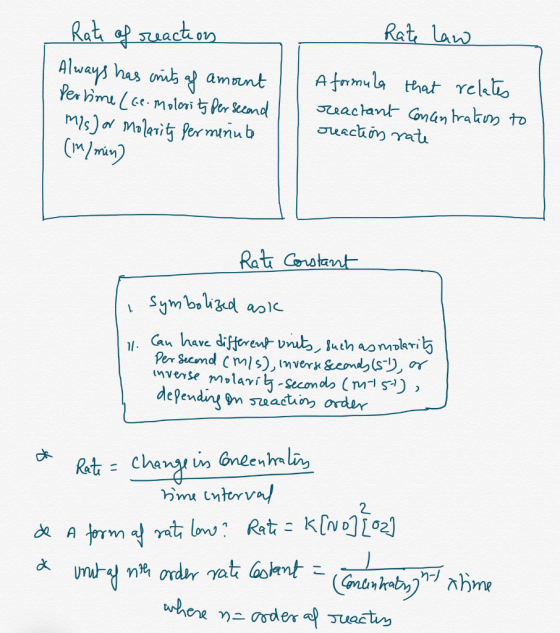
Rate of reaction Rate law Rate constant Answer Bank always has units of amount per time...
 Rate of reaction Rate law Rate constant Answer Bank always has units of amount per time (i.e., molarity per second, M/s, or molarity per minute, M/min) a formula that relates reactant concentration to reaction rate can have different units, such as molarity per second (M/s), inverse seconds (s), or inverse molarity-seconds (M-.-'), depending on the reaction order symbolized as k
Integrated Rate Laws 1. The rate law expression for the reaction of sucrose in water C12H22O11 ...
Integrated Rate Laws 1. The rate law expression for the reaction of sucrose in water C12H22O11 + H2O ---> 2 C6H12O6 Is rate = k[C12H22O11]. a. What is the order with respect to each reactant? b. What is the overall order of the reaction? c. After 2.57 hours, 6.00g/L of C12H22O11 has decreased to 5.40g/L. Express these concentrations in units of M. d. What is the value and units for k given the information in part c? e. Knowing the...
Part 11: Integrated Rate Law 8 pts each If a second-order reaction with a rate constant...
 Part 11: Integrated Rate Law 8 pts each If a second-order reaction with a rate constant of 0.056 M's'has a reactant concentration of 1.2 M after 8.0 seconds have elapsed, what was the initial reactant c
1. A certain first order reaction has a rate constant of 0.036 min-1. How much of the reactant will remain if the reacti...
1. A certain first order reaction has a rate constant of 0.036 min-1. How much of the reactant will remain if the reaction is run for 2.5 hours and the initial concentration of the reactant is 0.31 M? 2. A certain first order reaction has a rate constant of 0.036 min-1. How much of the reactant will remain if the reaction is run for 2.5 hours and the initial concentration of the reactant is 0.31 M? 3. The rate constant...
The rate law of a reaction is rate =k[X]³. The units of the rate constant are
1)The rate law of a reaction is rate =k[X]³. The units of the rate constant areL mol-1 s-1mol² L-2 s-1mol L-1S-2L² mol-2 s-1mol L-1S-12)Given the following rate law, how does the rate of reaction change if the concentration of Z is tripled? Rate =k[X]³[Y]²[Z]⁰The rate of reaction will increase by a factor of136803)What data should be plotted to show that experimental concentration data fits a first-order reaction?1 / [reactant] vs. time[reactant] vs. timeln (k) vs. Ealn (k) vs. 1 / Tln [...
The integrated rate law allow chemists to predict the reactant concentration after a certain amount of...
 The integrated rate law allow chemists to predict the reactant concentration after a certain amount of time, or the time it would take for a certain concentration to be reached. The integrated rate law for a first-order reaction is: [A] = [A]oe -Rt Now say we are particularly interested in the time it would take for the concentration to become one-half of its initial value. Then we could substitute Z" for [A] and rearrange the equation to: A) 1/2= 0093...
The integrated rate law allows chemists to predict the reactant concentration after a certain amount of...
The integrated rate law allows chemists to predict the reactant concentration after a certain amount of time, or the time it would take for a certain concentration to be reached. The integrated rate law for a first-order reaction is: [A]=[A]0e−kt[A]=[A]0e−kt Now say we are particularly interested in the time it would take for the concentration to become one-half of its initial value. Then we could substitute [A]02[A]02 for [A][A] and rearrange the equation to: t1/2=0.693k t1/2=0.693k This equation calculates the...
The integrated rate law allows chemists to predict the reactant concentration after a certain amount of...
 The integrated rate law allows
chemists to predict the reactant concentration after a certain
amount of time, or the time it would take for a certain
concentration to be reached. The integrated rate law for a
first-order reaction is: [A]=[A]0e−kt Now say we are particularly
interested in the time it would take for the concentration to
become one-half of its initial value. Then we could substitute
[A]02 for [A] and rearrange the equation to: t1/2=0.693k This
equation calculates the time...
The integrated rate law allows
chemists to predict the reactant concentration after a certain
amount of time, or the time it would take for a certain
concentration to be reached. The integrated rate law for a
first-order reaction is: [A]=[A]0e−kt Now say we are particularly
interested in the time it would take for the concentration to
become one-half of its initial value. Then we could substitute
[A]02 for [A] and rearrange the equation to: t1/2=0.693k This
equation calculates the time...
What are the units of the rate constant for a reaction whose rate law is second...
What are the units of the rate constant for a reaction whose rate law is second order with respect to reactant A and zero order with respect to reactant B? A. L * mol^-1 * s^-1 B. L * mol^-1 * s C. L^2 * mol^-2 * s^-1 D. L^2 * mol^-2 * s^-2 E. L^-1/2 * mol^1/2 * s^-1
1. Part: A The rate constant for a certain reaction is k = 6.00×10⁻³ s−1. If...
1. Part: A The rate constant for a certain reaction is k = 6.00×10⁻³ s−1. If the initial reactant concentration was 0.550 M, what will the concentration be after 10.0 minutes? Part B: A zero-order reaction has a constant rate of 1.80×10⁻⁴M/s. If after 75.0 seconds the concentration has dropped to 7.50×10⁻²M, what was the initial concentration? 2. At 500 ∘C, cyclopropane (C3H6) rearranges to propane (CH3−CH=CH2). The reaction is first order, and the rate constant is 6.7×10⁻⁴s−1. If the...
 Rate of reaction Rate law Rate constant Answer Bank always has units of amount per time (i.e., molarity per second, M/s, or molarity per minute, M/min) a formula that relates reactant concentration to reaction rate can have different units, such as molarity per second (M/s), inverse seconds (s), or inverse molarity-seconds (M-.-'), depending on the reaction order symbolized as k
 Part 11: Integrated Rate Law 8 pts each If a second-order reaction with a rate constant of 0.056 M's'has a reactant concentration of 1.2 M after 8.0 seconds have elapsed, what was the initial reactant c
 The integrated rate law allow chemists to predict the reactant concentration after a certain amount of time, or the time it would take for a certain concentration to be reached. The integrated rate law for a first-order reaction is: [A] = [A]oe -Rt Now say we are particularly interested in the time it would take for the concentration to become one-half of its initial value. Then we could substitute Z" for [A] and rearrange the equation to: A) 1/2= 0093...
 The integrated rate law allows
chemists to predict the reactant concentration after a certain
amount of time, or the time it would take for a certain
concentration to be reached. The integrated rate law for a
first-order reaction is: [A]=[A]0e−kt Now say we are particularly
interested in the time it would take for the concentration to
become one-half of its initial value. Then we could substitute
[A]02 for [A] and rearrange the equation to: t1/2=0.693k This
equation calculates the time...
The integrated rate law allows
chemists to predict the reactant concentration after a certain
amount of time, or the time it would take for a certain
concentration to be reached. The integrated rate law for a
first-order reaction is: [A]=[A]0e−kt Now say we are particularly
interested in the time it would take for the concentration to
become one-half of its initial value. Then we could substitute
[A]02 for [A] and rearrange the equation to: t1/2=0.693k This
equation calculates the time...
Most questions answered within 3 hours.
-
Where is the error in this code sequence?
String s1 = "Hello";
String s2 = "ello";...
asked 10 months ago -
Financial data for Joel de Paris, Inc., for last year
follow:
Joel de Paris, Inc.
Balance...
asked 10 months ago -
Consider this reaction:
Al2(SO4)3 (aq)+ BaCl3
(aq) Al2Cl6 (aq)- +
3BaSO4(s) . What is the...
asked 10 months ago -
Suppose that Savneet is considering increasing her
recent random sample from 20 car rentals to 40...
asked 10 months ago -
Trucks arrive at an unloading terminal at an average rate of 120
per hour.
Trucks arrive...
asked 10 months ago -
Why are methanol and ethanol completely soluble in water while
octanol is not very little soluble....
asked 10 months ago -
A facilities manager at a university reads in a research report
that the mean amount of...
asked 10 months ago -
When the CuSO4 is rehydrated by adding water to the anhydrous
compound, is this an endothermic...
asked 10 months ago -
A ray of sunlight is passing from diamond into crown glass; the
angle of incidence is...
asked 10 months ago -
A block of mass 0.249 kg is placed on top of a light, vertical
spring of...
asked 10 months ago -
how do the kidneys compensate in the presences of acidosis
a) trigger hyperventilate
b) reserve acid...
asked 10 months ago -
Question 501 pts
The rental rate of capital to the firm increases. Which of the
following...
asked 10 months ago