
Homework Answers
Add Answer to:
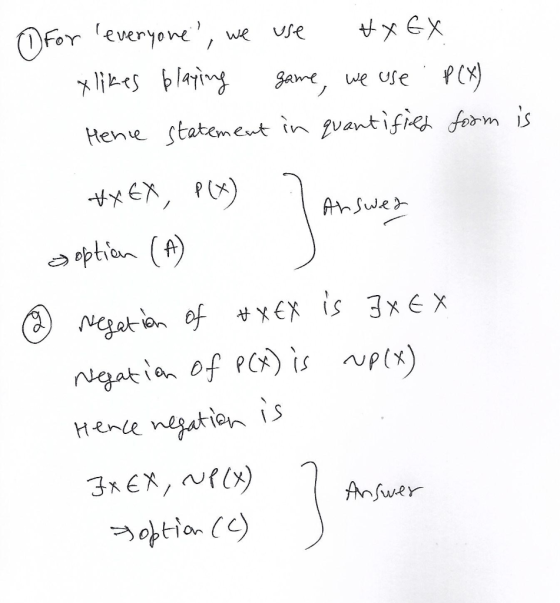
(2 points) Consider the following statement: Everyone likes playing games. For the following questions, Let X...
II.2: Let L(u,v) be a predicate indicating "u likes v". Note that L is not in...
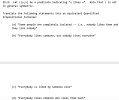 II.2: Let L(u,v) be a predicate indicating "u likes v". Note that L is not in general symmetric. Translate the following statements into an equivalent Quantified Propositional Formulae: (a) "Some people are completely isolated - i.e., nobody likes them and they like nobody (b) "Everybody likes someone, but nobody likes everyone" (c) "Everybody is liked by someone else" (d) "Everybody likes someone who likes them back"
6. Suppose A = {x | x is a person), and ·E(x) means “x likes curly...
 6. Suppose A = {x | x is a person), and ·E(x) means “x likes curly fries." Example: C(Morgan) means "Morgan likes curly fries." ·S(x) means “x likes scallops." .R(x) means"x likes roast beef" ·T(x) means “x likes turkey." (a) (2 points) Translate into words: S (Calvin) →-C(Phoebe). (b) (2 points) Translate into symbols: "There are people who like roast beef but not scallops." (c) (2 points) Translate into words: -Vx E A, (C(a) A R(x). (d) (4 points) Negate...
Module Outcome #3: Translate prose with quantified statements to symbolic and find the negation of quantified statements. (CO #1) Module outcome #3: Translate prose with quantified statements to symbo...
 Module Outcome #3: Translate
prose with quantified statements to symbolic and find the negation
of quantified statements. (CO #1)
Module outcome #3: Translate prose with quantified statements to symbolic negation of quantified statements. (CO #1) (a.) Negate the statement and simplify so that no quantifier or connective lies within the scope of a negation: (Bx)(y)-P(x.y) AQ(x, y)) (b.) Consider the domain of people working at field site Huppaloo, Let M(xx): x has access to mailbox y. Translate into predicate logic...
Module Outcome #3: Translate
prose with quantified statements to symbolic and find the negation
of quantified statements. (CO #1)
Module outcome #3: Translate prose with quantified statements to symbolic negation of quantified statements. (CO #1) (a.) Negate the statement and simplify so that no quantifier or connective lies within the scope of a negation: (Bx)(y)-P(x.y) AQ(x, y)) (b.) Consider the domain of people working at field site Huppaloo, Let M(xx): x has access to mailbox y. Translate into predicate logic...
3. In the domain of all movies, let D(x) be the predicate "x has a demon...
 3. In the domain of all movies, let D(x) be the predicate "x has a demon in it." and P(x) be the predicate "x is about ponies." Which one of the following statements represents "Some movies that have a demon in it are not about ponies." (3 points] a. (3x)(D(x) → P(x)) b. (3x)(D(x) A-P(x)) c. (Vx)(P(x) →D(x)) d. (3x)(PD(x)) +-P(x))
Answer the following questions in the space provided below. 1. For each proposition below, first determine...
 Answer the following questions in the space provided below. 1. For each proposition below, first determine its truth value, then negate the proposition and simplify (using DeMorgan's laws) to eliminate all – symbols. All variables are from the domain of integers. (a) 3x, 22 <2. (b) Vx, ((:22 = 0) + (x = 0)). (e) 3xWy((x > 0) (y > 0 + x Sy)). 2. Consider the predicates defined below. Take the domain to be the positive integers. P(x): x...
Click and drag the appropriate word, symbol or phrase into the most appropriate blank. Let P(x)...
 Click and drag the appropriate word, symbol or phrase into the most appropriate blank. Let P(x) be the statement "x can speak Russian" and let Q(x) be the statement "x knows the computer language C++." Consider the statement, "No student at your school can speak Russian or knows C++." This statement is equivalent to the statement This statement is a statement, because of the word, "All." So, the appropriate quantifier to be applied at the beginning of the symbolic statement...
2. Let X be a Bernoulli random variable with probability of X -1 being a. a)...
 2. Let X be a Bernoulli random variable with probability of X -1 being a. a) Write down the probability mass function p(X) of X in terms of a. Mark the range of a (b) Find the mean value mx(a) EX] of X, as a function of a (c) Find the variance σ剤a) IX-mx)2) of X, as a function of a. (d) Consider another random variable Y as a function of X: Y = g(X) =-log p(X) where the binary...
2. Let D-E-(-2,-10,1,2). write negations for each of the following statements and determine which is true,...
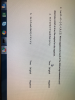 2. Let D-E-(-2,-10,1,2). write negations for each of the following statements and determine which is true, the original or the negation. Vx e D,3y E E such that xy 2 y True: OriginalNesgation a. b. 3x E D such that Vy E E, x y True: Original Negation
Hello, If anyone would be so kind as to help me out with a solution in...
 Hello, If anyone would be so kind as to help me out with a
solution in either Java or C++ please and thank you !!!
CS 278 Lab3: Quantified statements Write a program that does the following. It should take as a user input ten different integers and store them in a length ten integer array (with no repeated entries). The domain D is the set of entries in this array. Recall that if the domain is a finite set...
Hello, If anyone would be so kind as to help me out with a
solution in either Java or C++ please and thank you !!!
CS 278 Lab3: Quantified statements Write a program that does the following. It should take as a user input ten different integers and store them in a length ten integer array (with no repeated entries). The domain D is the set of entries in this array. Recall that if the domain is a finite set...
13. Consider the random variables X and Y with the following expectations: E(X)= 2, E(Y)=1 E(X²)=15,...
 13. Consider the random variables X and Y with the following expectations: E(X)= 2, E(Y)=1 E(X²)=15, E(Y2)=9, E(XY)=1. Let U = X + 2Y, V = 3X - Y and calculate the covariance of U and V.
 II.2: Let L(u,v) be a predicate indicating "u likes v". Note that L is not in general symmetric. Translate the following statements into an equivalent Quantified Propositional Formulae: (a) "Some people are completely isolated - i.e., nobody likes them and they like nobody (b) "Everybody likes someone, but nobody likes everyone" (c) "Everybody is liked by someone else" (d) "Everybody likes someone who likes them back"
 6. Suppose A = {x | x is a person), and ·E(x) means “x likes curly fries." Example: C(Morgan) means "Morgan likes curly fries." ·S(x) means “x likes scallops." .R(x) means"x likes roast beef" ·T(x) means “x likes turkey." (a) (2 points) Translate into words: S (Calvin) →-C(Phoebe). (b) (2 points) Translate into symbols: "There are people who like roast beef but not scallops." (c) (2 points) Translate into words: -Vx E A, (C(a) A R(x). (d) (4 points) Negate...
 Module Outcome #3: Translate
prose with quantified statements to symbolic and find the negation
of quantified statements. (CO #1)
Module outcome #3: Translate prose with quantified statements to symbolic negation of quantified statements. (CO #1) (a.) Negate the statement and simplify so that no quantifier or connective lies within the scope of a negation: (Bx)(y)-P(x.y) AQ(x, y)) (b.) Consider the domain of people working at field site Huppaloo, Let M(xx): x has access to mailbox y. Translate into predicate logic...
Module Outcome #3: Translate
prose with quantified statements to symbolic and find the negation
of quantified statements. (CO #1)
Module outcome #3: Translate prose with quantified statements to symbolic negation of quantified statements. (CO #1) (a.) Negate the statement and simplify so that no quantifier or connective lies within the scope of a negation: (Bx)(y)-P(x.y) AQ(x, y)) (b.) Consider the domain of people working at field site Huppaloo, Let M(xx): x has access to mailbox y. Translate into predicate logic...
 3. In the domain of all movies, let D(x) be the predicate "x has a demon in it." and P(x) be the predicate "x is about ponies." Which one of the following statements represents "Some movies that have a demon in it are not about ponies." (3 points] a. (3x)(D(x) → P(x)) b. (3x)(D(x) A-P(x)) c. (Vx)(P(x) →D(x)) d. (3x)(PD(x)) +-P(x))
 Answer the following questions in the space provided below. 1. For each proposition below, first determine its truth value, then negate the proposition and simplify (using DeMorgan's laws) to eliminate all – symbols. All variables are from the domain of integers. (a) 3x, 22 <2. (b) Vx, ((:22 = 0) + (x = 0)). (e) 3xWy((x > 0) (y > 0 + x Sy)). 2. Consider the predicates defined below. Take the domain to be the positive integers. P(x): x...
 Click and drag the appropriate word, symbol or phrase into the most appropriate blank. Let P(x) be the statement "x can speak Russian" and let Q(x) be the statement "x knows the computer language C++." Consider the statement, "No student at your school can speak Russian or knows C++." This statement is equivalent to the statement This statement is a statement, because of the word, "All." So, the appropriate quantifier to be applied at the beginning of the symbolic statement...
 2. Let X be a Bernoulli random variable with probability of X -1 being a. a) Write down the probability mass function p(X) of X in terms of a. Mark the range of a (b) Find the mean value mx(a) EX] of X, as a function of a (c) Find the variance σ剤a) IX-mx)2) of X, as a function of a. (d) Consider another random variable Y as a function of X: Y = g(X) =-log p(X) where the binary...
 2. Let D-E-(-2,-10,1,2). write negations for each of the following statements and determine which is true, the original or the negation. Vx e D,3y E E such that xy 2 y True: OriginalNesgation a. b. 3x E D such that Vy E E, x y True: Original Negation
 Hello, If anyone would be so kind as to help me out with a
solution in either Java or C++ please and thank you !!!
CS 278 Lab3: Quantified statements Write a program that does the following. It should take as a user input ten different integers and store them in a length ten integer array (with no repeated entries). The domain D is the set of entries in this array. Recall that if the domain is a finite set...
Hello, If anyone would be so kind as to help me out with a
solution in either Java or C++ please and thank you !!!
CS 278 Lab3: Quantified statements Write a program that does the following. It should take as a user input ten different integers and store them in a length ten integer array (with no repeated entries). The domain D is the set of entries in this array. Recall that if the domain is a finite set...
 13. Consider the random variables X and Y with the following expectations: E(X)= 2, E(Y)=1 E(X²)=15, E(Y2)=9, E(XY)=1. Let U = X + 2Y, V = 3X - Y and calculate the covariance of U and V.
Most questions answered within 3 hours.
-
Where is the error in this code sequence?
String s1 = "Hello";
String s2 = "ello";...
asked 10 months ago -
Financial data for Joel de Paris, Inc., for last year
follow:
Joel de Paris, Inc.
Balance...
asked 10 months ago -
Consider this reaction:
Al2(SO4)3 (aq)+ BaCl3
(aq) Al2Cl6 (aq)- +
3BaSO4(s) . What is the...
asked 10 months ago -
Suppose that Savneet is considering increasing her
recent random sample from 20 car rentals to 40...
asked 10 months ago -
Trucks arrive at an unloading terminal at an average rate of 120
per hour.
Trucks arrive...
asked 10 months ago -
Why are methanol and ethanol completely soluble in water while
octanol is not very little soluble....
asked 10 months ago -
A facilities manager at a university reads in a research report
that the mean amount of...
asked 10 months ago -
When the CuSO4 is rehydrated by adding water to the anhydrous
compound, is this an endothermic...
asked 10 months ago -
A ray of sunlight is passing from diamond into crown glass; the
angle of incidence is...
asked 10 months ago -
A block of mass 0.249 kg is placed on top of a light, vertical
spring of...
asked 10 months ago -
how do the kidneys compensate in the presences of acidosis
a) trigger hyperventilate
b) reserve acid...
asked 10 months ago -
Question 501 pts
The rental rate of capital to the firm increases. Which of the
following...
asked 10 months ago