
Homework Answers

Add Answer to:
The rate constant for the first-order decomposition of a compound A in the reaction 2A rightarrow...
The rate constant for the first-order decomposition of N_2O_5 in the xeactron2 N_2O_5(g) rightarroe 4 NO_2(g)+O_2(g)...
 The rate constant for the first-order decomposition of N_2O_5 in the xeactron2 N_2O_5(g) rightarroe 4 NO_2(g)+O_2(g) is k_I = 3.38 times 10^-5 s^-1 at 25 degree C. What is the half-life of N205? What will be the pressure, initially 500 Torr, after 50 20 min after initiation of the reaction?
6) The rate constant for the first-order decomposition of N2O5 in the reaction 2N2O5(g) → 4NO2(g)...
6) The rate constant for the first-order decomposition of N2O5 in the reaction 2N2O5(g) → 4NO2(g) + O2(g) is k=3.38 x 10⁻⁵ s-1 at 25°C. What is the half-life of N2O5? What will be the total pressure, initially 88.3 kPa for the pure N2O5 vapour, (a) 10 s, (b) 10 minutes after initiation of the reaction?
6. (a) The rate constant for the first-order decomposition of N2Os in the reaction, 2 N2Os(g)-4...
 6. (a) The rate constant for the first-order decomposition of N2Os in the reaction, 2 N2Os(g)-4 NO(g)+0.(g), k-3x10-s at 25°C. What is the half-life of N20s? What will be the pressure, initially 500 bar, at 10 min after initiation of the reaction? (b) Knowing the activation energy of the above reaction is 100 kJ mor', calculate the required reaction temperature at which the reaction rate is doubled. (c) What is the conversion efficiency of N20s at 1 bar and 25...
Be sure to answer all parts. The reaction 2A rightarrow B is second order in A...
 Be sure to answer all parts. The reaction 2A rightarrow B is second order in A with a rate constant of 32.1 M^-1 s^-1 at 25 degree C. Starting with [A]0 = 0.00779 M, how long will it take for the concentration of A to drop to 0.001803M? s Calculate the half-life of the reaction for [A]_0 = 0.00779 M. s Calculate the half-life of the reaction for [A)0 = 0.00269 M.
1) The rate constant for the reaction 2 N,Os(9) = 4 NO (9) + O2(9) is...
 1) The rate constant for the reaction 2 N,Os(9) = 4 NO (9) + O2(9) is reported in units of sl. What is the overall order of the reaction? 2) The rate law for a reaction was reported as rate=k[A] [B][C] with molar concentrations in moles per cubic decimetre and time in seconds. What are the units of k? 3) The rate constant for the pseudo first-order acid- catalysed hydrolysis of glucose is 4.07' 10-s. Calculate the half-life for the...
9. The reaction 2A → B is second order with a rate constant of 51.0/M·min at...
9. The reaction 2A → B is second order with a rate constant of 51.0/M·min at 24°C. (a) Starting with [A]0 = 9.50 × 10⁻³M, how long will it take for [A]t = 3.10 × 10⁻³M? ______ min (b) Calculate the half-life of the reaction. _______ min 10. The thermal decomposition of phosphine (PH3) into phosphorus and molecular hydrogen is a first-order reaction: 4PH3(g) → P4(g) + 6H2(g) The half-life of the reaction is 35.0 s at 680°C. a) Calculate...
The decomposition of N2O to N2 and O2 is a first-order reaction. At 730°C the half-life...
The decomposition of N2O to N2 and O2 is a first-order reaction. At 730°C the half-life of the reaction is 3.58 ×10³ min. If the initial pressure of N2O is 4.30 atm at 730°C, calculate the total gas pressure after one half-life. Assume that the volume remains constant. ___ atm
Question 6 (18 marks) (a) Given that the rate constant k for the first-order decomposition of...
 Question 6 (18 marks) (a) Given that the rate constant k for the first-order decomposition of compound X is 2.65 x 10⁻⁹ s', calculate the percentage of compound X that has decomposed in the first 2250 seconds after the reaction begins. (4 marks) (b) Consider the first order reaction: W2 → 2 Y. If [W2]=0.8 M initially and 0.17 M after 160 seconds, what will [W2] be after 350 seconds? (4 marks) (c) Data for the reaction 3A + 5B...
help The thermal decomposition of NOCl is a second-order process, and the rate constant k for...
 help
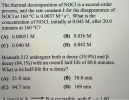
The thermal decomposition of NOCl is a second-order process, and the rate constant k for the disappearance of NOCI at 160 °C is 0.0037 Msl. What is the concentration of NOCI, initially at 0.043 M, after 20.0 minutes at 160 °C? (A) 0.00051 M (B) 0.036 M (C) 0.040 M (D) 0.042 M Bismuth-212 undergoes both a decay (35.9%) and B decay (64.1%) with an overall half-life of 60.6 minutes. What is its half-life for a decay? (A) 21.8...
help
The thermal decomposition of NOCl is a second-order process, and the rate constant k for the disappearance of NOCI at 160 °C is 0.0037 Msl. What is the concentration of NOCI, initially at 0.043 M, after 20.0 minutes at 160 °C? (A) 0.00051 M (B) 0.036 M (C) 0.040 M (D) 0.042 M Bismuth-212 undergoes both a decay (35.9%) and B decay (64.1%) with an overall half-life of 60.6 minutes. What is its half-life for a decay? (A) 21.8...
7) The rate constant for the reaction 2N2O5(g) 25°C 4NO2(g) +O2(g) is k = 3.38x10⁻⁵/s at...
 7) The rate constant for the reaction 2N2O5(g) 25°C 4NO2(g) +O2(g) is k = 3.38x10⁻⁵/s at a) Enter the half-life of N20s in seconds. Use two significant figures and do not enter units b) Enter the total pressure in kPa 10 seconds after initiation of the reaction if initially there was 88.3kPa of pure N2O5 vapor. Use two significant figures and do not enter the units c) Enter the total pressure in kPa 10 minutes after initiation of the reaction...
 The rate constant for the first-order decomposition of N_2O_5 in the xeactron2 N_2O_5(g) rightarroe 4 NO_2(g)+O_2(g) is k_I = 3.38 times 10^-5 s^-1 at 25 degree C. What is the half-life of N205? What will be the pressure, initially 500 Torr, after 50 20 min after initiation of the reaction?
 6. (a) The rate constant for the first-order decomposition of N2Os in the reaction, 2 N2Os(g)-4 NO(g)+0.(g), k-3x10-s at 25°C. What is the half-life of N20s? What will be the pressure, initially 500 bar, at 10 min after initiation of the reaction? (b) Knowing the activation energy of the above reaction is 100 kJ mor', calculate the required reaction temperature at which the reaction rate is doubled. (c) What is the conversion efficiency of N20s at 1 bar and 25...
 Be sure to answer all parts. The reaction 2A rightarrow B is second order in A with a rate constant of 32.1 M^-1 s^-1 at 25 degree C. Starting with [A]0 = 0.00779 M, how long will it take for the concentration of A to drop to 0.001803M? s Calculate the half-life of the reaction for [A]_0 = 0.00779 M. s Calculate the half-life of the reaction for [A)0 = 0.00269 M.
 1) The rate constant for the reaction 2 N,Os(9) = 4 NO (9) + O2(9) is reported in units of sl. What is the overall order of the reaction? 2) The rate law for a reaction was reported as rate=k[A] [B][C] with molar concentrations in moles per cubic decimetre and time in seconds. What are the units of k? 3) The rate constant for the pseudo first-order acid- catalysed hydrolysis of glucose is 4.07' 10-s. Calculate the half-life for the...
 Question 6 (18 marks) (a) Given that the rate constant k for the first-order decomposition of compound X is 2.65 x 10⁻⁹ s', calculate the percentage of compound X that has decomposed in the first 2250 seconds after the reaction begins. (4 marks) (b) Consider the first order reaction: W2 → 2 Y. If [W2]=0.8 M initially and 0.17 M after 160 seconds, what will [W2] be after 350 seconds? (4 marks) (c) Data for the reaction 3A + 5B...
 help
The thermal decomposition of NOCl is a second-order process, and the rate constant k for the disappearance of NOCI at 160 °C is 0.0037 Msl. What is the concentration of NOCI, initially at 0.043 M, after 20.0 minutes at 160 °C? (A) 0.00051 M (B) 0.036 M (C) 0.040 M (D) 0.042 M Bismuth-212 undergoes both a decay (35.9%) and B decay (64.1%) with an overall half-life of 60.6 minutes. What is its half-life for a decay? (A) 21.8...
help
The thermal decomposition of NOCl is a second-order process, and the rate constant k for the disappearance of NOCI at 160 °C is 0.0037 Msl. What is the concentration of NOCI, initially at 0.043 M, after 20.0 minutes at 160 °C? (A) 0.00051 M (B) 0.036 M (C) 0.040 M (D) 0.042 M Bismuth-212 undergoes both a decay (35.9%) and B decay (64.1%) with an overall half-life of 60.6 minutes. What is its half-life for a decay? (A) 21.8...
 7) The rate constant for the reaction 2N2O5(g) 25°C 4NO2(g) +O2(g) is k = 3.38x10⁻⁵/s at a) Enter the half-life of N20s in seconds. Use two significant figures and do not enter units b) Enter the total pressure in kPa 10 seconds after initiation of the reaction if initially there was 88.3kPa of pure N2O5 vapor. Use two significant figures and do not enter the units c) Enter the total pressure in kPa 10 minutes after initiation of the reaction...
Most questions answered within 3 hours.
-
Where is the error in this code sequence?
String s1 = "Hello";
String s2 = "ello";...
asked 11 months ago -
Financial data for Joel de Paris, Inc., for last year
follow:
Joel de Paris, Inc.
Balance...
asked 11 months ago -
Consider this reaction:
Al2(SO4)3 (aq)+ BaCl3
(aq) Al2Cl6 (aq)- +
3BaSO4(s) . What is the...
asked 11 months ago -
Suppose that Savneet is considering increasing her
recent random sample from 20 car rentals to 40...
asked 11 months ago -
Trucks arrive at an unloading terminal at an average rate of 120
per hour.
Trucks arrive...
asked 11 months ago -
Why are methanol and ethanol completely soluble in water while
octanol is not very little soluble....
asked 11 months ago -
A facilities manager at a university reads in a research report
that the mean amount of...
asked 11 months ago -
When the CuSO4 is rehydrated by adding water to the anhydrous
compound, is this an endothermic...
asked 11 months ago -
A ray of sunlight is passing from diamond into crown glass; the
angle of incidence is...
asked 11 months ago -
A block of mass 0.249 kg is placed on top of a light, vertical
spring of...
asked 11 months ago -
how do the kidneys compensate in the presences of acidosis
a) trigger hyperventilate
b) reserve acid...
asked 11 months ago -
Question 501 pts
The rental rate of capital to the firm increases. Which of the
following...
asked 11 months ago