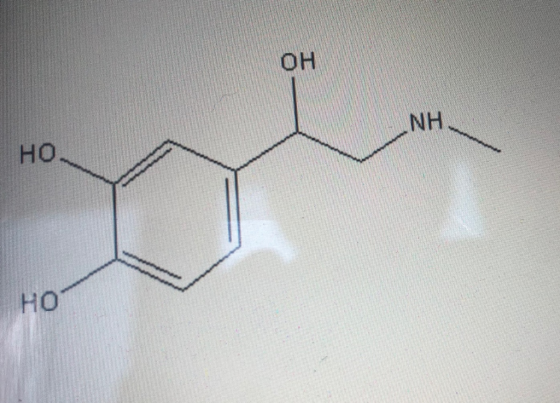
Adrenaline, also called epinephrine, is produced in the body and
circulates in the blood. It affects the autonomic nervous system
(nerves that are not under voluntary control) such as the force of
contractions by the heart or the dilation of the pupils in the eye.
Indicate the number of chiral centres in the adrenaline
molecule.
Homework Answers

Add Answer to:
Adrenaline, also called epinephrine, is produced in the body and
circulates in the blood. It affects...
Create a map or outline of the nervous system and include the required data: Divisions of...
 Create a map or outline of the nervous system and include the
required data:
Divisions of the nervous system and function
Neurotransmitters of the Sympathetic/Parasympathetic Nervous
System
Sympathetic Response/Parasympathetic Response
Example of Adrenergic Rx & It's therapeutic use
Example of Adrenergic Blocker Rx & It's therapeutic
use
Example of Cholinergic Rx & It's therapeutic use
Example of Cholinergic Blocker Rx & therapeutic use
NERVOUS SYSTEM Peripheral Nervous System CENTRAL NERVOUS SYSTEM Consists of: Brain and spinal cord All the rest...
Create a map or outline of the nervous system and include the
required data:
Divisions of the nervous system and function
Neurotransmitters of the Sympathetic/Parasympathetic Nervous
System
Sympathetic Response/Parasympathetic Response
Example of Adrenergic Rx & It's therapeutic use
Example of Adrenergic Blocker Rx & It's therapeutic
use
Example of Cholinergic Rx & It's therapeutic use
Example of Cholinergic Blocker Rx & therapeutic use
NERVOUS SYSTEM Peripheral Nervous System CENTRAL NERVOUS SYSTEM Consists of: Brain and spinal cord All the rest...
Can you please help me to find Possible test questions? Course Here.com Test #4 " Autonomic...
 Can you please help me to find Possible test questions?
Course Here.com Test #4 " Autonomic Nervous System Overview of the Autonomic Nervous System (ANSH Maior Functions: maintain optimal muscle in order to maintain homeostatic state within the body Aalso is inv performance of visceral organs, glands, smooth muscle, and cardiac not under conscious control: regulates heart rate, blood pressure, MOST "effectors" (organs & tissues regulated) are visceral- r function, and secretions emperaturs smooth musele contraction, glandula most are not...
Can you please help me to find Possible test questions?
Course Here.com Test #4 " Autonomic Nervous System Overview of the Autonomic Nervous System (ANSH Maior Functions: maintain optimal muscle in order to maintain homeostatic state within the body Aalso is inv performance of visceral organs, glands, smooth muscle, and cardiac not under conscious control: regulates heart rate, blood pressure, MOST "effectors" (organs & tissues regulated) are visceral- r function, and secretions emperaturs smooth musele contraction, glandula most are not...
Please answer all questions. Thank You? 31) Sympathetic nerve stimulation and epinephrine heart activity. A) increase...
 Please answer all questions. Thank You?
31) Sympathetic nerve stimulation and epinephrine heart activity. A) increase B) decrease C) have no effect on D) The heart responds to hormones, but not to nerve stimulation. E) The heart responds to nerve stimulation, but not to hormones. 52) Rheumatic Tever is a bacterial disease that can result in degeneration of heart valves. That would cause A) slower heartbeat. B) uncoordinated attraction of ventricles. C) faster heart beat. D) backfire of blood from...
Please answer all questions. Thank You?
31) Sympathetic nerve stimulation and epinephrine heart activity. A) increase B) decrease C) have no effect on D) The heart responds to hormones, but not to nerve stimulation. E) The heart responds to nerve stimulation, but not to hormones. 52) Rheumatic Tever is a bacterial disease that can result in degeneration of heart valves. That would cause A) slower heartbeat. B) uncoordinated attraction of ventricles. C) faster heart beat. D) backfire of blood from...
Hi, please help me with my homework and please do not answer if you intend to...
 Hi, please help me with my homework and please do not answer
if you intend to answers all the questions. Thank you
The Central Nervous System, endocrine system B. Figure 1 Use the diagram above to answer the following question 1) Which letter indicates the primary visual cortex, which receives information from neurons in the retina of the eye? A) A B) B C) C D) D E) E Figure 2 Use the diagram above to answer the following questions....
Hi, please help me with my homework and please do not answer
if you intend to answers all the questions. Thank you
The Central Nervous System, endocrine system B. Figure 1 Use the diagram above to answer the following question 1) Which letter indicates the primary visual cortex, which receives information from neurons in the retina of the eye? A) A B) B C) C D) D E) E Figure 2 Use the diagram above to answer the following questions....
1. According to the paper, what does lactate dehydrogenase (LDH) do and what does it allow...
 1. According to the paper, what does lactate dehydrogenase
(LDH) do and what does it allow to happen within the myofiber? (5
points)
2. According to the paper, what is the major disadvantage of
relying on glycolysis during high-intensity exercise? (5
points)
3. Using Figure 1 in the paper, briefly describe the different
sources of ATP production at 50% versus 90% AND explain whether you
believe this depiction of ATP production applies to a Type IIX
myofiber in a human....
1. According to the paper, what does lactate dehydrogenase
(LDH) do and what does it allow to happen within the myofiber? (5
points)
2. According to the paper, what is the major disadvantage of
relying on glycolysis during high-intensity exercise? (5
points)
3. Using Figure 1 in the paper, briefly describe the different
sources of ATP production at 50% versus 90% AND explain whether you
believe this depiction of ATP production applies to a Type IIX
myofiber in a human....
 Create a map or outline of the nervous system and include the
required data:
Divisions of the nervous system and function
Neurotransmitters of the Sympathetic/Parasympathetic Nervous
System
Sympathetic Response/Parasympathetic Response
Example of Adrenergic Rx & It's therapeutic use
Example of Adrenergic Blocker Rx & It's therapeutic
use
Example of Cholinergic Rx & It's therapeutic use
Example of Cholinergic Blocker Rx & therapeutic use
NERVOUS SYSTEM Peripheral Nervous System CENTRAL NERVOUS SYSTEM Consists of: Brain and spinal cord All the rest...
Create a map or outline of the nervous system and include the
required data:
Divisions of the nervous system and function
Neurotransmitters of the Sympathetic/Parasympathetic Nervous
System
Sympathetic Response/Parasympathetic Response
Example of Adrenergic Rx & It's therapeutic use
Example of Adrenergic Blocker Rx & It's therapeutic
use
Example of Cholinergic Rx & It's therapeutic use
Example of Cholinergic Blocker Rx & therapeutic use
NERVOUS SYSTEM Peripheral Nervous System CENTRAL NERVOUS SYSTEM Consists of: Brain and spinal cord All the rest...
 Can you please help me to find Possible test questions?
Course Here.com Test #4 " Autonomic Nervous System Overview of the Autonomic Nervous System (ANSH Maior Functions: maintain optimal muscle in order to maintain homeostatic state within the body Aalso is inv performance of visceral organs, glands, smooth muscle, and cardiac not under conscious control: regulates heart rate, blood pressure, MOST "effectors" (organs & tissues regulated) are visceral- r function, and secretions emperaturs smooth musele contraction, glandula most are not...
Can you please help me to find Possible test questions?
Course Here.com Test #4 " Autonomic Nervous System Overview of the Autonomic Nervous System (ANSH Maior Functions: maintain optimal muscle in order to maintain homeostatic state within the body Aalso is inv performance of visceral organs, glands, smooth muscle, and cardiac not under conscious control: regulates heart rate, blood pressure, MOST "effectors" (organs & tissues regulated) are visceral- r function, and secretions emperaturs smooth musele contraction, glandula most are not...
 Please answer all questions. Thank You?
31) Sympathetic nerve stimulation and epinephrine heart activity. A) increase B) decrease C) have no effect on D) The heart responds to hormones, but not to nerve stimulation. E) The heart responds to nerve stimulation, but not to hormones. 52) Rheumatic Tever is a bacterial disease that can result in degeneration of heart valves. That would cause A) slower heartbeat. B) uncoordinated attraction of ventricles. C) faster heart beat. D) backfire of blood from...
Please answer all questions. Thank You?
31) Sympathetic nerve stimulation and epinephrine heart activity. A) increase B) decrease C) have no effect on D) The heart responds to hormones, but not to nerve stimulation. E) The heart responds to nerve stimulation, but not to hormones. 52) Rheumatic Tever is a bacterial disease that can result in degeneration of heart valves. That would cause A) slower heartbeat. B) uncoordinated attraction of ventricles. C) faster heart beat. D) backfire of blood from...
 Hi, please help me with my homework and please do not answer
if you intend to answers all the questions. Thank you
The Central Nervous System, endocrine system B. Figure 1 Use the diagram above to answer the following question 1) Which letter indicates the primary visual cortex, which receives information from neurons in the retina of the eye? A) A B) B C) C D) D E) E Figure 2 Use the diagram above to answer the following questions....
Hi, please help me with my homework and please do not answer
if you intend to answers all the questions. Thank you
The Central Nervous System, endocrine system B. Figure 1 Use the diagram above to answer the following question 1) Which letter indicates the primary visual cortex, which receives information from neurons in the retina of the eye? A) A B) B C) C D) D E) E Figure 2 Use the diagram above to answer the following questions....
 1. According to the paper, what does lactate dehydrogenase
(LDH) do and what does it allow to happen within the myofiber? (5
points)
2. According to the paper, what is the major disadvantage of
relying on glycolysis during high-intensity exercise? (5
points)
3. Using Figure 1 in the paper, briefly describe the different
sources of ATP production at 50% versus 90% AND explain whether you
believe this depiction of ATP production applies to a Type IIX
myofiber in a human....
1. According to the paper, what does lactate dehydrogenase
(LDH) do and what does it allow to happen within the myofiber? (5
points)
2. According to the paper, what is the major disadvantage of
relying on glycolysis during high-intensity exercise? (5
points)
3. Using Figure 1 in the paper, briefly describe the different
sources of ATP production at 50% versus 90% AND explain whether you
believe this depiction of ATP production applies to a Type IIX
myofiber in a human....
Most questions answered within 3 hours.
-
Where is the error in this code sequence?
String s1 = "Hello";
String s2 = "ello";...
asked 10 months ago -
Financial data for Joel de Paris, Inc., for last year
follow:
Joel de Paris, Inc.
Balance...
asked 10 months ago -
Consider this reaction:
Al2(SO4)3 (aq)+ BaCl3
(aq) Al2Cl6 (aq)- +
3BaSO4(s) . What is the...
asked 10 months ago -
Suppose that Savneet is considering increasing her
recent random sample from 20 car rentals to 40...
asked 10 months ago -
Trucks arrive at an unloading terminal at an average rate of 120
per hour.
Trucks arrive...
asked 10 months ago -
Why are methanol and ethanol completely soluble in water while
octanol is not very little soluble....
asked 10 months ago -
A facilities manager at a university reads in a research report
that the mean amount of...
asked 10 months ago -
When the CuSO4 is rehydrated by adding water to the anhydrous
compound, is this an endothermic...
asked 10 months ago -
A ray of sunlight is passing from diamond into crown glass; the
angle of incidence is...
asked 10 months ago -
A block of mass 0.249 kg is placed on top of a light, vertical
spring of...
asked 10 months ago -
how do the kidneys compensate in the presences of acidosis
a) trigger hyperventilate
b) reserve acid...
asked 10 months ago -
Question 501 pts
The rental rate of capital to the firm increases. Which of the
following...
asked 10 months ago