The electric potential at a point that is halfway between two identical charged particles is 330...
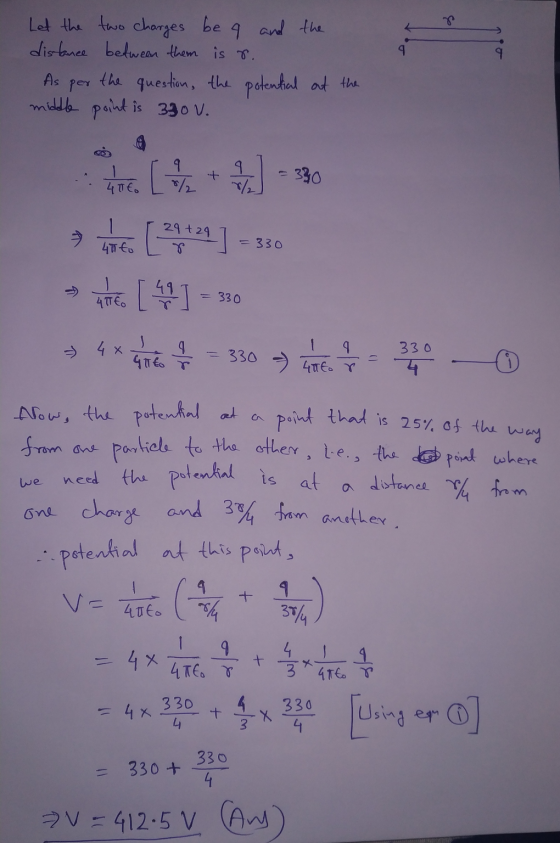
The electric potential at a point that is halfway between two identical charged particles is 330 V.
What is the potential at a point that is 25%% of the way from one particle to the other?
Homework Answers
Add Answer to:
The electric potential at a point that is halfway between two
identical charged particles is 330...
Two identical charged particles separated by a distance R have a point exactly in the middle...
Two identical charged particles separated by a distance R have a point exactly in the middle which has an electrical potential of 500V. What is the potential at a point that is R/6 of the way from one particle to the other? V (Volts)
Four identical charged particles (q = +20.0 C) are located on the corners of a rectangle...
 Four identical charged particles (q = +20.0 C) are located on the corners of a rectangle as shown in the figure below. The dimensions of the rectangle are L = 59.0 cm and W = 10.0 cm. Calculate the change in electric potential energy of the system as the particle at the lower left corner in the figure is brought to this position from infinitely far away. Assume the other three particles in the figure below remain fixed in position....
6.Four identical charged particles (q = +20.0 µC) are located on the corners of a rectangle...
6.Four identical charged particles (q = +20.0 µC) are located on the corners of a rectangle as shown in the figure below. The dimensions of the rectangle are L = 61.0 cm and W = 13.0cm. Calculate the change in electric potential energy of the system as the particle at the lower left corner in the figure is brought to this position from infinitely far away. Assume the other three particles in the figure below remain fixed in position. J
Four identical charged particles (q = +19.0 μC) are located on the corners of a rectangle...
 Four identical charged particles (q = +19.0 μC) are located on the corners of a rectangle as shown in the figure below. The dimensions of the rectangle are L = 61.0 cm and W = 12.0 cm. Calculate the change in electric potential energy of the system as the particle at the lower left corner in the figure is brought to this position from infinitely far away. Assume the other three particles in the figure below remain fixed in position...
A particle with charge q is placed halfway between two other particles, each of charge Q....
A particle with charge q is placed halfway between two other particles, each of charge Q. The distance between q and Q is a distance of d. If all three particles experience zero net force, what is the value of Q in terms of q? Draw picture with calculations please.
A particle with negative charge "q" is placed halfway between two other particles, each of charge...
 A particle with negative charge "q" is placed halfway between
two other particles, each of charge Q ("Q1" and
"Q2"). The distance between Q1 and charge q
is a distance of d. If all three particles experience a
net force of zero, what is the value of Q in terms of q?
Help with dimensional analysis?
na 2.
A particle with negative charge "q" is placed halfway between
two other particles, each of charge Q ("Q1" and
"Q2"). The distance between Q1 and charge q
is a distance of d. If all three particles experience a
net force of zero, what is the value of Q in terms of q?
Help with dimensional analysis?
na 2.
A particle with negative charge "q" is placed halfway between two other particles, each of charge...
A particle with negative charge "q" is placed halfway between two other particles, each of charge Q ("Q1" and "Q2"). The distance between Q1 and charge q is a distance of d. If all three particles experience a net force of zero, what is the value of Q in terms of q? I would appreciate if a dimensional analysis could be added to this.
An electrically neutral molecule is collinear with (and located between) two charged particles, one carrying a...
An electrically neutral molecule is collinear with (and located between) two charged particles, one carrying a charge of +3.56 μC and the other carrying a charge of -1.05 μC. The center of the molecule is 2.57 μm from each particle. Part A If the vector sum of the electric forces exerted on the molecule is 45.0 nN , what is the polarizability of the molecule? Express your answer using two significant digits. α =
Please help me with this Problem. Thank you so much! Two charged particles create an electric...
 Please help me with this Problem. Thank you
so much!
Two charged particles create an electric potential, and everywhere in the xy-plane this potential is described by the following function. 24.0 V 41.0 V V = (x + 1.51 m)2 + y2 x2 + (y – 2.96 m)2 Determine the charge and coordinates for the position of the two particles. Give the charge (in nC) and coordinates (in m) for the position of the particle responsible for the first term...
Please help me with this Problem. Thank you
so much!
Two charged particles create an electric potential, and everywhere in the xy-plane this potential is described by the following function. 24.0 V 41.0 V V = (x + 1.51 m)2 + y2 x2 + (y – 2.96 m)2 Determine the charge and coordinates for the position of the two particles. Give the charge (in nC) and coordinates (in m) for the position of the particle responsible for the first term...
Why is the following situation impossible? Two identical dust particles of mass 1.00 µg are floating...
Why is the following situation impossible? Two identical dust particles of mass 1.00 µg are floating in empty space, far from any external sources of large gravitational or electric fields, and at rest with respect to each other. Both particles carry electric charges that are identical in magnitude and sign. The gravitational and electric forces between the particles happen to have the same magnitude, so each particle experiences zero net force and the distance between the particles remains constant.
 Four identical charged particles (q = +20.0 C) are located on the corners of a rectangle as shown in the figure below. The dimensions of the rectangle are L = 59.0 cm and W = 10.0 cm. Calculate the change in electric potential energy of the system as the particle at the lower left corner in the figure is brought to this position from infinitely far away. Assume the other three particles in the figure below remain fixed in position....
 Four identical charged particles (q = +19.0 μC) are located on the corners of a rectangle as shown in the figure below. The dimensions of the rectangle are L = 61.0 cm and W = 12.0 cm. Calculate the change in electric potential energy of the system as the particle at the lower left corner in the figure is brought to this position from infinitely far away. Assume the other three particles in the figure below remain fixed in position...
 A particle with negative charge "q" is placed halfway between
two other particles, each of charge Q ("Q1" and
"Q2"). The distance between Q1 and charge q
is a distance of d. If all three particles experience a
net force of zero, what is the value of Q in terms of q?
Help with dimensional analysis?
na 2.
A particle with negative charge "q" is placed halfway between
two other particles, each of charge Q ("Q1" and
"Q2"). The distance between Q1 and charge q
is a distance of d. If all three particles experience a
net force of zero, what is the value of Q in terms of q?
Help with dimensional analysis?
na 2.
 Please help me with this Problem. Thank you
so much!
Two charged particles create an electric potential, and everywhere in the xy-plane this potential is described by the following function. 24.0 V 41.0 V V = (x + 1.51 m)2 + y2 x2 + (y – 2.96 m)2 Determine the charge and coordinates for the position of the two particles. Give the charge (in nC) and coordinates (in m) for the position of the particle responsible for the first term...
Please help me with this Problem. Thank you
so much!
Two charged particles create an electric potential, and everywhere in the xy-plane this potential is described by the following function. 24.0 V 41.0 V V = (x + 1.51 m)2 + y2 x2 + (y – 2.96 m)2 Determine the charge and coordinates for the position of the two particles. Give the charge (in nC) and coordinates (in m) for the position of the particle responsible for the first term...
Most questions answered within 3 hours.
-
Where is the error in this code sequence?
String s1 = "Hello";
String s2 = "ello";...
asked 11 months ago -
Financial data for Joel de Paris, Inc., for last year
follow:
Joel de Paris, Inc.
Balance...
asked 11 months ago -
Consider this reaction:
Al2(SO4)3 (aq)+ BaCl3
(aq) Al2Cl6 (aq)- +
3BaSO4(s) . What is the...
asked 11 months ago -
Suppose that Savneet is considering increasing her
recent random sample from 20 car rentals to 40...
asked 11 months ago -
Trucks arrive at an unloading terminal at an average rate of 120
per hour.
Trucks arrive...
asked 11 months ago -
Why are methanol and ethanol completely soluble in water while
octanol is not very little soluble....
asked 11 months ago -
A facilities manager at a university reads in a research report
that the mean amount of...
asked 11 months ago -
When the CuSO4 is rehydrated by adding water to the anhydrous
compound, is this an endothermic...
asked 11 months ago -
A ray of sunlight is passing from diamond into crown glass; the
angle of incidence is...
asked 11 months ago -
A block of mass 0.249 kg is placed on top of a light, vertical
spring of...
asked 11 months ago -
how do the kidneys compensate in the presences of acidosis
a) trigger hyperventilate
b) reserve acid...
asked 11 months ago -
Question 501 pts
The rental rate of capital to the firm increases. Which of the
following...
asked 11 months ago