
Homework Answers
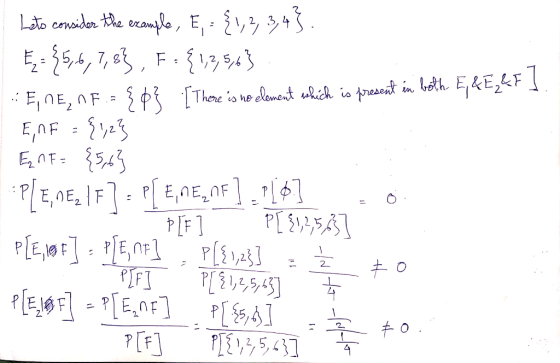
![1P [5, 084)F] + P[5,1F ] P[E.)F] [Disopened long Counter Example ] :P[E, NE 1F ] = PLENE, OF] P[E] P[E.] P[F] [98 €78.E,&F P[](http://img.homeworklib.com/questions/b7337810-c6d8-11ea-9bee-23f22fbdd451.png?x-oss-process=image/resize,w_560)
Add Answer to:
3. Suppose E, and Eare independent. Either give a counter example or demonstrate that P(En E2|F)...
(1 point) If P(En F) = 0.036, P(E|F) = 0.12, and P(F|E) = 0.4, then (a)...
 (1 point) If P(En F) = 0.036, P(E|F) = 0.12, and P(F|E) = 0.4, then (a) P(E) = (b) P(F) = (c) P(EUF) = (d) Are the events E and F independent? Enter yes or no
Suppose that events E and F are independent, P(E)=0.7, and P(F)=0.8. What is the P(E and F)? The probability P(E and F...
Suppose that events E and F are independent, P(E)=0.7, and P(F)=0.8. What is the P(E and F)? The probability P(E and F) is ______
Suppose that events E and F are independent, P(E) 0.3, and P(F) 0.8. What is the...
 Suppose that events E and F are independent, P(E) 0.3, and P(F) 0.8. What is the P(E and F)? The probability P(E and F) is (Type an integer or a decimal.)
2. 15 pts] Suppose E,, E. , En are independent events. Prove that に!
 2. 15 pts] Suppose E,, E. , En are independent events. Prove that に!
Suppose P (E) = 3/7 and P (F ) = 2/7 . Each of the following...
Suppose P (E) = 3/7 and P (F ) = 2/7 . Each of the following answers should be given as 77 a single fraction. (a) [6 pts] If E and F are independent events, find P (E ∩ F ). (b) [6 pts] If E and F are mutually exclusive events, find P (E ∪ F ). (Do not assume independence for this part.)
Decide whether each statement is true or false and explain your reasoning. Give a counter-example...
 Decide whether each statement is true or false and explain your reasoning. Give a counter-example for false statements. The matrices A and B are n x n. a. The equation Ax b must have at least one solution for all b e R". b. IfAx-0 has only the trivial solution, then A is row equivalent to the n x p, identity matrix. c. If A is invertible, then the columns of A-1 are linearly independent. d. If A is invertible,...
Let E and F be two events of an experiment with sample space S. Suppose P(E)= 0.4,...
Let E and F be two events of an experiment with sample space S. Suppose P(E)= 0.4, P(F)=0.3, P(E U F) =0.5, Find P(F|E) and determine if the two events are independent. A) P(F|E)= 3/4, E and F are independent. B) P(F|E)= 3/4, E and F are not independent. C) P(F|E)=1/2 , E and F are independent. D) P(F|E)= 1/2, E and F are not independent.
24) If events E, F & G are mutually independent, and P(E)P(F) P(G).3, then P(EF I...
 24) If events E, F & G are mutually independent, and P(E)P(F) P(G).3, then P(EF I G) a).16 b).18 c).20 d).21 e).24
Suppose E and F are independent events. Find Pr[E′∩F] if Pr[E]=1/3 and Pr[F]=1/3 A and B...
Suppose E and F are independent events. Find Pr[E′∩F] if Pr[E]=1/3 and Pr[F]=1/3 A and B are independent events. If Pr(A∩B)=0.24 and Pr[A]=0.3, what is Pr[B]?
Suppose that E, F, and G are events with P(E) = 8/25 , P(F) = 11/50...
Suppose that E, F, and G are events with P(E) = 8/25 , P(F) = 11/50 , P(G) = 23/100 , E and F are mutually exclusive, E and G are independent, and P(F | G) = 20/23 . Find P(E ∪ F ∪ G).
 (1 point) If P(En F) = 0.036, P(E|F) = 0.12, and P(F|E) = 0.4, then (a) P(E) = (b) P(F) = (c) P(EUF) = (d) Are the events E and F independent? Enter yes or no
 Suppose that events E and F are independent, P(E) 0.3, and P(F) 0.8. What is the P(E and F)? The probability P(E and F) is (Type an integer or a decimal.)
 2. 15 pts] Suppose E,, E. , En are independent events. Prove that に!
 Decide whether each statement is true or false and explain your reasoning. Give a counter-example for false statements. The matrices A and B are n x n. a. The equation Ax b must have at least one solution for all b e R". b. IfAx-0 has only the trivial solution, then A is row equivalent to the n x p, identity matrix. c. If A is invertible, then the columns of A-1 are linearly independent. d. If A is invertible,...
 24) If events E, F & G are mutually independent, and P(E)P(F) P(G).3, then P(EF I G) a).16 b).18 c).20 d).21 e).24
Most questions answered within 3 hours.
-
Where is the error in this code sequence?
String s1 = "Hello";
String s2 = "ello";...
asked 10 months ago -
Financial data for Joel de Paris, Inc., for last year
follow:
Joel de Paris, Inc.
Balance...
asked 10 months ago -
Consider this reaction:
Al2(SO4)3 (aq)+ BaCl3
(aq) Al2Cl6 (aq)- +
3BaSO4(s) . What is the...
asked 10 months ago -
Suppose that Savneet is considering increasing her
recent random sample from 20 car rentals to 40...
asked 10 months ago -
Trucks arrive at an unloading terminal at an average rate of 120
per hour.
Trucks arrive...
asked 10 months ago -
Why are methanol and ethanol completely soluble in water while
octanol is not very little soluble....
asked 10 months ago -
A facilities manager at a university reads in a research report
that the mean amount of...
asked 10 months ago -
When the CuSO4 is rehydrated by adding water to the anhydrous
compound, is this an endothermic...
asked 10 months ago -
A ray of sunlight is passing from diamond into crown glass; the
angle of incidence is...
asked 10 months ago -
A block of mass 0.249 kg is placed on top of a light, vertical
spring of...
asked 10 months ago -
how do the kidneys compensate in the presences of acidosis
a) trigger hyperventilate
b) reserve acid...
asked 10 months ago -
Question 501 pts
The rental rate of capital to the firm increases. Which of the
following...
asked 10 months ago