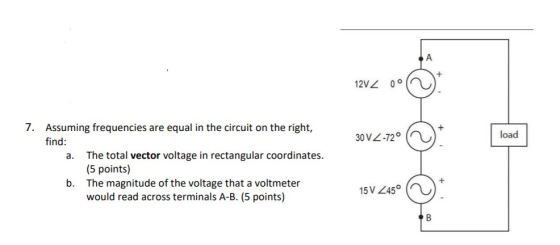
Assuming frequencies are equal in the circuit on the right, find:
a. The total vector voltage in rectangular coordinates.
b. The magnitude of the voltage that a voltmeter would read across terminals A-B.
Homework Answers
Request Answer!
We need at least 10 more requests to produce the answer.
0 / 10 have requested this problem solution
The more requests, the faster the answer.
Add Answer to:
Assuming frequencies are equal in the circuit on the right,
find:
a. The total vector voltage...
(a) The following circuit shows a linear voltage regulator. Assuming the zener diode has specifications (VZ = 2.5 V, IZ...
 (a) The following circuit shows a linear
voltage regulator. Assuming the zener diode has specifications (VZ
= 2.5 V, IZ = 60 mA), select adequate resistor values to provide a
regulated output voltage Vo = 10 V from an unregulated voltage Vi =
15V.
(b) Calculate the power efficiency of the
regulator when a load RL = 10Ω is connected to the regulator
output.
(c) Briefly explain the terms “dropout”, “line
regulation”, and “load regulation”, as they apply to voltage...
(a) The following circuit shows a linear
voltage regulator. Assuming the zener diode has specifications (VZ
= 2.5 V, IZ = 60 mA), select adequate resistor values to provide a
regulated output voltage Vo = 10 V from an unregulated voltage Vi =
15V.
(b) Calculate the power efficiency of the
regulator when a load RL = 10Ω is connected to the regulator
output.
(c) Briefly explain the terms “dropout”, “line
regulation”, and “load regulation”, as they apply to voltage...
Q1. (3 marks) In the circuit shown below, R-1.5KO and the voltage drop across Ri is...
 Q1. (3 marks) In the circuit shown below, R-1.5KO and the voltage drop across Ri is 4.5V. (1 pt.) A. What is the voltage drop across R? (1 pt.) B. What is the value of the resistance R? (1 pt.) C. What is the power delivered by the source voltage? S Answer: wwiw R Ri Vs=15V Q2. (3 marks) Refer to the circuit below. A. Using the voltage divider law, find the voltage between the points A and B. B....
For the given circuit, find the following: The total load resistance of the circuit between circuit...
 For the given circuit, find the following:
The total load resistance of the circuit between circuit points
a and b.
The current through each resistor.
The voltage across each resistor.
The power dissipated by each resistor.
The power supplied by the battery.
The terminal voltage, Vab.
Please be as detailed as possible and explain each
step.
10.0 Ω - 8.0 Ω 6.0 Ω 4.0 Ω LW 5.0 Ω a r=0.50 Ω - L (a) & = 9.0V
For the given circuit, find the following:
The total load resistance of the circuit between circuit points
a and b.
The current through each resistor.
The voltage across each resistor.
The power dissipated by each resistor.
The power supplied by the battery.
The terminal voltage, Vab.
Please be as detailed as possible and explain each
step.
10.0 Ω - 8.0 Ω 6.0 Ω 4.0 Ω LW 5.0 Ω a r=0.50 Ω - L (a) & = 9.0V
4. Refer to the following amplifier assuming β-150 for Q1 an d Q2, and β-50 for Q3. (a) Find the total voltage gain in dB (20 points) (b) Find the total power gain dB (20 points) (c) Find the pow...
 4. Refer to the following amplifier assuming β-150 for Q1 an d Q2, and β-50 for Q3. (a) Find the total voltage gain in dB (20 points) (b) Find the total power gain dB (20 points) (c) Find the power efficiency (20 points) +15V Ry Ri Rc 0.22 μF ei 2, 1.0μF 47 Ω 500 mVppn 15 k2 Res 100μF 16Ω 2 W 1.0 kHz Ca RE: 160
4. Refer to the following amplifier assuming β-150 for Q1 an d...
4. Refer to the following amplifier assuming β-150 for Q1 an d Q2, and β-50 for Q3. (a) Find the total voltage gain in dB (20 points) (b) Find the total power gain dB (20 points) (c) Find the power efficiency (20 points) +15V Ry Ri Rc 0.22 μF ei 2, 1.0μF 47 Ω 500 mVppn 15 k2 Res 100μF 16Ω 2 W 1.0 kHz Ca RE: 160
4. Refer to the following amplifier assuming β-150 for Q1 an d...
HOMEWORK FOR LAB 7 KIRCHHOFF'S CIRCUIT RULES Find the equivalent resistance of the followine etwock. Alles...
 HOMEWORK FOR LAB 7 KIRCHHOFF'S CIRCUIT RULES Find the equivalent resistance of the followine etwock. Alles in ohms.) Show your work below. 1. network (All resistances are potential 2. Show on the circuit diagram in Question 1 how you would connect a mu meter to measure the current through the 8-n resistor a. Explain why the multimeter is connected in this way. has a low vesitity so it would difference. b. What characteristic of a good multimeter allows you to...
For the circuit shown, find the following: a) v(0+), the voltage across the capacitor right after...
 For the circuit shown, find the following: a) v(0+), the voltage across the capacitor right after the switch closes. b) v), the voltage across the capacitor after the switch has been closed for a long time. c) v(T), the voltage across the capacitor after one time constant. 2. 3 S2 I(t) 12 V+ 6 Ω 0.5 F u(t) 3. For the circuit above, write the differential equation for t > 0.
constant, find the power delivered to the wire 9-2 In the circuit on the right, find a. the equivalent resistance between points a and b b. the voltage across the 7 1-2 on resistor o c. the curren...
 constant, find the power delivered to the wire 9-2 In the circuit on the right, find a. the equivalent resistance between points a and b b. the voltage across the 7 1-2 on resistor o c. the current in the 6 resistor d. the potential difference between points a and c, that is Ve-Va 3-n ㄟˋ 4o.oV
constant, find the power delivered to the wire 9-2 In the circuit on the right, find a. the equivalent resistance between points a...
constant, find the power delivered to the wire 9-2 In the circuit on the right, find a. the equivalent resistance between points a and b b. the voltage across the 7 1-2 on resistor o c. the current in the 6 resistor d. the potential difference between points a and c, that is Ve-Va 3-n ㄟˋ 4o.oV
constant, find the power delivered to the wire 9-2 In the circuit on the right, find a. the equivalent resistance between points a...
a) Use the node-voltage method to find the magnitude of total power developed in the circuit....
 a) Use the node-voltage method to find the magnitude of total
power developed in the circuit.
b) Find the magnitude of the total power absorbed in the
circuit
Consider the circuit shown in (Figure 1). Suppose that R-1300 Ω and k-2500 Figure 200 Ω 20 mA kis
a) Use the node-voltage method to find the magnitude of total
power developed in the circuit.
b) Find the magnitude of the total power absorbed in the
circuit
Consider the circuit shown in (Figure 1). Suppose that R-1300 Ω and k-2500 Figure 200 Ω 20 mA kis
10kΩ 3) Use the circuit to the right. The source's voltage is V = 50V 230...
 10kΩ 3) Use the circuit to the right. The source's voltage is V = 50V 230 a) (10pts) Find the capacitor value to make the circuit resonate at 1.5MHz. 20uH Vs с b) (10pts) Find the circuit current at resonance (magnitude and phase). c) (10pts) Find the circuit's total real (average) power at resonance. d) (10pts) Find the circuit's total reactive power at resonance.
Calculate the voltage at points A, B, and C, in the following circuit. Find the power...
 Calculate the voltage at points A, B, and C, in the following circuit. Find the power dissipated by each resistor. 6 V Calculate the total current I flowing through the following circuit segment. Then, find the voltage drop across each resistor. -18 V 12 kΩ 12 k
 (a) The following circuit shows a linear
voltage regulator. Assuming the zener diode has specifications (VZ
= 2.5 V, IZ = 60 mA), select adequate resistor values to provide a
regulated output voltage Vo = 10 V from an unregulated voltage Vi =
15V.
(b) Calculate the power efficiency of the
regulator when a load RL = 10Ω is connected to the regulator
output.
(c) Briefly explain the terms “dropout”, “line
regulation”, and “load regulation”, as they apply to voltage...
(a) The following circuit shows a linear
voltage regulator. Assuming the zener diode has specifications (VZ
= 2.5 V, IZ = 60 mA), select adequate resistor values to provide a
regulated output voltage Vo = 10 V from an unregulated voltage Vi =
15V.
(b) Calculate the power efficiency of the
regulator when a load RL = 10Ω is connected to the regulator
output.
(c) Briefly explain the terms “dropout”, “line
regulation”, and “load regulation”, as they apply to voltage...
 Q1. (3 marks) In the circuit shown below, R-1.5KO and the voltage drop across Ri is 4.5V. (1 pt.) A. What is the voltage drop across R? (1 pt.) B. What is the value of the resistance R? (1 pt.) C. What is the power delivered by the source voltage? S Answer: wwiw R Ri Vs=15V Q2. (3 marks) Refer to the circuit below. A. Using the voltage divider law, find the voltage between the points A and B. B....
 For the given circuit, find the following:
The total load resistance of the circuit between circuit points
a and b.
The current through each resistor.
The voltage across each resistor.
The power dissipated by each resistor.
The power supplied by the battery.
The terminal voltage, Vab.
Please be as detailed as possible and explain each
step.
10.0 Ω - 8.0 Ω 6.0 Ω 4.0 Ω LW 5.0 Ω a r=0.50 Ω - L (a) & = 9.0V
For the given circuit, find the following:
The total load resistance of the circuit between circuit points
a and b.
The current through each resistor.
The voltage across each resistor.
The power dissipated by each resistor.
The power supplied by the battery.
The terminal voltage, Vab.
Please be as detailed as possible and explain each
step.
10.0 Ω - 8.0 Ω 6.0 Ω 4.0 Ω LW 5.0 Ω a r=0.50 Ω - L (a) & = 9.0V
 4. Refer to the following amplifier assuming β-150 for Q1 an d Q2, and β-50 for Q3. (a) Find the total voltage gain in dB (20 points) (b) Find the total power gain dB (20 points) (c) Find the power efficiency (20 points) +15V Ry Ri Rc 0.22 μF ei 2, 1.0μF 47 Ω 500 mVppn 15 k2 Res 100μF 16Ω 2 W 1.0 kHz Ca RE: 160
4. Refer to the following amplifier assuming β-150 for Q1 an d...
4. Refer to the following amplifier assuming β-150 for Q1 an d Q2, and β-50 for Q3. (a) Find the total voltage gain in dB (20 points) (b) Find the total power gain dB (20 points) (c) Find the power efficiency (20 points) +15V Ry Ri Rc 0.22 μF ei 2, 1.0μF 47 Ω 500 mVppn 15 k2 Res 100μF 16Ω 2 W 1.0 kHz Ca RE: 160
4. Refer to the following amplifier assuming β-150 for Q1 an d...
 HOMEWORK FOR LAB 7 KIRCHHOFF'S CIRCUIT RULES Find the equivalent resistance of the followine etwock. Alles in ohms.) Show your work below. 1. network (All resistances are potential 2. Show on the circuit diagram in Question 1 how you would connect a mu meter to measure the current through the 8-n resistor a. Explain why the multimeter is connected in this way. has a low vesitity so it would difference. b. What characteristic of a good multimeter allows you to...
 For the circuit shown, find the following: a) v(0+), the voltage across the capacitor right after the switch closes. b) v), the voltage across the capacitor after the switch has been closed for a long time. c) v(T), the voltage across the capacitor after one time constant. 2. 3 S2 I(t) 12 V+ 6 Ω 0.5 F u(t) 3. For the circuit above, write the differential equation for t > 0.
 constant, find the power delivered to the wire 9-2 In the circuit on the right, find a. the equivalent resistance between points a and b b. the voltage across the 7 1-2 on resistor o c. the current in the 6 resistor d. the potential difference between points a and c, that is Ve-Va 3-n ㄟˋ 4o.oV
constant, find the power delivered to the wire 9-2 In the circuit on the right, find a. the equivalent resistance between points a...
constant, find the power delivered to the wire 9-2 In the circuit on the right, find a. the equivalent resistance between points a and b b. the voltage across the 7 1-2 on resistor o c. the current in the 6 resistor d. the potential difference between points a and c, that is Ve-Va 3-n ㄟˋ 4o.oV
constant, find the power delivered to the wire 9-2 In the circuit on the right, find a. the equivalent resistance between points a...
 a) Use the node-voltage method to find the magnitude of total
power developed in the circuit.
b) Find the magnitude of the total power absorbed in the
circuit
Consider the circuit shown in (Figure 1). Suppose that R-1300 Ω and k-2500 Figure 200 Ω 20 mA kis
a) Use the node-voltage method to find the magnitude of total
power developed in the circuit.
b) Find the magnitude of the total power absorbed in the
circuit
Consider the circuit shown in (Figure 1). Suppose that R-1300 Ω and k-2500 Figure 200 Ω 20 mA kis
 10kΩ 3) Use the circuit to the right. The source's voltage is V = 50V 230 a) (10pts) Find the capacitor value to make the circuit resonate at 1.5MHz. 20uH Vs с b) (10pts) Find the circuit current at resonance (magnitude and phase). c) (10pts) Find the circuit's total real (average) power at resonance. d) (10pts) Find the circuit's total reactive power at resonance.
 Calculate the voltage at points A, B, and C, in the following circuit. Find the power dissipated by each resistor. 6 V Calculate the total current I flowing through the following circuit segment. Then, find the voltage drop across each resistor. -18 V 12 kΩ 12 k
Most questions answered within 3 hours.
-
Where is the error in this code sequence?
String s1 = "Hello";
String s2 = "ello";...
asked 10 months ago -
Financial data for Joel de Paris, Inc., for last year
follow:
Joel de Paris, Inc.
Balance...
asked 10 months ago -
Consider this reaction:
Al2(SO4)3 (aq)+ BaCl3
(aq) Al2Cl6 (aq)- +
3BaSO4(s) . What is the...
asked 10 months ago -
Suppose that Savneet is considering increasing her
recent random sample from 20 car rentals to 40...
asked 10 months ago -
Trucks arrive at an unloading terminal at an average rate of 120
per hour.
Trucks arrive...
asked 10 months ago -
Why are methanol and ethanol completely soluble in water while
octanol is not very little soluble....
asked 10 months ago -
A facilities manager at a university reads in a research report
that the mean amount of...
asked 10 months ago -
When the CuSO4 is rehydrated by adding water to the anhydrous
compound, is this an endothermic...
asked 10 months ago -
A ray of sunlight is passing from diamond into crown glass; the
angle of incidence is...
asked 10 months ago -
A block of mass 0.249 kg is placed on top of a light, vertical
spring of...
asked 10 months ago -
how do the kidneys compensate in the presences of acidosis
a) trigger hyperventilate
b) reserve acid...
asked 10 months ago -
Question 501 pts
The rental rate of capital to the firm increases. Which of the
following...
asked 10 months ago