The time (in years) after reaching age 60 that it takes an individual to retire is approximately exponentially distributed with a mean of about 5 years. Suppose we randomly pick one retired individual. We are interested in the time after age 60 to retirem
State "60% of commuters wait more than how long for the train?" in a probability question. (Enter your answer to one decimal place.)
Find the probability that the commuter waits more than minutes
Homework Answers
Request Answer!
We need at least 10 more requests to produce the answer.
0 / 10 have requested this problem solution
The more requests, the faster the answer.
Add Answer to:
The time (in years) after reaching age 60 that it takes an individual to retire is approximately exponentially distributed with a mean of about 5 years. Suppose we randomly pick one retired individual. We are interested in the time after age 60 to retirem
For each probability and percentile problem, draw the picture. A subway train on the Red Line...
For each probability and percentile problem, draw the picture. A subway train on the Red Line arrives every 7 minutes during rush hour. We are interested in the length of time a commuter must wait for a train to arrive. The time follows a uniform distribution. State "70% of commuters wait more than how long for the train?" in a probability question. (Enter your answer to one decimal place.) Find the probability that the commuter waits more than 2.1 minutes. find...
Please 77. A subway train on the 4 line arrives every sight minutes during rush hour....
 Please
77. A subway train on the 4 line arrives every sight minutes during rush hour. We are interested in the length of time a commuter must wait for a train to arrive.The time follows a uniform distribution. 1. Define the random variable. X_ 2. Х~ 3. Graph the probability distribution 7. 8. Find the probability that the commuter waits less than one minute. Find the probability that the commuter waits between three and four minutes. 9. Siorty percent of...
Please
77. A subway train on the 4 line arrives every sight minutes during rush hour. We are interested in the length of time a commuter must wait for a train to arrive.The time follows a uniform distribution. 1. Define the random variable. X_ 2. Х~ 3. Graph the probability distribution 7. 8. Find the probability that the commuter waits less than one minute. Find the probability that the commuter waits between three and four minutes. 9. Siorty percent of...
The time (in years) after reaching age sixty that it takes an individual to retire is...
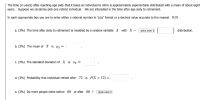 The time (in years) after reaching age sixty that it takes an individual to retire is approximately exponentially distributed with a mean of about eight years. Suppose we randomly pick one retired individual. We are interested in the time after age sixty to retirement. In each appropriate box you are to enter either a rational number in "p/q" format or a decimal value accurate to the nearest 0.01 a. (390) The time after sixty to retirement is modeled by a...
The time (in years) after reaching age sixty that it takes an individual to retire is...
The time (in years) after reaching age sixty that it takes an individual to retire is approximately exponentially distributed with a mean of about five years. Suppose we randomly pick one retired individual. We are interested in the time after age sixty to retirement. In each appropriate box you are to enter either a rational number in "p/q" format or a decimal value accurate to the nearest 0.01 . (3%) The time after sixty to retirement is modeled by a...
The time spent waiting in the line is approximately normally distributed. The mean waiting time is...
The time spent waiting in the line is approximately normally distributed. The mean waiting time is 6 minutes and the standard deviation of the waiting time is 2 minutes. Find the probability that a person will wait for more than 8 minutes. Round your answer the four decimal places.
The time spent waiting in the line is approximately normally distributed. The mean waiting time is...
The time spent waiting in the line is approximately normally distributed. The mean waiting time is 55 minutes and the standard deviation of the waiting time is 22 minutes. Find the probability that a person will wait for more than 33 minutes. Round your answer to four decimal places.
The time spent waiting in the line is approximately normally distributed. The mean waiting time is...
The time spent waiting in the line is approximately normally distributed. The mean waiting time is 6 minutes and the standard deviation of the waiting time is 2 minutes. Find the probability that a person will wait for more than 9 minutes. Round your answer to four decimal places.
The time spent waiting in the line is approximately normally distributed. The mean waiting time is...
The time spent waiting in the line is approximately normally distributed. The mean waiting time is 6 minutes and the variance of the waiting time is 4. Find the probability that a person will wait for more than 7 minutes. Round your answer to four decimal places.
The time spent waiting in the line is approximately normally distributed. The mean waiting time is...
The time spent waiting in the line is approximately normally distributed. The mean waiting time is 77 minutes and the variance of the waiting time is 44. Find the probability that a person will wait for more than 33 minutes. Round your answer to four decimal places.
The time spent waiting in the line is approximately normally distributed. The mean waiting time is...
The time spent waiting in the line is approximately normally distributed. The mean waiting time is 5 minutes and the standard deviation of the waiting time is 1 minute. Find the probability that a person will wait for more than 3 minutes. Round your answer to four decimal places.
 Please
77. A subway train on the 4 line arrives every sight minutes during rush hour. We are interested in the length of time a commuter must wait for a train to arrive.The time follows a uniform distribution. 1. Define the random variable. X_ 2. Х~ 3. Graph the probability distribution 7. 8. Find the probability that the commuter waits less than one minute. Find the probability that the commuter waits between three and four minutes. 9. Siorty percent of...
Please
77. A subway train on the 4 line arrives every sight minutes during rush hour. We are interested in the length of time a commuter must wait for a train to arrive.The time follows a uniform distribution. 1. Define the random variable. X_ 2. Х~ 3. Graph the probability distribution 7. 8. Find the probability that the commuter waits less than one minute. Find the probability that the commuter waits between three and four minutes. 9. Siorty percent of...
 The time (in years) after reaching age sixty that it takes an individual to retire is approximately exponentially distributed with a mean of about eight years. Suppose we randomly pick one retired individual. We are interested in the time after age sixty to retirement. In each appropriate box you are to enter either a rational number in "p/q" format or a decimal value accurate to the nearest 0.01 a. (390) The time after sixty to retirement is modeled by a...
Most questions answered within 3 hours.
-
Where is the error in this code sequence?
String s1 = "Hello";
String s2 = "ello";...
asked 10 months ago -
Financial data for Joel de Paris, Inc., for last year
follow:
Joel de Paris, Inc.
Balance...
asked 10 months ago -
Consider this reaction:
Al2(SO4)3 (aq)+ BaCl3
(aq) Al2Cl6 (aq)- +
3BaSO4(s) . What is the...
asked 10 months ago -
Suppose that Savneet is considering increasing her
recent random sample from 20 car rentals to 40...
asked 10 months ago -
Trucks arrive at an unloading terminal at an average rate of 120
per hour.
Trucks arrive...
asked 10 months ago -
Why are methanol and ethanol completely soluble in water while
octanol is not very little soluble....
asked 10 months ago -
A facilities manager at a university reads in a research report
that the mean amount of...
asked 10 months ago -
When the CuSO4 is rehydrated by adding water to the anhydrous
compound, is this an endothermic...
asked 10 months ago -
A ray of sunlight is passing from diamond into crown glass; the
angle of incidence is...
asked 10 months ago -
A block of mass 0.249 kg is placed on top of a light, vertical
spring of...
asked 10 months ago -
how do the kidneys compensate in the presences of acidosis
a) trigger hyperventilate
b) reserve acid...
asked 10 months ago -
Question 501 pts
The rental rate of capital to the firm increases. Which of the
following...
asked 10 months ago