
Homework Answers
Add Answer to:
Charging Capacitor 3. In the below charging circuit the switch is closed at t-Os and the...
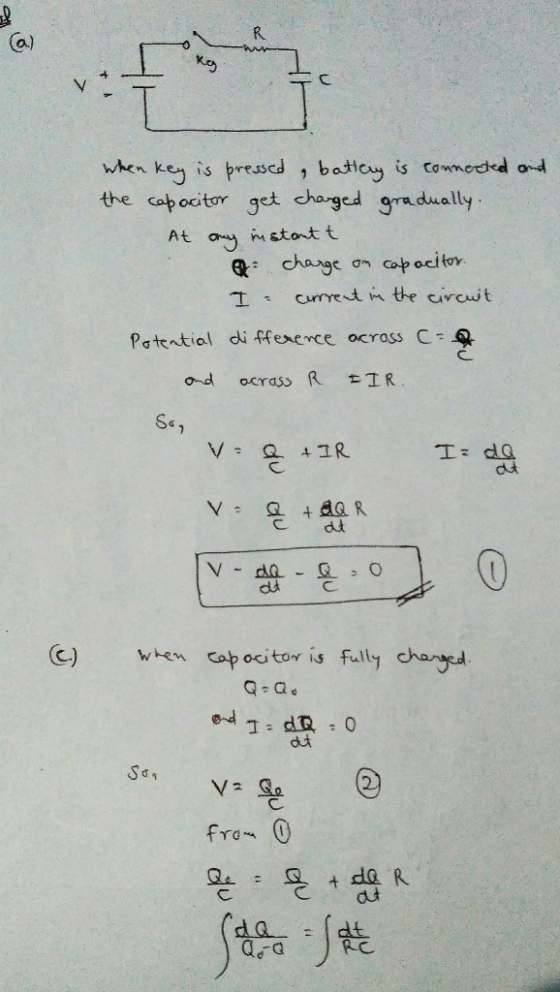
Question 4: RC Circuit: a) Charging capacitor: A simple RC circuit is given in Figure 4a....
 Question 4: RC Circuit: a) Charging capacitor: A simple RC circuit is given in Figure 4a. The capacitor is empty initially and switch was open for a long time. 4E, (V) EMF is used to charge the capacitor as switch is closed at t=0s. By using Kirchhoff's voltage law and Ohm's law that you learned so far, analyze this circuit and find the unknowns given below. 1)At t=0s. draw the equivalent circuit and find v. (Os), i. (Os), i (Os),...
a.) Consider the circuit below. Assume that the capacitor is fully discharged prior to t=0. The switch is closed at t=0...
 a.) Consider the circuit below. Assume that the capacitor is
fully discharged prior to t=0. The switch is closed at t=0
connecting the voltage source to the rest of the circuit. What is
the steady-state value of the voltage across the capacitor, VC(t),
after the switch is closed for a long time? Put your answer in the
box below, without the units (Volts).
b.) What is the time constant, ?, in ?s of the circuit in this
question.
c.) What...
a.) Consider the circuit below. Assume that the capacitor is
fully discharged prior to t=0. The switch is closed at t=0
connecting the voltage source to the rest of the circuit. What is
the steady-state value of the voltage across the capacitor, VC(t),
after the switch is closed for a long time? Put your answer in the
box below, without the units (Volts).
b.) What is the time constant, ?, in ?s of the circuit in this
question.
c.) What...
(1) Consider the RC circuit shown in Figure 1. For t<0 the switch is open, and...
 (1) Consider the RC circuit shown in Figure 1. For t<0 the switch is open, and the charge stored on the capacitor is 0. At t-0 the switch is closed, and the voltage source begins charging the capacitor. Let R1-R2-220 Ω , C-0.47 μ F , Vs-5 V. (a) Write the differential equation as an expression for the capacitor voltage fort> 0 (i.e. write the differential equation) and calculate the time constant (b) Calculate the steady-state capacitor voltage R2 R1...
(12 pts) In the circuit below the capacitor is fully charged to 12.0 V. Switch S...
 (12 pts) In the circuit below the capacitor is fully charged to 12.0 V. Switch S is next flipped down for discharge of the capacitor. (a) Show the new switch position on the diagram and the current flow direction during discharge. (b) Sketch the voltage Vc across the capacitor C (during discharge) as a function of time t on the graph below. (c) Calculate the time constant for the discharge from the given R and C values. 8. Graph of...
Please Show all steps in getting to the Solution (Please, thank you) 2. Charging a capacitor usually has a circuit with...
 Please Show all steps in getting to the Solution (Please, thank
you)
2. Charging a capacitor usually has a circuit with a battery, a resistor and a capacitor all in series The voltage of the resistor is given by Ohm's law VRIR and the voltage across the capacitor is given by Vc. According to Kirchoff's voltage law we have the equation Vb - Va + Vc Vb ㅡ R-+ Integrate the equation to find the charge on the capacitor as...
Please Show all steps in getting to the Solution (Please, thank
you)
2. Charging a capacitor usually has a circuit with a battery, a resistor and a capacitor all in series The voltage of the resistor is given by Ohm's law VRIR and the voltage across the capacitor is given by Vc. According to Kirchoff's voltage law we have the equation Vb - Va + Vc Vb ㅡ R-+ Integrate the equation to find the charge on the capacitor as...
What is the time constant of the charging circuit After the switch has been closed for...
 What is the time constant of the charging circuit After the switch has been closed for the time determined in part C (i.e. one time constant), what is the voltage across the 3.0 mu F capacitor
Question 4a Consider the LRC circuit shown below. At 0, the switch S is closed and a voltage Va-V...
 Question 4a Consider the LRC circuit shown below. At 0, the switch S is closed and a voltage Va-Vr = Vo cos wt is applied between A and F A -000i R. The equation describing the evolution of Q(t), the charge on the capacitor is CGiven Q0) amd #(o) - 0), the geteral solution of 1) may be written as (0), the general solution of (1) may be written as where Qc(t) as t0o, so after a long time, 2L...
The initial voltage across the capacitor is 0 V. At time t=0, the switch is closed
 The initial voltage across the capacitor is 0 V. At time t=0, the switch is closed a) What is the time constant for this circuit? b) What is the final voltage across the 50 capacitor? c) What is the expression for the voltage across the 50 capacitor? d) Sketch the waveform for . e) What is the maximum instantaneous current that will flow through the capacitor? f) When will the voltage reach 5.0 V?
Problem 2 You are given the circuit shown below and you are told that the switch...
 Problem 2 You are given the circuit shown below and you are told that the switch was closed for a long time prior tot0. Att0 the switchopens. IH 402 a) Find vc(0), i(0) dt c) Find the steady-state voltage Vess across the capacitor. d) Write the differential equation in terms of vc() indicated above. c) Is the transient response over, under or critically damped? Find v(t)t>0
In a series resistance-capacitance DC circuit, the instantaneous charge Q on the capacitor as a... In...
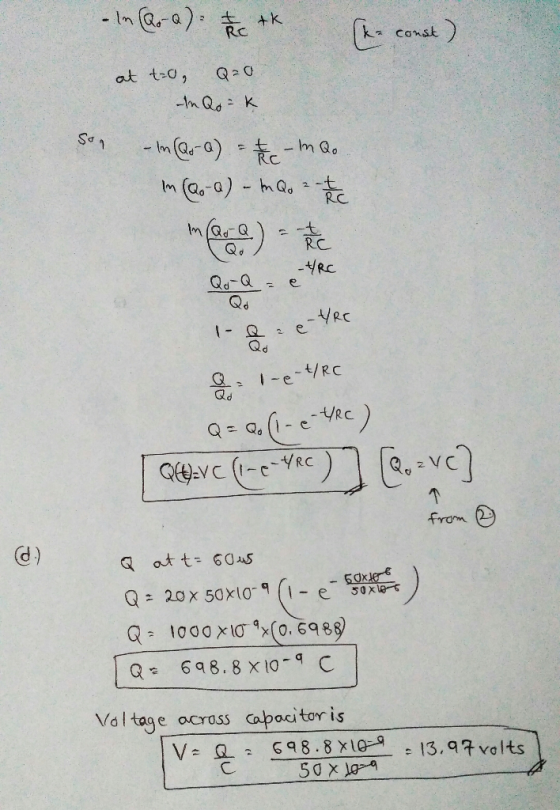
In a series resistance-capacitance DC circuit, the instantaneous charge Q on the capacitor as a... In a series resistance-capacitance DC circuit, the instantaneous charge Q on the capacitor as a function of time (where t=0 is the moment the circuit is energized by closing a switch) is given by the equation Q(t)=CV(1-e-t/(RC), where C, V, and R are constants. Further, the instantaneous charging current Ic is the rate of change of charge on the capacitor, or Ic=dQ/dt a. Find the...
 Question 4: RC Circuit: a) Charging capacitor: A simple RC circuit is given in Figure 4a. The capacitor is empty initially and switch was open for a long time. 4E, (V) EMF is used to charge the capacitor as switch is closed at t=0s. By using Kirchhoff's voltage law and Ohm's law that you learned so far, analyze this circuit and find the unknowns given below. 1)At t=0s. draw the equivalent circuit and find v. (Os), i. (Os), i (Os),...
 a.) Consider the circuit below. Assume that the capacitor is
fully discharged prior to t=0. The switch is closed at t=0
connecting the voltage source to the rest of the circuit. What is
the steady-state value of the voltage across the capacitor, VC(t),
after the switch is closed for a long time? Put your answer in the
box below, without the units (Volts).
b.) What is the time constant, ?, in ?s of the circuit in this
question.
c.) What...
a.) Consider the circuit below. Assume that the capacitor is
fully discharged prior to t=0. The switch is closed at t=0
connecting the voltage source to the rest of the circuit. What is
the steady-state value of the voltage across the capacitor, VC(t),
after the switch is closed for a long time? Put your answer in the
box below, without the units (Volts).
b.) What is the time constant, ?, in ?s of the circuit in this
question.
c.) What...
 (1) Consider the RC circuit shown in Figure 1. For t<0 the switch is open, and the charge stored on the capacitor is 0. At t-0 the switch is closed, and the voltage source begins charging the capacitor. Let R1-R2-220 Ω , C-0.47 μ F , Vs-5 V. (a) Write the differential equation as an expression for the capacitor voltage fort> 0 (i.e. write the differential equation) and calculate the time constant (b) Calculate the steady-state capacitor voltage R2 R1...
 (12 pts) In the circuit below the capacitor is fully charged to 12.0 V. Switch S is next flipped down for discharge of the capacitor. (a) Show the new switch position on the diagram and the current flow direction during discharge. (b) Sketch the voltage Vc across the capacitor C (during discharge) as a function of time t on the graph below. (c) Calculate the time constant for the discharge from the given R and C values. 8. Graph of...
 Please Show all steps in getting to the Solution (Please, thank
you)
2. Charging a capacitor usually has a circuit with a battery, a resistor and a capacitor all in series The voltage of the resistor is given by Ohm's law VRIR and the voltage across the capacitor is given by Vc. According to Kirchoff's voltage law we have the equation Vb - Va + Vc Vb ㅡ R-+ Integrate the equation to find the charge on the capacitor as...
Please Show all steps in getting to the Solution (Please, thank
you)
2. Charging a capacitor usually has a circuit with a battery, a resistor and a capacitor all in series The voltage of the resistor is given by Ohm's law VRIR and the voltage across the capacitor is given by Vc. According to Kirchoff's voltage law we have the equation Vb - Va + Vc Vb ㅡ R-+ Integrate the equation to find the charge on the capacitor as...
 What is the time constant of the charging circuit After the switch has been closed for the time determined in part C (i.e. one time constant), what is the voltage across the 3.0 mu F capacitor
 Question 4a Consider the LRC circuit shown below. At 0, the switch S is closed and a voltage Va-Vr = Vo cos wt is applied between A and F A -000i R. The equation describing the evolution of Q(t), the charge on the capacitor is CGiven Q0) amd #(o) - 0), the geteral solution of 1) may be written as (0), the general solution of (1) may be written as where Qc(t) as t0o, so after a long time, 2L...
 Problem 2 You are given the circuit shown below and you are told that the switch was closed for a long time prior tot0. Att0 the switchopens. IH 402 a) Find vc(0), i(0) dt c) Find the steady-state voltage Vess across the capacitor. d) Write the differential equation in terms of vc() indicated above. c) Is the transient response over, under or critically damped? Find v(t)t>0
Most questions answered within 3 hours.
-
Where is the error in this code sequence?
String s1 = "Hello";
String s2 = "ello";...
asked 10 months ago -
Financial data for Joel de Paris, Inc., for last year
follow:
Joel de Paris, Inc.
Balance...
asked 10 months ago -
Consider this reaction:
Al2(SO4)3 (aq)+ BaCl3
(aq) Al2Cl6 (aq)- +
3BaSO4(s) . What is the...
asked 10 months ago -
Suppose that Savneet is considering increasing her
recent random sample from 20 car rentals to 40...
asked 10 months ago -
Trucks arrive at an unloading terminal at an average rate of 120
per hour.
Trucks arrive...
asked 10 months ago -
Why are methanol and ethanol completely soluble in water while
octanol is not very little soluble....
asked 10 months ago -
A facilities manager at a university reads in a research report
that the mean amount of...
asked 10 months ago -
When the CuSO4 is rehydrated by adding water to the anhydrous
compound, is this an endothermic...
asked 10 months ago -
A ray of sunlight is passing from diamond into crown glass; the
angle of incidence is...
asked 10 months ago -
A block of mass 0.249 kg is placed on top of a light, vertical
spring of...
asked 10 months ago -
how do the kidneys compensate in the presences of acidosis
a) trigger hyperventilate
b) reserve acid...
asked 10 months ago -
Question 501 pts
The rental rate of capital to the firm increases. Which of the
following...
asked 10 months ago