
Homework Answers


Add Answer to:
3. (30 points) Critically-damped - Determine vo(t)! 200 10uH Vo(t) i(t) v(t) 1Vu(t) 100nF
In the critically damped circuit shown in the figure below, the initial conditions on the storage...
 In the critically damped circuit shown in the figure below, the
initial conditions on the storage elements are
iL(0) = 2 A and
vC(0) = 5 V. Determine the voltage
v(50 ms).
Please show all work, thank you.
In the critically damped circuit shown in the figure below, the initial conditions on the storage elements are i(0) = 2 A and vc0) = 5 V. Determine the voltage v(50 ms). + + il(0) vc( 0+ 0.01 F v(t) 3 1002...
In the critically damped circuit shown in the figure below, the
initial conditions on the storage elements are
iL(0) = 2 A and
vC(0) = 5 V. Determine the voltage
v(50 ms).
Please show all work, thank you.
In the critically damped circuit shown in the figure below, the initial conditions on the storage elements are i(0) = 2 A and vc0) = 5 V. Determine the voltage v(50 ms). + + il(0) vc( 0+ 0.01 F v(t) 3 1002...
Problem #3 a) Determine if the next second order system is oscillating, low damped, critically damped...
 Problem #3 a) Determine if the next second order system is oscillating, low damped, critically damped or overdamped. Justify your conclusion. G(s)10 s2 +s +1 b) Determine the maximum percentage overdrive (if any) and the set time to the 2% criterion that will have the response to the unit step of the previous system. c) Plot the response to the magnitude 5 step of the G (s) system.
Problem 4. The Fast Decay of Critically Damped Simple Harmonic Oscillator. A simple harmonic oscillator (a...
 Problem 4. The Fast Decay of Critically Damped Simple Harmonic Oscillator. A simple harmonic oscillator (a box with mass m attached to a Hook's spring of coefficient k with linear air friction of coefficient n) is described by mx"(t) + n2'(t) + ku(t) = 0 where m, n, k > 0. (a) Write down the solutions for three cases and their long term limits 1. Overdamped: when friction is strong 1 > 4mk 2. Underdamped: when friction is weak 72...
Determine if overdamped,underdamped, or critically damped For the circuit shown below, Vs-200V, R-30, R.-50. C -0.125pF...
 Determine if overdamped,underdamped, or critically damped
For the circuit shown below, Vs-200V, R-30, R.-50. C -0.125pF and L-SmH. Find (a) the initial voltage across the capacitor 20. (b) the initial current through the inductor, lu(0). (e) the damping coefficient and resonant frequency . (d) the initial condition dvede , (e) the voltage across the capacitor (t) for the initial condition diu/dt , and the current through the inductor lu(t) for p R2 Voc
Determine if overdamped,underdamped, or critically damped
For the circuit shown below, Vs-200V, R-30, R.-50. C -0.125pF and L-SmH. Find (a) the initial voltage across the capacitor 20. (b) the initial current through the inductor, lu(0). (e) the damping coefficient and resonant frequency . (d) the initial condition dvede , (e) the voltage across the capacitor (t) for the initial condition diu/dt , and the current through the inductor lu(t) for p R2 Voc
2) a) Derie weayti for the critically damped case, 5-1. b) Determine the position, velocity and acceleration error cons...
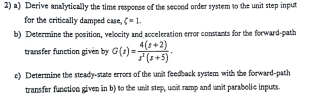 2) a) Derie weayti for the critically damped case, 5-1. b) Determine the position, velocity and acceleration error constants for the forward-path 4(s+2 s" (s+5) transfer function given by G(s)-- c) Determine the steady-state errors of the unit feedback system with the forward-path paroc i ansfer funcioo given ru n
2) a) Derie weayti for the critically damped case, 5-1. b) Determine the position, velocity and acceleration error constants for the forward-path 4(s+2 s" (s+5) transfer function given by G(s)--...
2) a) Derie weayti for the critically damped case, 5-1. b) Determine the position, velocity and acceleration error constants for the forward-path 4(s+2 s" (s+5) transfer function given by G(s)-- c) Determine the steady-state errors of the unit feedback system with the forward-path paroc i ansfer funcioo given ru n
2) a) Derie weayti for the critically damped case, 5-1. b) Determine the position, velocity and acceleration error constants for the forward-path 4(s+2 s" (s+5) transfer function given by G(s)--...
Calculate vo(t) in the circuit shown in the figure below if i(t) is 200 cos(105t+ 60°) mA, i2(t) is 100 sin(105t90°) mA, and vst) 10 sin(105t) v uci) + 250 nF o(r) 52 Ohm Calculate vo(t) in the...
 Calculate vo(t) in the circuit shown in the figure below if i(t) is 200 cos(105t+ 60°) mA, i2(t) is 100 sin(105t90°) mA, and vst) 10 sin(105t) v uci) + 250 nF o(r) 52 Ohm
Calculate vo(t) in the circuit shown in the figure below if i(t) is 200 cos(105t+ 60°) mA, i2(t) is 100 sin(105t90°) mA, and vst) 10 sin(105t) v uci) + 250 nF o(r) 52 Ohm
Calculate vo(t) in the circuit shown in the figure below if i(t) is 200 cos(105t+ 60°) mA, i2(t) is 100 sin(105t90°) mA, and vst) 10 sin(105t) v uci) + 250 nF o(r) 52 Ohm
Problem 4 Problem 3 (35): The particle with mass m is initially at equilibrium. The cord is assum...
 Problem 4 Problem 3 (35): The particle with mass m is initially at equilibrium. The cord is assumed to be taut throughout the motion. The system is critically damped with parameters are m = 4 kg and k = 200 N/m. 7n a) (15) Determine the value of the viscous damping coefficient c. b) (10) If at t -0 the mass m is displaced down the incline by a distance xo -0.2 m from the equilibrium position and released with...
(1 point) This problem is an example of critically damped harmonic motion. A mass m =...
 (1 point) This problem is an example of critically damped harmonic motion. A mass m = 6 kg is attached to both a spring with spring constant k = 150 N/m and a dash-pot with damping constant c = 60 N· s/m . The ball is started in motion with initial position Xo = 8 m and initial velocity vo = -42 m/s. Determine the position function x(t) in meters. x(t) = Graph the function x(t). Now assume the mass...
5. For each of the following, determine if the system is underdamped, undamped, critically damped or...
 5. For each of the following, determine if the system is underdamped, undamped, critically damped or overdamped ad sketch the it step response (a) G (s) = (c) G(s)-t 2+68+ (d) G (s) = 36 6. The equation of motion of a rotational mechanical system is given by where θ° and θί are respectively, output and input angular displace- ments. Assuming that all initial conditions are zero, determine (a) the transfer function model. (b) the natural frequency, w natural frequency,...
5. For each of the following, determine if the system is underdamped, undamped, critically damped or overdamped ad sket...
 5. For each of the following, determine if the system is underdamped, undamped, critically damped or overdamped ad sketch the it step response (a) G (s) = (c) G(s)-t 2+68+ (d) G (s) = 36 6. The equation of motion of a rotational mechanical system is given by where θ° and θί are respectively, output and input angular displace- ments. Assuming that all initial conditions are zero, determine (a) the transfer function model. (b) the natural frequency, w natural frequency,...
 In the critically damped circuit shown in the figure below, the
initial conditions on the storage elements are
iL(0) = 2 A and
vC(0) = 5 V. Determine the voltage
v(50 ms).
Please show all work, thank you.
In the critically damped circuit shown in the figure below, the initial conditions on the storage elements are i(0) = 2 A and vc0) = 5 V. Determine the voltage v(50 ms). + + il(0) vc( 0+ 0.01 F v(t) 3 1002...
In the critically damped circuit shown in the figure below, the
initial conditions on the storage elements are
iL(0) = 2 A and
vC(0) = 5 V. Determine the voltage
v(50 ms).
Please show all work, thank you.
In the critically damped circuit shown in the figure below, the initial conditions on the storage elements are i(0) = 2 A and vc0) = 5 V. Determine the voltage v(50 ms). + + il(0) vc( 0+ 0.01 F v(t) 3 1002...
 Problem #3 a) Determine if the next second order system is oscillating, low damped, critically damped or overdamped. Justify your conclusion. G(s)10 s2 +s +1 b) Determine the maximum percentage overdrive (if any) and the set time to the 2% criterion that will have the response to the unit step of the previous system. c) Plot the response to the magnitude 5 step of the G (s) system.
 Problem 4. The Fast Decay of Critically Damped Simple Harmonic Oscillator. A simple harmonic oscillator (a box with mass m attached to a Hook's spring of coefficient k with linear air friction of coefficient n) is described by mx"(t) + n2'(t) + ku(t) = 0 where m, n, k > 0. (a) Write down the solutions for three cases and their long term limits 1. Overdamped: when friction is strong 1 > 4mk 2. Underdamped: when friction is weak 72...
 Determine if overdamped,underdamped, or critically damped
For the circuit shown below, Vs-200V, R-30, R.-50. C -0.125pF and L-SmH. Find (a) the initial voltage across the capacitor 20. (b) the initial current through the inductor, lu(0). (e) the damping coefficient and resonant frequency . (d) the initial condition dvede , (e) the voltage across the capacitor (t) for the initial condition diu/dt , and the current through the inductor lu(t) for p R2 Voc
Determine if overdamped,underdamped, or critically damped
For the circuit shown below, Vs-200V, R-30, R.-50. C -0.125pF and L-SmH. Find (a) the initial voltage across the capacitor 20. (b) the initial current through the inductor, lu(0). (e) the damping coefficient and resonant frequency . (d) the initial condition dvede , (e) the voltage across the capacitor (t) for the initial condition diu/dt , and the current through the inductor lu(t) for p R2 Voc
 2) a) Derie weayti for the critically damped case, 5-1. b) Determine the position, velocity and acceleration error constants for the forward-path 4(s+2 s" (s+5) transfer function given by G(s)-- c) Determine the steady-state errors of the unit feedback system with the forward-path paroc i ansfer funcioo given ru n
2) a) Derie weayti for the critically damped case, 5-1. b) Determine the position, velocity and acceleration error constants for the forward-path 4(s+2 s" (s+5) transfer function given by G(s)--...
2) a) Derie weayti for the critically damped case, 5-1. b) Determine the position, velocity and acceleration error constants for the forward-path 4(s+2 s" (s+5) transfer function given by G(s)-- c) Determine the steady-state errors of the unit feedback system with the forward-path paroc i ansfer funcioo given ru n
2) a) Derie weayti for the critically damped case, 5-1. b) Determine the position, velocity and acceleration error constants for the forward-path 4(s+2 s" (s+5) transfer function given by G(s)--...
 Calculate vo(t) in the circuit shown in the figure below if i(t) is 200 cos(105t+ 60°) mA, i2(t) is 100 sin(105t90°) mA, and vst) 10 sin(105t) v uci) + 250 nF o(r) 52 Ohm
Calculate vo(t) in the circuit shown in the figure below if i(t) is 200 cos(105t+ 60°) mA, i2(t) is 100 sin(105t90°) mA, and vst) 10 sin(105t) v uci) + 250 nF o(r) 52 Ohm
Calculate vo(t) in the circuit shown in the figure below if i(t) is 200 cos(105t+ 60°) mA, i2(t) is 100 sin(105t90°) mA, and vst) 10 sin(105t) v uci) + 250 nF o(r) 52 Ohm
 Problem 4 Problem 3 (35): The particle with mass m is initially at equilibrium. The cord is assumed to be taut throughout the motion. The system is critically damped with parameters are m = 4 kg and k = 200 N/m. 7n a) (15) Determine the value of the viscous damping coefficient c. b) (10) If at t -0 the mass m is displaced down the incline by a distance xo -0.2 m from the equilibrium position and released with...
 (1 point) This problem is an example of critically damped harmonic motion. A mass m = 6 kg is attached to both a spring with spring constant k = 150 N/m and a dash-pot with damping constant c = 60 N· s/m . The ball is started in motion with initial position Xo = 8 m and initial velocity vo = -42 m/s. Determine the position function x(t) in meters. x(t) = Graph the function x(t). Now assume the mass...
 5. For each of the following, determine if the system is underdamped, undamped, critically damped or overdamped ad sketch the it step response (a) G (s) = (c) G(s)-t 2+68+ (d) G (s) = 36 6. The equation of motion of a rotational mechanical system is given by where θ° and θί are respectively, output and input angular displace- ments. Assuming that all initial conditions are zero, determine (a) the transfer function model. (b) the natural frequency, w natural frequency,...
 5. For each of the following, determine if the system is underdamped, undamped, critically damped or overdamped ad sketch the it step response (a) G (s) = (c) G(s)-t 2+68+ (d) G (s) = 36 6. The equation of motion of a rotational mechanical system is given by where θ° and θί are respectively, output and input angular displace- ments. Assuming that all initial conditions are zero, determine (a) the transfer function model. (b) the natural frequency, w natural frequency,...
Most questions answered within 3 hours.
-
Where is the error in this code sequence?
String s1 = "Hello";
String s2 = "ello";...
asked 10 months ago -
Financial data for Joel de Paris, Inc., for last year
follow:
Joel de Paris, Inc.
Balance...
asked 10 months ago -
Consider this reaction:
Al2(SO4)3 (aq)+ BaCl3
(aq) Al2Cl6 (aq)- +
3BaSO4(s) . What is the...
asked 10 months ago -
Suppose that Savneet is considering increasing her
recent random sample from 20 car rentals to 40...
asked 10 months ago -
Trucks arrive at an unloading terminal at an average rate of 120
per hour.
Trucks arrive...
asked 10 months ago -
Why are methanol and ethanol completely soluble in water while
octanol is not very little soluble....
asked 10 months ago -
A facilities manager at a university reads in a research report
that the mean amount of...
asked 10 months ago -
When the CuSO4 is rehydrated by adding water to the anhydrous
compound, is this an endothermic...
asked 10 months ago -
A ray of sunlight is passing from diamond into crown glass; the
angle of incidence is...
asked 10 months ago -
A block of mass 0.249 kg is placed on top of a light, vertical
spring of...
asked 10 months ago -
how do the kidneys compensate in the presences of acidosis
a) trigger hyperventilate
b) reserve acid...
asked 10 months ago -
Question 501 pts
The rental rate of capital to the firm increases. Which of the
following...
asked 10 months ago