
Homework Answers
The
kinetic energy is
and the potential energy is
The xi are the displacements from the equilibrium
positions.
let use the xi as our generalized coordinates
qi.
The Lagrangian is L = T - U.
This can be put into the form
where
Solutions of the form xj =
Re(Ajei?t) can be found. For solutions of
this form the equations of motion reduce to
.
We can find the ?2 from det(kij - ?2Tij) = 0.
For a system with n degrees of freedom, n characteristic frequencies ?a can be found. Our system has 3 degrees of freedom.
.
1.
.
2.
3.
Add Answer to:
Three masses are connected by a spring to each other and to fixed positions as shown...
5. 10 points Two ideal massless springs with spring constant k are connected to two masses...
 5. 10 points Two ideal massless springs with spring constant k are connected to two masses that hang vertically as shown in the figure. The top one has mass 3m and the bottom one has mass 2m. The system is only able to oscillate in the vertical direction. a) Determine the equations of motion. (4 pts) b) Find the frequencies of the normal modes of this system for small vertical dis- placements. (4 pts) c) Describe the relative motion and...
IV. Spring-Mass System Application - Consider the system of two masses and three springs as shown...
 IV. Spring-Mass System Application - Consider the system of two masses and three springs as shown in the figure below. Let z(t) be the position mass m, and y(t) be the position of mass m. Let m, = 1, m, = 1, k, = 4, k, = 6, and k, = 4. ksi-ik, a.) Model the system with two second order differential equations. 6a.) System: b) Find the general solution to the system using the constants.) head of your choice....
Please use derivatives and express the eq. of motion for each: mx’’ = ... 2. Two...
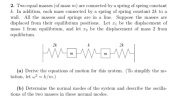 Please use derivatives and express the eq. of motion for each:
mx’’ = ...
2. Two equal masses (of mass m) are connected by a spring of spring constant k. In addition, each mass connected by a spring of spring constant 2k to a wall. All the masses and springs are in a line. Suppose the masses are displaced from their equilibrium positions. Let xi be the displacement of mass 1 from equilibrium, and let r2 be the displacement of...
Please use derivatives and express the eq. of motion for each:
mx’’ = ...
2. Two equal masses (of mass m) are connected by a spring of spring constant k. In addition, each mass connected by a spring of spring constant 2k to a wall. All the masses and springs are in a line. Suppose the masses are displaced from their equilibrium positions. Let xi be the displacement of mass 1 from equilibrium, and let r2 be the displacement of...
4. Two objects of masses m/ and m2 are connected by a massless spring as shown...
 4. Two objects of masses m/ and m2 are connected by a massless spring as shown in the figure below. The spring has a natural length of L and a stiffness of k. Owo a. If x is the extension of the spring by the horizontal motion of the masses, use Newton's second law to determine the equations of motion for each object. b. Combine these equations to show that the system oscillates at a frequency of - mįm2 w2...
The three masses shown in (Figure 1) are connected by massless, rigid rods.
 The three masses shown in (Figure 1) are connected by massless, rigid rods. Part A Find the coordinates of the center of gravity. Part B Find the moment of inertia about an axis that passes through mass A and is perpendicular to the page. Part C Find the moment of inertia about an axis that passes through masses B and C.
A2. Two identical simple pendulums are connected via a spring as it is shown in Figure A2. The length of the pendulum strut L-0.5m and the mass of attached bob m-2kg, the stiffness coefficient of the...
 A2. Two identical simple pendulums are connected via a spring as it is shown in Figure A2. The length of the pendulum strut L-0.5m and the mass of attached bob m-2kg, the stiffness coefficient of the connecting spring is k-80Ns/m. 02 Figure A2. a) Using the free-body diagram method derive the following governing equations for the coupled pendulum system which are given below in matrix form b) Using the characteristic equation method or transformation to principal coordinates find out two...
Three identical 7.50 kg masses are hung by three identical springs (Figure 1) . Each spring...
Three identical 7.50 kg masses are hung by three identical springs (Figure 1) . Each spring has a force constant of 7.70 kN/m and was 12.0 long before any masses were attached to it. A)How long is the bottom spring when hanging as shown? (Hint: isolate only the bottom mass.) Express your answer with the appropriate units. B) How long is the middle spring when hanging as shown? (Hint: treat the bottom two masses as a system.) Express your answer...
number 6 solve Two springs with spring constants k_1 and k_2, are connected with each other...
 number 6 solve
Two springs with spring constants k_1 and k_2, are connected with each other and attached to a block with mass m, as shown in Figure below.
number 6 solve
Two springs with spring constants k_1 and k_2, are connected with each other and attached to a block with mass m, as shown in Figure below.
3. Consider the spring - mass system shown below, consisting of two masses mi and ma sus- pended ...
 3. Consider the spring - mass system shown below, consisting of two masses mi and ma sus- pended from springs with spring constants ki and k, respectively. Assume that there is no damping in the system. a) Show that the displacements z1 and 2 of the masses from their respective equilibrium positions satisfy the differential equations b) Use the above resuit to show that the spring-mass system satisfies the following fourth order differential equation. and ) Find the general solution...
4. Two masses mi and m2 are connected to three springs of negligible mass having spring constants...
 4. Two masses mi and m2 are connected to three springs of negligible mass having spring constants k1, k2 and k3, respectively. x2=0 Il k, Let xi and x2 represent The motion of the equations: displacements of masses mi and m2 from their equilibrium positions . coupled system is represented by the system of second-order differential d2x dt2 d2x2 Using Laplace transform to solve the system when k1 1 and x1(0) = 0, xi (0)--1 , x2(0) = 0, x(0)-1....
 5. 10 points Two ideal massless springs with spring constant k are connected to two masses that hang vertically as shown in the figure. The top one has mass 3m and the bottom one has mass 2m. The system is only able to oscillate in the vertical direction. a) Determine the equations of motion. (4 pts) b) Find the frequencies of the normal modes of this system for small vertical dis- placements. (4 pts) c) Describe the relative motion and...
 IV. Spring-Mass System Application - Consider the system of two masses and three springs as shown in the figure below. Let z(t) be the position mass m, and y(t) be the position of mass m. Let m, = 1, m, = 1, k, = 4, k, = 6, and k, = 4. ksi-ik, a.) Model the system with two second order differential equations. 6a.) System: b) Find the general solution to the system using the constants.) head of your choice....
 Please use derivatives and express the eq. of motion for each:
mx’’ = ...
2. Two equal masses (of mass m) are connected by a spring of spring constant k. In addition, each mass connected by a spring of spring constant 2k to a wall. All the masses and springs are in a line. Suppose the masses are displaced from their equilibrium positions. Let xi be the displacement of mass 1 from equilibrium, and let r2 be the displacement of...
Please use derivatives and express the eq. of motion for each:
mx’’ = ...
2. Two equal masses (of mass m) are connected by a spring of spring constant k. In addition, each mass connected by a spring of spring constant 2k to a wall. All the masses and springs are in a line. Suppose the masses are displaced from their equilibrium positions. Let xi be the displacement of mass 1 from equilibrium, and let r2 be the displacement of...
 4. Two objects of masses m/ and m2 are connected by a massless spring as shown in the figure below. The spring has a natural length of L and a stiffness of k. Owo a. If x is the extension of the spring by the horizontal motion of the masses, use Newton's second law to determine the equations of motion for each object. b. Combine these equations to show that the system oscillates at a frequency of - mįm2 w2...
 A2. Two identical simple pendulums are connected via a spring as it is shown in Figure A2. The length of the pendulum strut L-0.5m and the mass of attached bob m-2kg, the stiffness coefficient of the connecting spring is k-80Ns/m. 02 Figure A2. a) Using the free-body diagram method derive the following governing equations for the coupled pendulum system which are given below in matrix form b) Using the characteristic equation method or transformation to principal coordinates find out two...
 number 6 solve
Two springs with spring constants k_1 and k_2, are connected with each other and attached to a block with mass m, as shown in Figure below.
number 6 solve
Two springs with spring constants k_1 and k_2, are connected with each other and attached to a block with mass m, as shown in Figure below.
 3. Consider the spring - mass system shown below, consisting of two masses mi and ma sus- pended from springs with spring constants ki and k, respectively. Assume that there is no damping in the system. a) Show that the displacements z1 and 2 of the masses from their respective equilibrium positions satisfy the differential equations b) Use the above resuit to show that the spring-mass system satisfies the following fourth order differential equation. and ) Find the general solution...
 4. Two masses mi and m2 are connected to three springs of negligible mass having spring constants k1, k2 and k3, respectively. x2=0 Il k, Let xi and x2 represent The motion of the equations: displacements of masses mi and m2 from their equilibrium positions . coupled system is represented by the system of second-order differential d2x dt2 d2x2 Using Laplace transform to solve the system when k1 1 and x1(0) = 0, xi (0)--1 , x2(0) = 0, x(0)-1....
Most questions answered within 3 hours.
-
Where is the error in this code sequence?
String s1 = "Hello";
String s2 = "ello";...
asked 10 months ago -
Financial data for Joel de Paris, Inc., for last year
follow:
Joel de Paris, Inc.
Balance...
asked 10 months ago -
Consider this reaction:
Al2(SO4)3 (aq)+ BaCl3
(aq) Al2Cl6 (aq)- +
3BaSO4(s) . What is the...
asked 10 months ago -
Suppose that Savneet is considering increasing her
recent random sample from 20 car rentals to 40...
asked 10 months ago -
Trucks arrive at an unloading terminal at an average rate of 120
per hour.
Trucks arrive...
asked 10 months ago -
Why are methanol and ethanol completely soluble in water while
octanol is not very little soluble....
asked 10 months ago -
A facilities manager at a university reads in a research report
that the mean amount of...
asked 10 months ago -
When the CuSO4 is rehydrated by adding water to the anhydrous
compound, is this an endothermic...
asked 10 months ago -
A ray of sunlight is passing from diamond into crown glass; the
angle of incidence is...
asked 10 months ago -
A block of mass 0.249 kg is placed on top of a light, vertical
spring of...
asked 10 months ago -
how do the kidneys compensate in the presences of acidosis
a) trigger hyperventilate
b) reserve acid...
asked 10 months ago -
Question 501 pts
The rental rate of capital to the firm increases. Which of the
following...
asked 10 months ago