
Homework Answers
t1/2 = 1.27*10^9 y
K = 0.693/t/12
= 0.693/1.27*10^9 = 5.45*10^-10 y^-1
The ration of Ar-40 to K-40 is 4.2 to 1
Then the fraction of K-40 remains = 1/4.2+1 = 1/5.2 = 0.1923
ln[A]/[A0] = -Kt
ln0.1923 = -5.45*10^-10*t
-1.6489 = 5.45*10^-10 * t
t = 1.6489/5.45*10^-10 = 3.02*10^9 y >>>answer
Add Answer to:
11. Potassium-40 decays to argon-40 with a half-life of 1.27x10 y. What is the age of...
The half life for the radioactive decay of potassium-40 to argon-40 is 1.26 × 10⁹ years....
 The half life for the radioactive decay of potassium-40 to argon-40 is 1.26 × 10⁹ years. Suppose nuclear chemical analysis shows that there is 0.444 mmol of argon-40 for every 1.000 mmol of potassium-40 in a certain sample of rock. Calculate the age of the rock. Round your answer to 2 significant digits 1.5×10 years
The technique known as potassium-argon dating is used to date old lava flows. The potassium isotope,...
 The technique known as potassium-argon dating is used to date old lava flows. The potassium isotope, ^40K has a 1.28 billion year half-life and is naturally present at very low levels. ^40K decays by beta emission into ^40Ar. Argon is a gas, and there is no argon in flowing lava because the gas escapes. Once the lava solidifies, any argon produced in the decay of ^40K is trapped inside and cannot escape. A geologist brings you a piece of solidified...
The voltaic cell is made of the following two electrodes: 9. Fe (0.200 M) 2e Fe(s)...
 The voltaic cell is made of the following two electrodes: 9. Fe (0.200 M) 2e Fe(s) E.d= -0.44 v, Fe(0.100 M) e Fe (0.200 M) Eed0.77 v. Which electrode works as an anode? (20 pt) al Write the cell reaction. b) Calculate E°cell and Ecel. cl 10. A Cr(ag) solution is electrolyzed, using a current of 5.30 A for 2.00 days. What mass of Cr(s) (AM: 52.0) is plated out? (F=96485 C /mol) 11. For nuclear reaction occurred in the...
The half-life of Potassium-40 (K-40) decaying to Argon-40 (Ar-40) is 1.3 billion years. Suppose an igneous...
 The half-life of Potassium-40 (K-40) decaying to Argon-40 (Ar-40) is 1.3 billion years. Suppose an igneous rock contains 105 million atoms of Ar-40 and 15 million atoms of K-40. (Assume here that no Ar-40 was present in the mineral when it formed and that no Ar-40 has escaped since formation). Using the number of half-lives from the previous question, how old is this rock? 2.6 billion years old 5.2 billion years old 3.9 billion years old 1.3 billion years old
4. (20 pts) Potassium-Argon dating is used in geology and archeology to date sedimentary rocks. Potassium...
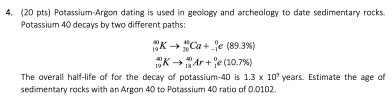 4. (20 pts) Potassium-Argon dating is used in geology and archeology to date sedimentary rocks. Potassium 40 decays by two different paths: 10K → 20Ca + _e (89.3%) 10K → 18 Ar+je (10.7%) The overall half-life of for the decay of potassium-40 is 1.3 x 100 years. Estimate the age of sedimentary rocks with an Argon 40 to Potassium 40 ratio of 0.0102.
You are dating rocks by their proportions of parent isotope potassium-40(half life 1.25 billion years) and...
You are dating rocks by their proportions of parent isotope potassium-40(half life 1.25 billion years) and daughter isotope argon-40. Find the age for a rock that contains 3 times as much Argon-40 as potassium 40
ReviewI Constants The technique known as potassium-argon dating is used to date volcanic rock and ash, and thus establish dates for nearby fossils like this hominid skull.(Figure 1) The potassi...
 ReviewI Constants The technique known as potassium-argon dating is used to date volcanic rock and ash, and thus establish dates for nearby fossils like this hominid skull.(Figure 1) The potassium isotope "0K has a 1.28-billion-year half-life and is naturally present at very low levels. Its most common decay mode is beta-minus decay into the stable isotope 40 Ca, but 10.9% of its decays are beta-plus which result in the creation of the stable isotope 40 Ar. The high temperatures in...
The half-lives of different radioisotopes are given in the table. Half-life (min) Radioisotope argon-44 12 lead-196...
 The half-lives of different radioisotopes are given in the table. Half-life (min) Radioisotope argon-44 12 lead-196 37 22 potassium 44 indium-117 43 If the initial amount of potassium-44 is 8.8 g, how much potassium-44 is left in the body after 44 min? mass: g TOOLS x10 What is the half-life of an isotope that decays to 12.5% of its original activity in 70.6 h? half-life: h The half-lives of different radioisotopes are given in the table. Half-life (min) 12 Radioisotope...
Question 9 What material is usually dated when scientists use the Potassium-Argon (K/Ar) dating method to...
Question 9 What material is usually dated when scientists use the Potassium-Argon (K/Ar) dating method to date fossils? a. Bones b. Stone tools c. Ostrich shells d. Teeth e. Volcanic rocks Question 10 __________ is a radiometric dating method popular with archaeologists that can be used to date materials up to 75,000 years old. a. Carbon-14 b. Paleomagnetism c. Dendrochronology d. K/Ar e. Biostratigraphy Question 11 Potassium-40 (40K) a. decays to the gas, argon-40 (40Ar). b. decays to carbon-14. c....
Rubidium-87 decays by β production to strontium-87 with a half life of 4.7 × 10¹⁰ years....
Rubidium-87 decays by β production to strontium-87 with a half life of 4.7 × 10¹⁰ years. What is the age of a rock sample that contains 109.7 µg 87Rb and 4.0 µg 87Sr ? ___ years old Assume that no 87Sr was present when the rock was formed. Nuclide Atomic Mass 87Rb 86.90919 87Sr 86.90888
 The half life for the radioactive decay of potassium-40 to argon-40 is 1.26 × 10⁹ years. Suppose nuclear chemical analysis shows that there is 0.444 mmol of argon-40 for every 1.000 mmol of potassium-40 in a certain sample of rock. Calculate the age of the rock. Round your answer to 2 significant digits 1.5×10 years
 The technique known as potassium-argon dating is used to date old lava flows. The potassium isotope, ^40K has a 1.28 billion year half-life and is naturally present at very low levels. ^40K decays by beta emission into ^40Ar. Argon is a gas, and there is no argon in flowing lava because the gas escapes. Once the lava solidifies, any argon produced in the decay of ^40K is trapped inside and cannot escape. A geologist brings you a piece of solidified...
 The voltaic cell is made of the following two electrodes: 9. Fe (0.200 M) 2e Fe(s) E.d= -0.44 v, Fe(0.100 M) e Fe (0.200 M) Eed0.77 v. Which electrode works as an anode? (20 pt) al Write the cell reaction. b) Calculate E°cell and Ecel. cl 10. A Cr(ag) solution is electrolyzed, using a current of 5.30 A for 2.00 days. What mass of Cr(s) (AM: 52.0) is plated out? (F=96485 C /mol) 11. For nuclear reaction occurred in the...
 The half-life of Potassium-40 (K-40) decaying to Argon-40 (Ar-40) is 1.3 billion years. Suppose an igneous rock contains 105 million atoms of Ar-40 and 15 million atoms of K-40. (Assume here that no Ar-40 was present in the mineral when it formed and that no Ar-40 has escaped since formation). Using the number of half-lives from the previous question, how old is this rock? 2.6 billion years old 5.2 billion years old 3.9 billion years old 1.3 billion years old
 4. (20 pts) Potassium-Argon dating is used in geology and archeology to date sedimentary rocks. Potassium 40 decays by two different paths: 10K → 20Ca + _e (89.3%) 10K → 18 Ar+je (10.7%) The overall half-life of for the decay of potassium-40 is 1.3 x 100 years. Estimate the age of sedimentary rocks with an Argon 40 to Potassium 40 ratio of 0.0102.
 ReviewI Constants The technique known as potassium-argon dating is used to date volcanic rock and ash, and thus establish dates for nearby fossils like this hominid skull.(Figure 1) The potassium isotope "0K has a 1.28-billion-year half-life and is naturally present at very low levels. Its most common decay mode is beta-minus decay into the stable isotope 40 Ca, but 10.9% of its decays are beta-plus which result in the creation of the stable isotope 40 Ar. The high temperatures in...
 The half-lives of different radioisotopes are given in the table. Half-life (min) Radioisotope argon-44 12 lead-196 37 22 potassium 44 indium-117 43 If the initial amount of potassium-44 is 8.8 g, how much potassium-44 is left in the body after 44 min? mass: g TOOLS x10 What is the half-life of an isotope that decays to 12.5% of its original activity in 70.6 h? half-life: h The half-lives of different radioisotopes are given in the table. Half-life (min) 12 Radioisotope...
Most questions answered within 3 hours.
-
Where is the error in this code sequence?
String s1 = "Hello";
String s2 = "ello";...
asked 10 months ago -
Financial data for Joel de Paris, Inc., for last year
follow:
Joel de Paris, Inc.
Balance...
asked 10 months ago -
Consider this reaction:
Al2(SO4)3 (aq)+ BaCl3
(aq) Al2Cl6 (aq)- +
3BaSO4(s) . What is the...
asked 10 months ago -
Suppose that Savneet is considering increasing her
recent random sample from 20 car rentals to 40...
asked 10 months ago -
Trucks arrive at an unloading terminal at an average rate of 120
per hour.
Trucks arrive...
asked 10 months ago -
Why are methanol and ethanol completely soluble in water while
octanol is not very little soluble....
asked 10 months ago -
A facilities manager at a university reads in a research report
that the mean amount of...
asked 10 months ago -
When the CuSO4 is rehydrated by adding water to the anhydrous
compound, is this an endothermic...
asked 10 months ago -
A ray of sunlight is passing from diamond into crown glass; the
angle of incidence is...
asked 10 months ago -
A block of mass 0.249 kg is placed on top of a light, vertical
spring of...
asked 10 months ago -
how do the kidneys compensate in the presences of acidosis
a) trigger hyperventilate
b) reserve acid...
asked 10 months ago -
Question 501 pts
The rental rate of capital to the firm increases. Which of the
following...
asked 10 months ago