


Homework Answers
In DC load flow method we estimate power flows on AC power systems. This looks only at active power flows and neglects reactive power flows. Hee we simplify nonlinear model of the AC system is simplified to a linear form through these assumptions:-
• Line resistances (active power losses) are negligible
• Voltage angle differences are assumed to be small
• Magnitudes of bus voltages are set to 1.0 per unit (flat voltage profile).
• Tap settings are ignored.
The real power equation after above approximations used to solve the DC load flow are:-
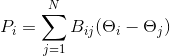
Bij is the reciprocal of the reactance between bus i and bus j and Bij is the imaginary part of Yij.
Similarly the active power flow through transmission line i, between buses s and r, can be calculated as
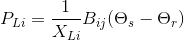
where XLi is the reactance of line i.
DC power flow equations in the matrix form are given as
![\Theta=[B]^{^{-1}}P](http://img.homeworklib.com/questions/edf4ca70-c7be-11ea-a2d1-91b0a8567224.png?x-oss-process=image/resize,w_560)

where P is Nx1 vector of bus active power injections for buses 1, …, N
B is N XN admittance matrix with R = 0
 is N X1 vector of bus voltage angles for buses 1, …,
N
is N X1 vector of bus voltage angles for buses 1, …,
N
PL is MX1 vector of branch flows (M is the number of branches)
b is M X M matrix (bkk is equal to the susceptance of line k and non-diagonal elements are zero)
A is M X N bus-branch incidence matrix
By applying to this problem and solving the appropriate
the solution for this is given as:-
| Sl.no | From Bus | To Bus | pu MW flows |
| 1 | 1 | 2 | 0.253 |
| 2 | 1 | 4 | 0.416 |
| 3 | 1 | 5 | 0.331 |
| 4 | 2 | 3 | 0.019 |
| 5 | 2 | 4 | 0.325 |
| 6 | 2 | 5 | 0.162 |
| 7 | 2 | 6 | 0.248 |
| 8 | 3 | 5 | 0.169 |
| 9 | 3 | 6 | 0.449 |
| 10 | 4 | 5 | 0.04 |
| 11 | 5 | 6 | 0.003 |
The slack bus(Bus 1) power flow is 1pu MW
Add Answer to:
For the six-bus system shown in Figure 2, use DC Power Flow method to find all...
For the six-bus system shown in Figure 2, use DC Power Flow method to find all...
 For the six-bus system shown in Figure 2, use DC Power Flow method to find all line flows and bus 1 (slack bus) power. Line and bus data are shown in Tables 1 and 2 respectively. The base is 100 MVA.
The six-bus system shown in Figure 1 will be simulated using MATLAB. Transmission line data and b...
 The six-bus system shown in Figure 1 will be simulated using MATLAB. Transmission line data and bus data are given in Tables 1 and 2 respectively. The transmission line data are calculated on 100 MVA base and 230 (line-to-line) kV base for generator. Tasks: 1. Determine the network admittance matrix Y 2. Find the load flow solution using Gauss-Seidel/Newton Raphson method until first iteration by manual calculation. Use Maltab software to solve power flow problem using Gauss-Seidel method. Find the...
Consider the single line diagram of a 3-bus power system shown in Figure 2. Slack bus...
 Consider the single line diagram of a 3-bus power system shown in Figure 2. Slack bus 3 Figure 2. The data for this system are given in Tables 1 and 2. Bus Table 1 Generation Load Assumed PG QGPLQL bus voltage (MW) (MVar) (MW) (MVar) 1.05 +10.0 - - 1.0 + 0.0 50 30 305.6 140.2 1.0 +0.0 0.0 0.0 138.6 45.2 slack bus) Table 2 Bus-to-bus Impedance 0.2 + j0.04 .01 +0.03 2.3 0.0125 + j0.025 (0) Convert all...
1. In the power system network shown in Figure 1, Vi bus 1 is a slack bus with 1.00 per unit and bus 2 is a load bus wi...
 1. In the power system network shown in Figure 1, Vi bus 1 is a slack bus with 1.00 per unit and bus 2 is a load bus with S2 Mvar. The line impedance on a base of 100 MVA is Z = 0.02 + j0.04 per unit (a) Using Gauss-Seidel method, determine V2 . Use an initial estimate of V=1.0j0.0 and perform four iterations (b) If after several iterations voltage at bus 2 converges to V2 = 0.90-j0.10, determine...
The single line diagram of a power network is shown in the figure. Bus#1 is a slack bus. The sche...
 Answer part D
The single line diagram of a power network is shown in the figure. Bus#1 is a slack bus. The scheduled powers for bus#2 and bus#3 are given. The impedances shown in the figure are all in per-unit considering a power base of 100 MVA. 30 400 MW 320 MVAr Slack V-140 j0.0125 jo.0s 00 MW 270 MVAr A. Use the Gauss Seidel technique to determine voltages at bus#2 & bus#3. (Start with an initial guess 140 for...
Answer part D
The single line diagram of a power network is shown in the figure. Bus#1 is a slack bus. The scheduled powers for bus#2 and bus#3 are given. The impedances shown in the figure are all in per-unit considering a power base of 100 MVA. 30 400 MW 320 MVAr Slack V-140 j0.0125 jo.0s 00 MW 270 MVAr A. Use the Gauss Seidel technique to determine voltages at bus#2 & bus#3. (Start with an initial guess 140 for...
ystem Design December 17, 2019 2. (20 pts.) Using the "DC" power flow method find the...
 ystem Design December 17, 2019 2. (20 pts.) Using the "DC" power flow method find the real power flows in MW between the buses and the power generated in MWW by the generator on bus 1. The impedance values shown for the lines in the figure are in per unit with a base of 100 MVA and 230 kV. PG2 = 250 MW P2 = 50 MW 120 1 3 j0.25 j0.2 j0.4 P3 = 300 MW
The single line diagram of a power network is shown in the figure. Bus#1 is a slack bus. The sche...
 The single line diagram of a power network is shown in the figure. Bus#1 is a slack bus. The scheduled powers for bus#2 and bus#3 are given. The impedances shown in the figure are all in per-unit considering a power base of 100 MVA. 30 400 MW 320 MVAr Slack V-1400.0125 jo.os 3 300 MW 270 MVAr A. Use the Gauss Seidel technique to determine voltages at bus#2 & bus#3. (Start with an initial guess 140 for both buses). [Only...
2. In the two-bus system shown in Figure 59, bus l is a slack bus with...
 2. In the two-bus system shown in Figure 59, bus l is a slack bus with Vi = 1.0/0° pu. A load of 100 MW and 50 Mvar is taken from bus 2. The line impedance is zi2 0.12 + j0.16 pu on a base of 100 MVA. Using Newton-Raphson method. obtain the voltage magnitude and phase angle of bus 2. Start with an initial estimate of | ½|(0) = 1 .0 pu and δ2(0) = 0°. Perform two terations....
Q2) For the three bus power system shown below, use the NR power flow to determine the only first...
 USING NEWTON RAPHSON
Q2) For the three bus power system shown below, use the NR power flow to determine the only first iteration voltage magnitude and angle at bus 2 and bus 3. Assume that SB 100 MVA Bus 1 Bus 2 s3.85 1.90 22.36 2.0331.62 [1.89 31.62 1.89 40 W258.13 1.10 5.7/20s Gen 58.131-1.1035.772.03 31.62 1.89 35.772.03 67.231.17 250 MVr Bus Slack Bus V10510 pu Bus 3 Gen V3-1.04 pu p- 200 Mw 2 1 211 11 + i...
USING NEWTON RAPHSON
Q2) For the three bus power system shown below, use the NR power flow to determine the only first iteration voltage magnitude and angle at bus 2 and bus 3. Assume that SB 100 MVA Bus 1 Bus 2 s3.85 1.90 22.36 2.0331.62 [1.89 31.62 1.89 40 W258.13 1.10 5.7/20s Gen 58.131-1.1035.772.03 31.62 1.89 35.772.03 67.231.17 250 MVr Bus Slack Bus V10510 pu Bus 3 Gen V3-1.04 pu p- 200 Mw 2 1 211 11 + i...
(POWER SYSTEM ANALYSIS) Load + Load Figure 1. One line diagram of a three bus power...
 (POWER SYSTEM ANALYSIS) Load + Load Figure 1. One line diagram of a three bus power transmission system. In Figure 1, the power flows in the transmission lines are to be found. In this system, 100 MVA and 154 kV are the base values. The generator bus, which is shown as Bus 1, is considered to be an infinite bus and the voltage magnitude and the angle are 1 and 0°, respectively. The voltages of Bus 2 and Bus 3...
 For the six-bus system shown in Figure 2, use DC Power Flow method to find all line flows and bus 1 (slack bus) power. Line and bus data are shown in Tables 1 and 2 respectively. The base is 100 MVA.
 The six-bus system shown in Figure 1 will be simulated using MATLAB. Transmission line data and bus data are given in Tables 1 and 2 respectively. The transmission line data are calculated on 100 MVA base and 230 (line-to-line) kV base for generator. Tasks: 1. Determine the network admittance matrix Y 2. Find the load flow solution using Gauss-Seidel/Newton Raphson method until first iteration by manual calculation. Use Maltab software to solve power flow problem using Gauss-Seidel method. Find the...
 Consider the single line diagram of a 3-bus power system shown in Figure 2. Slack bus 3 Figure 2. The data for this system are given in Tables 1 and 2. Bus Table 1 Generation Load Assumed PG QGPLQL bus voltage (MW) (MVar) (MW) (MVar) 1.05 +10.0 - - 1.0 + 0.0 50 30 305.6 140.2 1.0 +0.0 0.0 0.0 138.6 45.2 slack bus) Table 2 Bus-to-bus Impedance 0.2 + j0.04 .01 +0.03 2.3 0.0125 + j0.025 (0) Convert all...
 1. In the power system network shown in Figure 1, Vi bus 1 is a slack bus with 1.00 per unit and bus 2 is a load bus with S2 Mvar. The line impedance on a base of 100 MVA is Z = 0.02 + j0.04 per unit (a) Using Gauss-Seidel method, determine V2 . Use an initial estimate of V=1.0j0.0 and perform four iterations (b) If after several iterations voltage at bus 2 converges to V2 = 0.90-j0.10, determine...
 Answer part D
The single line diagram of a power network is shown in the figure. Bus#1 is a slack bus. The scheduled powers for bus#2 and bus#3 are given. The impedances shown in the figure are all in per-unit considering a power base of 100 MVA. 30 400 MW 320 MVAr Slack V-140 j0.0125 jo.0s 00 MW 270 MVAr A. Use the Gauss Seidel technique to determine voltages at bus#2 & bus#3. (Start with an initial guess 140 for...
Answer part D
The single line diagram of a power network is shown in the figure. Bus#1 is a slack bus. The scheduled powers for bus#2 and bus#3 are given. The impedances shown in the figure are all in per-unit considering a power base of 100 MVA. 30 400 MW 320 MVAr Slack V-140 j0.0125 jo.0s 00 MW 270 MVAr A. Use the Gauss Seidel technique to determine voltages at bus#2 & bus#3. (Start with an initial guess 140 for...
 ystem Design December 17, 2019 2. (20 pts.) Using the "DC" power flow method find the real power flows in MW between the buses and the power generated in MWW by the generator on bus 1. The impedance values shown for the lines in the figure are in per unit with a base of 100 MVA and 230 kV. PG2 = 250 MW P2 = 50 MW 120 1 3 j0.25 j0.2 j0.4 P3 = 300 MW
 The single line diagram of a power network is shown in the figure. Bus#1 is a slack bus. The scheduled powers for bus#2 and bus#3 are given. The impedances shown in the figure are all in per-unit considering a power base of 100 MVA. 30 400 MW 320 MVAr Slack V-1400.0125 jo.os 3 300 MW 270 MVAr A. Use the Gauss Seidel technique to determine voltages at bus#2 & bus#3. (Start with an initial guess 140 for both buses). [Only...
 2. In the two-bus system shown in Figure 59, bus l is a slack bus with Vi = 1.0/0° pu. A load of 100 MW and 50 Mvar is taken from bus 2. The line impedance is zi2 0.12 + j0.16 pu on a base of 100 MVA. Using Newton-Raphson method. obtain the voltage magnitude and phase angle of bus 2. Start with an initial estimate of | ½|(0) = 1 .0 pu and δ2(0) = 0°. Perform two terations....
 USING NEWTON RAPHSON
Q2) For the three bus power system shown below, use the NR power flow to determine the only first iteration voltage magnitude and angle at bus 2 and bus 3. Assume that SB 100 MVA Bus 1 Bus 2 s3.85 1.90 22.36 2.0331.62 [1.89 31.62 1.89 40 W258.13 1.10 5.7/20s Gen 58.131-1.1035.772.03 31.62 1.89 35.772.03 67.231.17 250 MVr Bus Slack Bus V10510 pu Bus 3 Gen V3-1.04 pu p- 200 Mw 2 1 211 11 + i...
USING NEWTON RAPHSON
Q2) For the three bus power system shown below, use the NR power flow to determine the only first iteration voltage magnitude and angle at bus 2 and bus 3. Assume that SB 100 MVA Bus 1 Bus 2 s3.85 1.90 22.36 2.0331.62 [1.89 31.62 1.89 40 W258.13 1.10 5.7/20s Gen 58.131-1.1035.772.03 31.62 1.89 35.772.03 67.231.17 250 MVr Bus Slack Bus V10510 pu Bus 3 Gen V3-1.04 pu p- 200 Mw 2 1 211 11 + i...
 (POWER SYSTEM ANALYSIS) Load + Load Figure 1. One line diagram of a three bus power transmission system. In Figure 1, the power flows in the transmission lines are to be found. In this system, 100 MVA and 154 kV are the base values. The generator bus, which is shown as Bus 1, is considered to be an infinite bus and the voltage magnitude and the angle are 1 and 0°, respectively. The voltages of Bus 2 and Bus 3...
Most questions answered within 3 hours.
-
Where is the error in this code sequence?
String s1 = "Hello";
String s2 = "ello";...
asked 10 months ago -
Financial data for Joel de Paris, Inc., for last year
follow:
Joel de Paris, Inc.
Balance...
asked 10 months ago -
Consider this reaction:
Al2(SO4)3 (aq)+ BaCl3
(aq) Al2Cl6 (aq)- +
3BaSO4(s) . What is the...
asked 10 months ago -
Suppose that Savneet is considering increasing her
recent random sample from 20 car rentals to 40...
asked 10 months ago -
Trucks arrive at an unloading terminal at an average rate of 120
per hour.
Trucks arrive...
asked 10 months ago -
Why are methanol and ethanol completely soluble in water while
octanol is not very little soluble....
asked 10 months ago -
A facilities manager at a university reads in a research report
that the mean amount of...
asked 10 months ago -
When the CuSO4 is rehydrated by adding water to the anhydrous
compound, is this an endothermic...
asked 10 months ago -
A ray of sunlight is passing from diamond into crown glass; the
angle of incidence is...
asked 10 months ago -
A block of mass 0.249 kg is placed on top of a light, vertical
spring of...
asked 10 months ago -
how do the kidneys compensate in the presences of acidosis
a) trigger hyperventilate
b) reserve acid...
asked 10 months ago -
Question 501 pts
The rental rate of capital to the firm increases. Which of the
following...
asked 10 months ago