
Homework Answers
![(a) FB.D = FB is in + j Diredie =+ [ėx B] Brust be - to get ti ..Bes sents the page]](http://img.homeworklib.com/questions/136606e0-cb6c-11ea-b347-8d042b74d14f.png?x-oss-process=image/resize,w_560)
I hope you understood the problem and got your answers, If yes rate me!! or else comment for a better solutions.
Add Answer to:
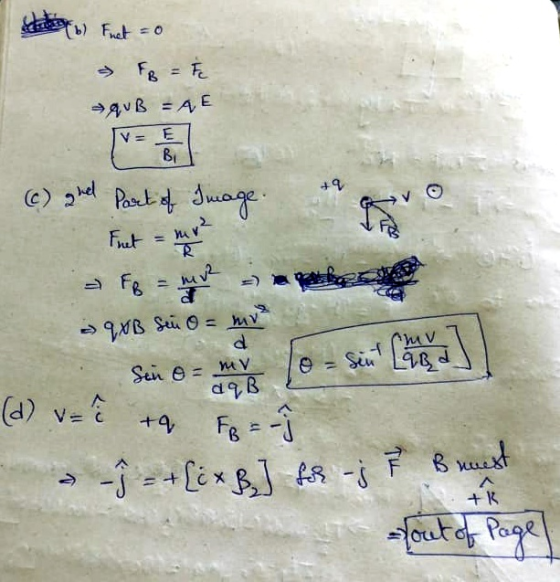
3. A beam of particles with charge +q, mass m and velocity v go straight through...
Suppose that a region with a uniform magnetic field B also has a uniform electric field...
Suppose that a region with a uniform magnetic field B also has a uniform electric field E perpendicular to the magnetic field, an arrangement called crossed fields. Show that for a charged particle moving in such crossed fields in a direction perpendicular to both E and B, the electric force cancels the magnetic force, provided the particle has a speed v= E/B If the magnetic field is in the vertical upward direction and the electric field is in the northward...
(A) What is the velocity of a beam of electrons that go undeflected when passing through...
(A) What is the velocity of a beam of electrons that go undeflected when passing through crossed electric and magnetic fields of magnitude 1.39x10⁴ V/m and 2.92x10⁻³ T, respectively? (B) The magnetic field in a cyclotron is 0.1 T. What must the minimum radius of the dees be in metres, if a proton beam is to be produced with a maximum speed of 1×10⁷ m/s? (C) The beam of electrons goes undeflected when passing through crossed electric and magnetic fields...
A uniform electric field of magnitude 148 kV/m is directed upward in a region of space....
 A uniform electric field of magnitude 148 kV/m is directed upward in a region of space. A uniform magnetic field of magnitude 0.42 T perpendicular to the electric field also exists in this region. A beam of positively charged particles travels into the region. Determine the speed of the particles at which they will not be deflected by the crossed electric and magnetic fields. (Assume the beam of particles travels perpendicularly to both fields.) m/s
Crossed E and B Fields. A particle with initial velocity V = (5.85 * 10^3 m/s)...
Crossed E and B Fields. A particle with initial velocity V = (5.85 * 10^3 m/s) j enters a region of uniform electric and magnetic fields. The magnetic field in the region is B= -(1.350 T) k . Calculate the magnitude and direction of the electric field in the region if the particle is to pass through undeflected, for a particle of charge (a) +0.640 nC and (b) -0.320 nC. You can ignore the weight of the particle.
A velocity selector is used in accelerator mass spectrometry to select particles based on their speed.
 A velocity selector is used in accelerator mass spectrometry to select particles based on their speed. The velocity selector is composed of orthogonal electric and magnetic fields, such that particles with the correct charge to mass ratio and speed will be unaffected, and other particles will be deflected. If the Electric Field is oriented down, What is the direction of the Magnetic Field? A charged particle moves through the velocity selector at a constant speed in a straight line. The electric field...
Two particles have equal masses m and electric charges of equal magnitude and opposite sign (+q...
Two particles have equal masses m and electric charges of equal magnitude and opposite sign (+q and –q). The particles are held at rest in uniform magnetic field with a magnitude of B. The direction of the field is perpendicular to the line connecting the charges. The particles are released simultaneously. What is the minimum initial separation L so that the particles do not collide after they are released? Neglect the magnetic fields produced by the particles themselves and the...
Velocity Selector-multiple choice
 The Velocity SelectorIn experiments where all the charged particles in a beam are required to have the same velocity (for example, when entering a mass spectrometer), scientists use a velocity selector. A velocity selector has a region of uniform electric and magnetic fields that are perpendicular to each other and perpendicular to the motion of the charged particles. Both the electric and magnetic fields exert a force on the charged particles. If a particle has precisely the right velocity, the...
Electrons (mass m, charge –e) are accelerated from rest through a potential difference V and are...
Electrons (mass m, charge –e) are accelerated from rest through a potential difference V and are then deflected by a magnetic field B that is perpendicular to their velocity. The radius of the resulting electron trajectory is:
3. (a) Show that when a particle with mass m and charge q enters a magnetic...
 3. (a) Show that when a particle with mass m and charge q enters a magnetic field having its velocity v perpendicular to the direction of the magnetic field B, it will perform a mv circular path of radius R- qB (b) Using the previous result find an expression for the period T of the circular motion. (c) A charged particle moves into a region of uniform magnetic field, goes through half a circle and then exits that region, as...
A singly ionized particle (charge =+e) beam of various isotopes moving at various speeds through a...
A singly ionized particle (charge =+e) beam of various isotopes moving at various speeds through a region of electric and magnetic fields ,with E V m =1000 / and B T = 0.5 . a) what should be the angle between these crossed fields so that they act like a velocity selector? Draw a picture indicating field directions. b) Explain clearly how this setup selects a single velocity among many within the beam. c) Calculate the value of this selected...
 A uniform electric field of magnitude 148 kV/m is directed upward in a region of space. A uniform magnetic field of magnitude 0.42 T perpendicular to the electric field also exists in this region. A beam of positively charged particles travels into the region. Determine the speed of the particles at which they will not be deflected by the crossed electric and magnetic fields. (Assume the beam of particles travels perpendicularly to both fields.) m/s
 3. (a) Show that when a particle with mass m and charge q enters a magnetic field having its velocity v perpendicular to the direction of the magnetic field B, it will perform a mv circular path of radius R- qB (b) Using the previous result find an expression for the period T of the circular motion. (c) A charged particle moves into a region of uniform magnetic field, goes through half a circle and then exits that region, as...
Most questions answered within 3 hours.
-
Where is the error in this code sequence?
String s1 = "Hello";
String s2 = "ello";...
asked 11 months ago -
Financial data for Joel de Paris, Inc., for last year
follow:
Joel de Paris, Inc.
Balance...
asked 11 months ago -
Consider this reaction:
Al2(SO4)3 (aq)+ BaCl3
(aq) Al2Cl6 (aq)- +
3BaSO4(s) . What is the...
asked 11 months ago -
Suppose that Savneet is considering increasing her
recent random sample from 20 car rentals to 40...
asked 11 months ago -
Trucks arrive at an unloading terminal at an average rate of 120
per hour.
Trucks arrive...
asked 11 months ago -
Why are methanol and ethanol completely soluble in water while
octanol is not very little soluble....
asked 11 months ago -
A facilities manager at a university reads in a research report
that the mean amount of...
asked 11 months ago -
When the CuSO4 is rehydrated by adding water to the anhydrous
compound, is this an endothermic...
asked 11 months ago -
A ray of sunlight is passing from diamond into crown glass; the
angle of incidence is...
asked 11 months ago -
A block of mass 0.249 kg is placed on top of a light, vertical
spring of...
asked 11 months ago -
how do the kidneys compensate in the presences of acidosis
a) trigger hyperventilate
b) reserve acid...
asked 11 months ago -
Question 501 pts
The rental rate of capital to the firm increases. Which of the
following...
asked 11 months ago