
Homework Answers
Add Answer to:
i need clear writing please
1) Water from a stationary horizontal nozzle strikes a lat plate...
2.) Water from a stationary nozzle strikes a flat plate as shown below. The water leaves...
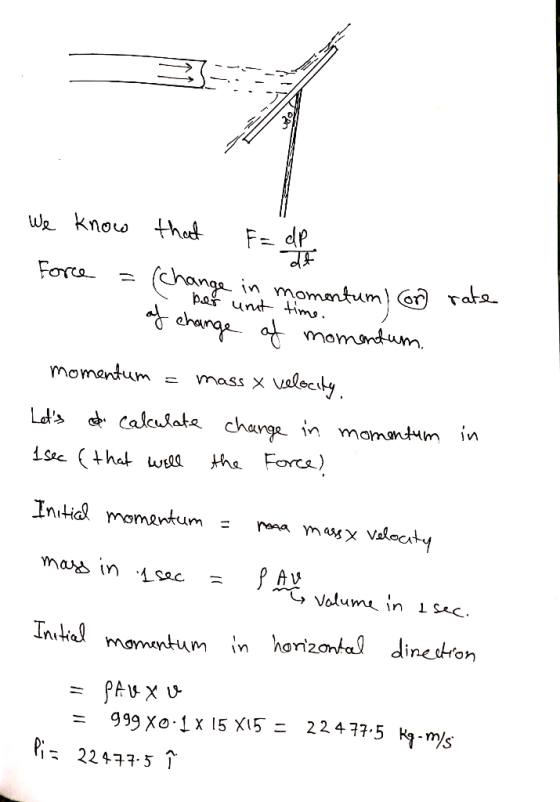
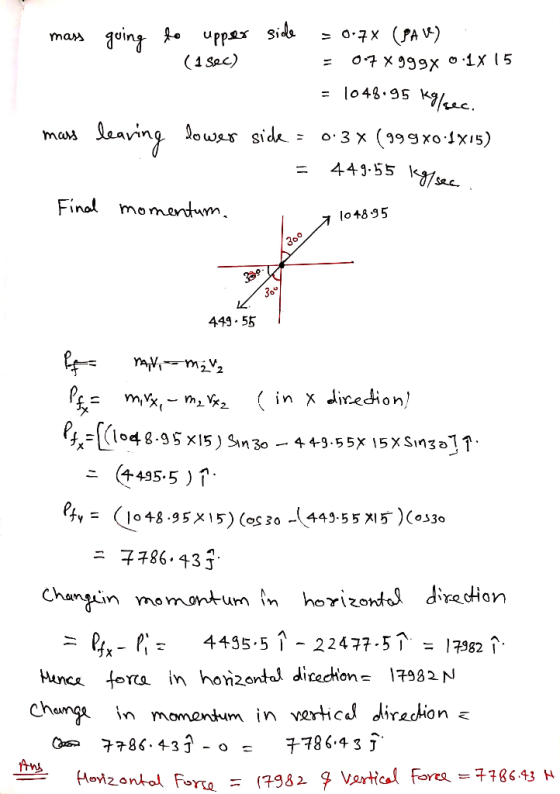
 2.) Water from a stationary nozzle strikes a flat plate as shown below. The water leaves the nozzle at 15 m/s; the nozzle area is 0.01 m2. Assuming the water is directed normal to the plate, and flows along the plate, determine the horizontal for on the support. FLOW -Plate 6 NEPLE
A horizontal water jet impinges against the vertical back surface of a stationary cart. After striking...
A horizontal water jet impinges against the vertical back surface of a stationary cart. After striking the surface the water stream splatters off in all directions along the surface of the plate. The diameter of the nozzle exit is 6 cm and the water jet leaves the nozzle at 20 m/sec. If the mass of the cart is 400 kg and if there is no friction between its wheels and the ground calculate the acceleration of the cart when the...
Air flows into the atmosphere from a nozzle and strikes a vertical plate as shown in...
 Air flows into the atmosphere from a nozzle and strikes a vertical plate as shown in below figure. The reading on the pressure gage was 1.82 kPa. Determine the horizontal force required to hold the plate in place. Assume the flow to be incompressible and frictionless. Also consider the density of air is 1.23 kg/m² and neglect the air weight. P-1.82 kPa F-IN A-0.003 m A-0.01 m
Air flows into the atmosphere from a nozzle and strikes a vertical plate as shown in...
 Air flows into the atmosphere from a nozzle and strikes a
vertical plate as shown in below figure. The reading on the
pressure gage was 1.82 kPa. Determine the horizontal force required
to hold the plate in place. Assume the flow to be incompressible
and frictionless. Also consider the density of air is 1.23 kg/m3
and neglect the air weight.
P= 1.82 kPa F = ?? N A=0.003 m A = 0,01 m²
Air flows into the atmosphere from a nozzle and strikes a
vertical plate as shown in below figure. The reading on the
pressure gage was 1.82 kPa. Determine the horizontal force required
to hold the plate in place. Assume the flow to be incompressible
and frictionless. Also consider the density of air is 1.23 kg/m3
and neglect the air weight.
P= 1.82 kPa F = ?? N A=0.003 m A = 0,01 m²
1 (a) A steady stream of water jet discharges from the nozzle with a uniform velocity...
 1 (a) A steady stream of water jet discharges from the nozzle with a uniform velocity of 10 m/s at angle 60° as shown in Figure 1. The jet strikes a horizontal plate 2 m above the nozzle exit. Upon impact, part of the flow is guided towards the left while the remainder towards the right, and the plate is suspended in the air. The weight of the plate is 25 N. Assume frictionless flow along the plate and weight...
III A horizontal 4-cm-diameter jet of water strikes a vertical plate. Determine the velocity issuing from...
 III A horizontal 4-cm-diameter jet of water strikes a vertical plate. Determine the velocity issuing from the jet if a force of 700 N is needed to 1) Hold the plate stationary 2) Move the plate away from the jet at 8 m/s
Show all work and answer all parts of the problem please. The 45 degree elbow nozzle discharges water into the atmosphere. The cross-sectional area of the elbow is 25 cm2 150 cm2 at the inlet and...
 Show all work and answer all parts of the problem
please.
The 45 degree elbow nozzle discharges water into the atmosphere. The cross-sectional area of the elbow is 25 cm2 150 cm2 at the inlet and 25 cm2 at the exit. Velocity at point 1 and 2 are given as 2 m/s and 12 m/s 450 respectively. The gage pressure at 1 is 73 kPa 150 em2 30 cm The elevation difference between the centers of the exit and the...
Show all work and answer all parts of the problem
please.
The 45 degree elbow nozzle discharges water into the atmosphere. The cross-sectional area of the elbow is 25 cm2 150 cm2 at the inlet and 25 cm2 at the exit. Velocity at point 1 and 2 are given as 2 m/s and 12 m/s 450 respectively. The gage pressure at 1 is 73 kPa 150 em2 30 cm The elevation difference between the centers of the exit and the...
please show me how I can finds the answers of these two examples Example 1: Design of a Solar Heater (Black bodies: no convection) A square flat plate collector is exposed to solar radiation from...
 please show me how I can finds the answers of these two
examples
Example 1: Design of a Solar Heater (Black bodies: no convection) A square flat plate collector is exposed to solar radiation from both the sides. The exposed surface of the plate has an absorptivity of 1.0 for solar radiation. On a clear summer day on the earth's surface the solar radiation flux is approximately 1140 W/m2 and the surrounding air temperature is 25oC. Determine the surface temperature?...
please show me how I can finds the answers of these two
examples
Example 1: Design of a Solar Heater (Black bodies: no convection) A square flat plate collector is exposed to solar radiation from both the sides. The exposed surface of the plate has an absorptivity of 1.0 for solar radiation. On a clear summer day on the earth's surface the solar radiation flux is approximately 1140 W/m2 and the surrounding air temperature is 25oC. Determine the surface temperature?...
Objective To determine the force generated by a jet of water striking on a surface Description...
 Objective To determine the force generated by a jet of water striking on a surface Description of apparatus The supply is led to a vertical pipe terminating in a tapered nozzle. This produces a jet of water which impinges on the vane in the form of a Flat Plate, Hemispherical Cup, Conical Plate or 30° Angled Plate. The nozzle and vane are contained within a transparent cylinder; at the base of the cylinder there is an outlet by which the...
Homework 7 heat transfer 2018-20 1) A horizontal tube of 12.5-mm dimeter with an outer srface temperature of 240°C is placed in a room with an air temperature of 20°C. Estimate the heat transfer rate...
 Homework 7 heat transfer 2018-20 1) A horizontal tube of 12.5-mm dimeter with an outer srface temperature of 240°C is placed in a room with an air temperature of 20°C. Estimate the heat transfer rate per unit length of the tube due to free convection. 2) Air at -10°C flows at 10 m/s over the roof plate of two 5m length rooms whose air is at Too-200C. The roof plate is 0.20-m thick concrete (k = 0.6 w/ m. K)....
 2.) Water from a stationary nozzle strikes a flat plate as shown below. The water leaves the nozzle at 15 m/s; the nozzle area is 0.01 m2. Assuming the water is directed normal to the plate, and flows along the plate, determine the horizontal for on the support. FLOW -Plate 6 NEPLE
 Air flows into the atmosphere from a nozzle and strikes a vertical plate as shown in below figure. The reading on the pressure gage was 1.82 kPa. Determine the horizontal force required to hold the plate in place. Assume the flow to be incompressible and frictionless. Also consider the density of air is 1.23 kg/m² and neglect the air weight. P-1.82 kPa F-IN A-0.003 m A-0.01 m
 Air flows into the atmosphere from a nozzle and strikes a
vertical plate as shown in below figure. The reading on the
pressure gage was 1.82 kPa. Determine the horizontal force required
to hold the plate in place. Assume the flow to be incompressible
and frictionless. Also consider the density of air is 1.23 kg/m3
and neglect the air weight.
P= 1.82 kPa F = ?? N A=0.003 m A = 0,01 m²
Air flows into the atmosphere from a nozzle and strikes a
vertical plate as shown in below figure. The reading on the
pressure gage was 1.82 kPa. Determine the horizontal force required
to hold the plate in place. Assume the flow to be incompressible
and frictionless. Also consider the density of air is 1.23 kg/m3
and neglect the air weight.
P= 1.82 kPa F = ?? N A=0.003 m A = 0,01 m²
 1 (a) A steady stream of water jet discharges from the nozzle with a uniform velocity of 10 m/s at angle 60° as shown in Figure 1. The jet strikes a horizontal plate 2 m above the nozzle exit. Upon impact, part of the flow is guided towards the left while the remainder towards the right, and the plate is suspended in the air. The weight of the plate is 25 N. Assume frictionless flow along the plate and weight...
 III A horizontal 4-cm-diameter jet of water strikes a vertical plate. Determine the velocity issuing from the jet if a force of 700 N is needed to 1) Hold the plate stationary 2) Move the plate away from the jet at 8 m/s
 Show all work and answer all parts of the problem
please.
The 45 degree elbow nozzle discharges water into the atmosphere. The cross-sectional area of the elbow is 25 cm2 150 cm2 at the inlet and 25 cm2 at the exit. Velocity at point 1 and 2 are given as 2 m/s and 12 m/s 450 respectively. The gage pressure at 1 is 73 kPa 150 em2 30 cm The elevation difference between the centers of the exit and the...
Show all work and answer all parts of the problem
please.
The 45 degree elbow nozzle discharges water into the atmosphere. The cross-sectional area of the elbow is 25 cm2 150 cm2 at the inlet and 25 cm2 at the exit. Velocity at point 1 and 2 are given as 2 m/s and 12 m/s 450 respectively. The gage pressure at 1 is 73 kPa 150 em2 30 cm The elevation difference between the centers of the exit and the...
 please show me how I can finds the answers of these two
examples
Example 1: Design of a Solar Heater (Black bodies: no convection) A square flat plate collector is exposed to solar radiation from both the sides. The exposed surface of the plate has an absorptivity of 1.0 for solar radiation. On a clear summer day on the earth's surface the solar radiation flux is approximately 1140 W/m2 and the surrounding air temperature is 25oC. Determine the surface temperature?...
please show me how I can finds the answers of these two
examples
Example 1: Design of a Solar Heater (Black bodies: no convection) A square flat plate collector is exposed to solar radiation from both the sides. The exposed surface of the plate has an absorptivity of 1.0 for solar radiation. On a clear summer day on the earth's surface the solar radiation flux is approximately 1140 W/m2 and the surrounding air temperature is 25oC. Determine the surface temperature?...
 Objective To determine the force generated by a jet of water striking on a surface Description of apparatus The supply is led to a vertical pipe terminating in a tapered nozzle. This produces a jet of water which impinges on the vane in the form of a Flat Plate, Hemispherical Cup, Conical Plate or 30° Angled Plate. The nozzle and vane are contained within a transparent cylinder; at the base of the cylinder there is an outlet by which the...
 Homework 7 heat transfer 2018-20 1) A horizontal tube of 12.5-mm dimeter with an outer srface temperature of 240°C is placed in a room with an air temperature of 20°C. Estimate the heat transfer rate per unit length of the tube due to free convection. 2) Air at -10°C flows at 10 m/s over the roof plate of two 5m length rooms whose air is at Too-200C. The roof plate is 0.20-m thick concrete (k = 0.6 w/ m. K)....
Most questions answered within 3 hours.
-
Where is the error in this code sequence?
String s1 = "Hello";
String s2 = "ello";...
asked 10 months ago -
Financial data for Joel de Paris, Inc., for last year
follow:
Joel de Paris, Inc.
Balance...
asked 10 months ago -
Consider this reaction:
Al2(SO4)3 (aq)+ BaCl3
(aq) Al2Cl6 (aq)- +
3BaSO4(s) . What is the...
asked 10 months ago -
Suppose that Savneet is considering increasing her
recent random sample from 20 car rentals to 40...
asked 10 months ago -
Trucks arrive at an unloading terminal at an average rate of 120
per hour.
Trucks arrive...
asked 10 months ago -
Why are methanol and ethanol completely soluble in water while
octanol is not very little soluble....
asked 10 months ago -
A facilities manager at a university reads in a research report
that the mean amount of...
asked 10 months ago -
When the CuSO4 is rehydrated by adding water to the anhydrous
compound, is this an endothermic...
asked 10 months ago -
A ray of sunlight is passing from diamond into crown glass; the
angle of incidence is...
asked 10 months ago -
A block of mass 0.249 kg is placed on top of a light, vertical
spring of...
asked 10 months ago -
how do the kidneys compensate in the presences of acidosis
a) trigger hyperventilate
b) reserve acid...
asked 10 months ago -
Question 501 pts
The rental rate of capital to the firm increases. Which of the
following...
asked 10 months ago