In a batch of 20 television picture tubes, 5 are known to be defective. What is...
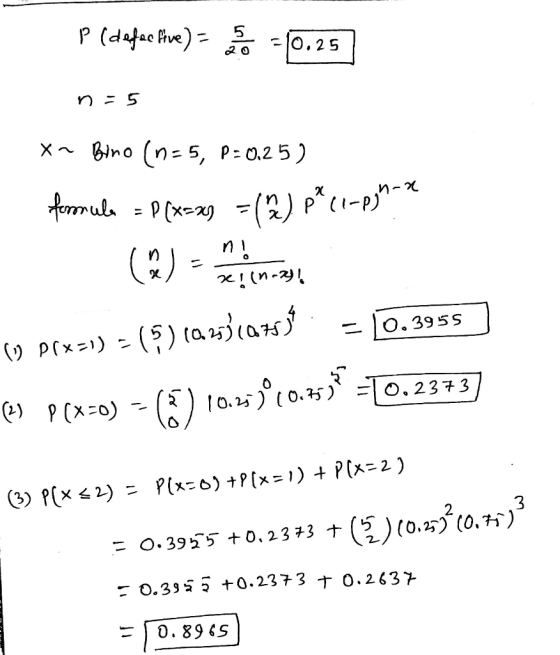
In a batch of 20 television picture tubes, 5 are known to be defective. What is the probability that a random sample of 5 (without replacement) will result in each of the following?
Exactly 1 defective
No defectives
Two or fewer defectives
Homework Answers
Add Answer to:
In a batch of 20 television picture tubes, 5 are known to be
defective. What is...
Suppose that in a batch of 500 components, 20 are defective and the rest are good....
Suppose that in a batch of 500 components, 20 are defective and the rest are good. A sample of 10 components is selected at random with replacement, and tested. Let X denote the number of defectives in the sample. a. What is the PMF of X? State the distribution, its parameters, and give the equation for its PMF with the correct parameters. b. What is the probability that the sample contains at least one defective component?
A batch of 587 containers for frozen orange juice defective. Two are se (a) What is...
 A batch of 587 containers for frozen orange juice defective. Two are se (a) What is the probability that the second one selected is defective given that the first one was contains 5 that are defective. Two are selected, at random, without replacement from the batch. Round your answers to four decimal places (e.g. 98 (c) What is the probability that both are acceptable?
2-108. + A batch of 500 containers for frozen orange juice contains 5 that are defective....
 2-108. + A batch of 500 containers for frozen orange juice contains 5 that are defective. Two are selected, at random, with out replacement from the batch. (a) What is the probability that the second one selected is defective given that the first one was defective? (b) What is the probability that both are defective? (c) What is the probability that both are acceptable? Three containers are selected, at random, without replace- ment, from the batch. given that the first...
In a production facility ., a batch of three hundred products contains eight that are defective....
In a production facility ., a batch of three hundred products contains eight that are defective. Two are selected from batch, at random, without replacement * What is the probability that the second one selected is defective given that the firstone was defective? *What is the probability that both are def ective? *What is the probability that both are acceptable?
A sample of 20 different iPads is randomly selected from a production batch containing 3% defectives....
A sample of 20 different iPads is randomly selected from a production batch containing 3% defectives. What is the probability that exactly 4 are working properly? What is the probability that at most one from the 20 randomly selected is defective?
Two competing companies make television picture tubes. A random sample of 100 tubes showed that the...
Two competing companies make television picture tubes. A random sample of 100 tubes showed that the average lifetime was 6.3 years with a population standard deviation of 0.8 years. Another random sample of 100 different tubes showed that the average lifetime was 6.2 years with a population standard deviation of 0.5 years. Using the 0.01 level of significance, determine if the first tubes last longer using traditional hypothesis testing. Provide statistical evidence to support your findings.
A machine produces an average of 10% defective bolts. A batch is accepted if a sample...
A machine produces an average of 10% defective bolts. A batch is accepted if a sample of five bolts taken from the batch that contains no defective and rejected if the sample contains 3 or more defectives. In other cases, a second sample is taken. 1- ehatvis rhe probability that the second sample will be required 2- what Is the probability that the sample is rejected 3- if 15 bolts are taken from a batch, how many bolts are defective
:Among 20 metal parts produced in a machine shop, 5 are defective. If a random sample...
:Among 20 metal parts produced in a machine shop, 5 are defective. If a random sample of three of these metal parts is selected, find: 1. The probability that this sample will contain at least two defectives? 2. The probability that this sample will contain at most one defective? Note: Use hypergeometric probability formula
A bin of 50 parts contains 5 that are defective. A sample of 10 parts is...
A bin of 50 parts contains 5 that are defective. A sample of 10 parts is selected at random, without replacement. (a) How many different samples of size 10 are there that contain at least three defective parts? (b) How many ways to obtain a sample of 10 parts from the bin of 50? (c) What is the probability of obtaining at least three defectives in a sample of 10 parts?
A manufacturer produces a component for use in the automotive industry. It is known that 1%...
A manufacturer produces a component for use in the automotive industry. It is known that 1% of the items produced are defective. Suppose a random sample of 20 items is examined. (a) Find the probability that (i) no defectives are found in the sample, (ii) one or fewer defectives are found in the sample. (b) Find: (i) the mean (expected) number of defectives in the sample, (ii) the variance and standard deviation.
 A batch of 587 containers for frozen orange juice defective. Two are se (a) What is the probability that the second one selected is defective given that the first one was contains 5 that are defective. Two are selected, at random, without replacement from the batch. Round your answers to four decimal places (e.g. 98 (c) What is the probability that both are acceptable?
 2-108. + A batch of 500 containers for frozen orange juice contains 5 that are defective. Two are selected, at random, with out replacement from the batch. (a) What is the probability that the second one selected is defective given that the first one was defective? (b) What is the probability that both are defective? (c) What is the probability that both are acceptable? Three containers are selected, at random, without replace- ment, from the batch. given that the first...
Most questions answered within 3 hours.
-
Where is the error in this code sequence?
String s1 = "Hello";
String s2 = "ello";...
asked 11 months ago -
Financial data for Joel de Paris, Inc., for last year
follow:
Joel de Paris, Inc.
Balance...
asked 11 months ago -
Consider this reaction:
Al2(SO4)3 (aq)+ BaCl3
(aq) Al2Cl6 (aq)- +
3BaSO4(s) . What is the...
asked 11 months ago -
Suppose that Savneet is considering increasing her
recent random sample from 20 car rentals to 40...
asked 11 months ago -
Trucks arrive at an unloading terminal at an average rate of 120
per hour.
Trucks arrive...
asked 11 months ago -
Why are methanol and ethanol completely soluble in water while
octanol is not very little soluble....
asked 11 months ago -
A facilities manager at a university reads in a research report
that the mean amount of...
asked 11 months ago -
When the CuSO4 is rehydrated by adding water to the anhydrous
compound, is this an endothermic...
asked 11 months ago -
A ray of sunlight is passing from diamond into crown glass; the
angle of incidence is...
asked 11 months ago -
A block of mass 0.249 kg is placed on top of a light, vertical
spring of...
asked 11 months ago -
how do the kidneys compensate in the presences of acidosis
a) trigger hyperventilate
b) reserve acid...
asked 11 months ago -
Question 501 pts
The rental rate of capital to the firm increases. Which of the
following...
asked 11 months ago