
Homework Answers
Add Answer to:
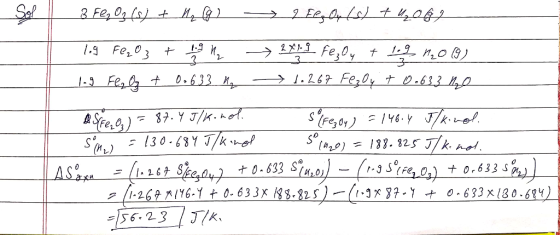
Consider the reaction: 3Fe2O3(8) + H2(g)_2F43046) + H20(8) Using standard absolute entropies at 298K, calculate the...
Consider the reaction: 4HCl(g) + O2(g)—2H2O(g) + 2Cl2(9) Using standard absolute entropies at 298K, calculate the...
 Consider the reaction: 4HCl(g) + O2(g)—2H2O(g) + 2Cl2(9) Using standard absolute entropies at 298K, calculate the entropy change for the system when 2.02 moles of HCl(g) react at standard conditions. AS J/K system Submit Answer Retry Entire Group 8 more group attempts remaining Consider the reaction: H2(g) + Cl2(g) —2HCl(g) Using standard absolute entropies at 298K, calculate the entropy change for the system when 2.40 moles of H2(g) react at standard conditions. AS J/K system Submit Answer Retry Entire Group...
6. Consider the reaction: 2HBr(g) + Cl2(g)—2HCl(g) + Brz(€) Using standard absolute entropies at 298K, calculate...
 6.
Consider the reaction: 2HBr(g) + Cl2(g)—2HCl(g) + Brz(€) Using standard absolute entropies at 298K, calculate the entropy change for the system when 2.45 moles of HBr(g) react at standard conditions. AS J/K system Consider the reaction: H2(g) + Cl2(g) +2HC (g) Using standard absolute entropies at 298K, calculate the entropy change for the system when 1.72 moles of H2() react at standard conditions. AS system J/K
6.
Consider the reaction: 2HBr(g) + Cl2(g)—2HCl(g) + Brz(€) Using standard absolute entropies at 298K, calculate the entropy change for the system when 2.45 moles of HBr(g) react at standard conditions. AS J/K system Consider the reaction: H2(g) + Cl2(g) +2HC (g) Using standard absolute entropies at 298K, calculate the entropy change for the system when 1.72 moles of H2() react at standard conditions. AS system J/K
Consider the reaction: 2Fe(s) + 3Cl2(g)— 2FeCl3(s) Using standard absolute entropies at 298K, calculate the entropy...
 Consider the reaction: 2Fe(s) + 3Cl2(g)— 2FeCl3(s) Using standard absolute entropies at 298K, calculate the entropy change for the system when 2.28 moles of Fe(s) react at standard conditions. ASºsystem JK Consider the reaction: NH4Cl(aq)— »NH3(g) + HCl(aq) Using standard absolute entropies at 298K, calculate the entropy change for the system when 1.86 moles of NH4Cl(aq) react at standard conditions. ASºsystem = 1 J/K
Consider the reaction: 2CH() + 702(g) 4CO2(g) + 6H2O(g) Using standard absolute entropies at 298K, calculate...
 Consider the reaction: 2CH() + 702(g) 4CO2(g) + 6H2O(g) Using standard absolute entropies at 298K, calculate the entropy change for the system when 1.56 moles of CH.C) react at standard conditions. AS J/K system Submit Answer Retry Entire Group 9 more group attempts remaining Consider the reaction: 2H2(g) + O2(0)+2H2O(g) Using standard absolute entropies at 298K, calculate the entropy change for the system when 1.75 moles of H2(g) react at standard conditions. AS° system J/K
1. Consider the reaction: H2CO(g) + O2(g)CO2(g) + H2O(l) Using standard absolute entropies at 298K, calculate...
1. Consider the reaction: H2CO(g) + O2(g)CO2(g) + H2O(l) Using standard absolute entropies at 298K, calculate the entropy change for the system when 2.41 moles of H2CO(g) react at standard conditions. S°system =___ J/K 2. For the reaction 3Fe2O3(s) + H2(g)>2Fe3O4(s) + H2O(g) DeltaH° = -6.0 kJ and DeltaS° = 88.7 J/K The standard free energy change for the reaction of 1.78 moles of Fe2O3(s) at 292 K, 1 atm would be ___ kJ. This reaction is (reactant, or product) favored...
Please solve both questions Consider the reaction: Br2(g)+3F2(g) 2BrF3(g) Using standard absolute entropies at 298K, calculate...
 Please solve both questions
Consider the reaction: Br2(g)+3F2(g) 2BrF3(g) Using standard absolute entropies at 298K, calculate the entropy change for the system when 2.35 moles of BrFy(g) react at standard conditions ASsystem J/K Consider the reaction: N2(g)+3H2(g)2NH3(g) Using standard absolute entropies at 298K, calculate the entropy change for the system when 2.00 moles of N2(g) react at standard conditions. AS syaem J/K
Please solve both questions
Consider the reaction: Br2(g)+3F2(g) 2BrF3(g) Using standard absolute entropies at 298K, calculate the entropy change for the system when 2.35 moles of BrFy(g) react at standard conditions ASsystem J/K Consider the reaction: N2(g)+3H2(g)2NH3(g) Using standard absolute entropies at 298K, calculate the entropy change for the system when 2.00 moles of N2(g) react at standard conditions. AS syaem J/K
Consider the reaction: 2SO2(g) + O2(g)2SO3(g) Using standard absolute entropies at 298K, calculate the entropy change...
Consider the reaction: 2SO2(g) + O2(g)2SO3(g) Using standard absolute entropies at 298K, calculate the entropy change for the system when 2.11 moles of SO2(g) react at standard conditions. S°system = J/K
1) Consider the reaction: P4O10(s) + 6H2O(l)------>4H3PO4(aq) Using standard absolute entropies at 298K, calculate the entropy...
1) Consider the reaction: P4O10(s) + 6H2O(l)------>4H3PO4(aq) Using standard absolute entropies at 298K, calculate the entropy change for the systemwhen 1.53 moles ofP4O10(s) react at standard conditions. S°system = J/K 1b) Consider the reaction: 2H2O2(l)--------->2H2O(l) +O2(g) Using standard absolute entropies at 298K, calculate the entropy change for the systemwhen 1.87 moles ofH2O2(l) react at standard conditions. S°system = J/K
Consider the reaction: 4NH3(g) + 5O2(g) -----> 4NO(g) +6H2O(g) Using standard absolute entropies at 298K, calculate...
Consider the reaction: 4NH3(g) + 5O2(g) -----> 4NO(g) +6H2O(g) Using standard absolute entropies at 298K, calculate the entropy change for the system when 2.25 moles of NH3(g) react at standard conditions. theta S°system = ___________ J/K
Consider the reaction: 4HCl(g) + O2(g)2H2O(g) + 2Cl2(g) Using standard absolute entropies at 298K, calculate the entropy...
Consider the reaction: 4HCl(g) + O2(g)2H2O(g) + 2Cl2(g) Using standard absolute entropies at 298K, calculate the entropy change for the system when 1.84 moles of HCl(g) react at standard conditions. S°system = J/K
 Consider the reaction: 4HCl(g) + O2(g)—2H2O(g) + 2Cl2(9) Using standard absolute entropies at 298K, calculate the entropy change for the system when 2.02 moles of HCl(g) react at standard conditions. AS J/K system Submit Answer Retry Entire Group 8 more group attempts remaining Consider the reaction: H2(g) + Cl2(g) —2HCl(g) Using standard absolute entropies at 298K, calculate the entropy change for the system when 2.40 moles of H2(g) react at standard conditions. AS J/K system Submit Answer Retry Entire Group...
 6.
Consider the reaction: 2HBr(g) + Cl2(g)—2HCl(g) + Brz(€) Using standard absolute entropies at 298K, calculate the entropy change for the system when 2.45 moles of HBr(g) react at standard conditions. AS J/K system Consider the reaction: H2(g) + Cl2(g) +2HC (g) Using standard absolute entropies at 298K, calculate the entropy change for the system when 1.72 moles of H2() react at standard conditions. AS system J/K
6.
Consider the reaction: 2HBr(g) + Cl2(g)—2HCl(g) + Brz(€) Using standard absolute entropies at 298K, calculate the entropy change for the system when 2.45 moles of HBr(g) react at standard conditions. AS J/K system Consider the reaction: H2(g) + Cl2(g) +2HC (g) Using standard absolute entropies at 298K, calculate the entropy change for the system when 1.72 moles of H2() react at standard conditions. AS system J/K
 Consider the reaction: 2Fe(s) + 3Cl2(g)— 2FeCl3(s) Using standard absolute entropies at 298K, calculate the entropy change for the system when 2.28 moles of Fe(s) react at standard conditions. ASºsystem JK Consider the reaction: NH4Cl(aq)— »NH3(g) + HCl(aq) Using standard absolute entropies at 298K, calculate the entropy change for the system when 1.86 moles of NH4Cl(aq) react at standard conditions. ASºsystem = 1 J/K
 Consider the reaction: 2CH() + 702(g) 4CO2(g) + 6H2O(g) Using standard absolute entropies at 298K, calculate the entropy change for the system when 1.56 moles of CH.C) react at standard conditions. AS J/K system Submit Answer Retry Entire Group 9 more group attempts remaining Consider the reaction: 2H2(g) + O2(0)+2H2O(g) Using standard absolute entropies at 298K, calculate the entropy change for the system when 1.75 moles of H2(g) react at standard conditions. AS° system J/K
 Please solve both questions
Consider the reaction: Br2(g)+3F2(g) 2BrF3(g) Using standard absolute entropies at 298K, calculate the entropy change for the system when 2.35 moles of BrFy(g) react at standard conditions ASsystem J/K Consider the reaction: N2(g)+3H2(g)2NH3(g) Using standard absolute entropies at 298K, calculate the entropy change for the system when 2.00 moles of N2(g) react at standard conditions. AS syaem J/K
Please solve both questions
Consider the reaction: Br2(g)+3F2(g) 2BrF3(g) Using standard absolute entropies at 298K, calculate the entropy change for the system when 2.35 moles of BrFy(g) react at standard conditions ASsystem J/K Consider the reaction: N2(g)+3H2(g)2NH3(g) Using standard absolute entropies at 298K, calculate the entropy change for the system when 2.00 moles of N2(g) react at standard conditions. AS syaem J/K
Most questions answered within 3 hours.
-
Where is the error in this code sequence?
String s1 = "Hello";
String s2 = "ello";...
asked 10 months ago -
Financial data for Joel de Paris, Inc., for last year
follow:
Joel de Paris, Inc.
Balance...
asked 10 months ago -
Consider this reaction:
Al2(SO4)3 (aq)+ BaCl3
(aq) Al2Cl6 (aq)- +
3BaSO4(s) . What is the...
asked 10 months ago -
Suppose that Savneet is considering increasing her
recent random sample from 20 car rentals to 40...
asked 10 months ago -
Trucks arrive at an unloading terminal at an average rate of 120
per hour.
Trucks arrive...
asked 10 months ago -
Why are methanol and ethanol completely soluble in water while
octanol is not very little soluble....
asked 10 months ago -
A facilities manager at a university reads in a research report
that the mean amount of...
asked 10 months ago -
When the CuSO4 is rehydrated by adding water to the anhydrous
compound, is this an endothermic...
asked 10 months ago -
A ray of sunlight is passing from diamond into crown glass; the
angle of incidence is...
asked 10 months ago -
A block of mass 0.249 kg is placed on top of a light, vertical
spring of...
asked 10 months ago -
how do the kidneys compensate in the presences of acidosis
a) trigger hyperventilate
b) reserve acid...
asked 10 months ago -
Question 501 pts
The rental rate of capital to the firm increases. Which of the
following...
asked 10 months ago