
Homework Answers

Add Answer to:
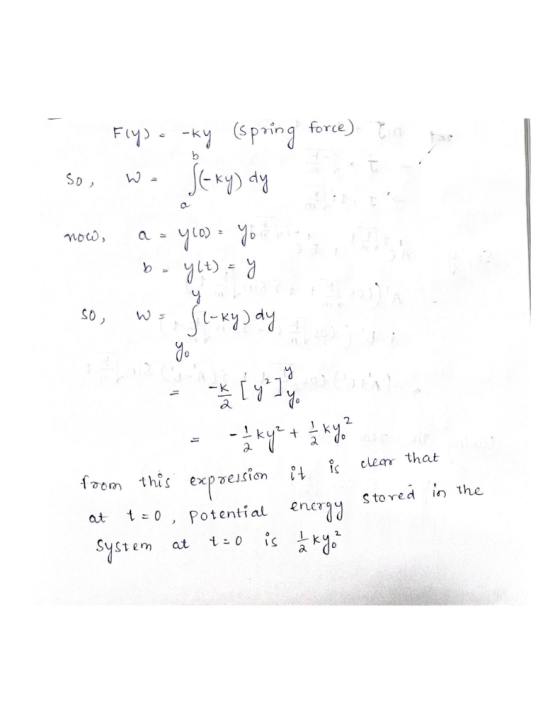
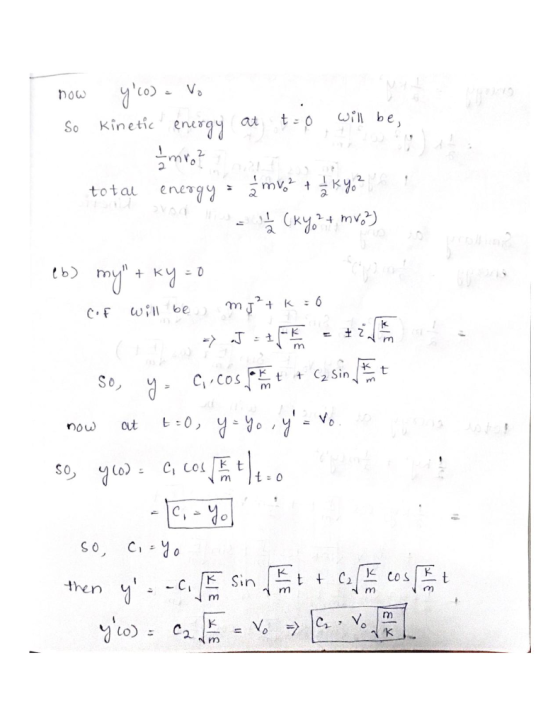
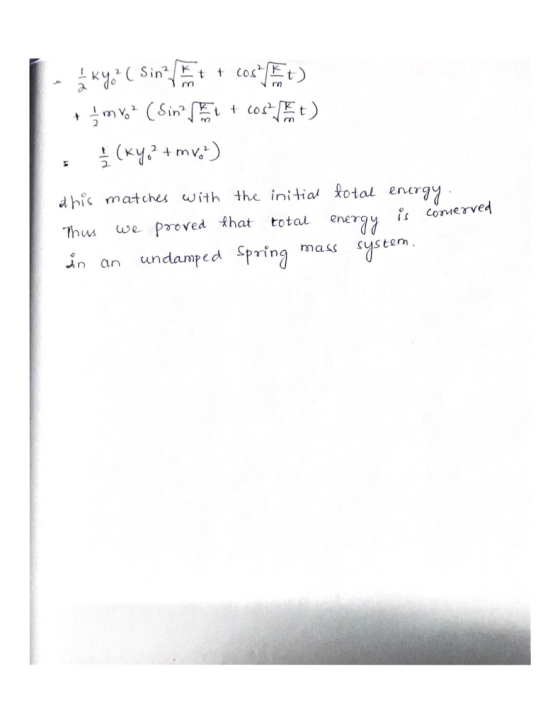
Problem 2. Recall that any undamped spring-mass system is described by an initial value problem of...
me are modeled by the differential equation, 1) (0) Recall that spring mass systems are mos...
 me are modeled by the differential equation, 1) (0) Recall that spring mass systems are mos ky FD A force of 180 newtons stretches a spring constant of 360N A mass of so kilograms spring and is initially released from resta equilibrium point. The motion is undamped es a spring 0.5 meters, which gives a spring 0 kilograms is attached to the end of the od from rest at a point 0.25 meters above the undamped Set up an initial...
1. Solve the initial value problem for a damped mass-spring system acted upon by a sinusoidal...
 1. Solve the initial value problem for a damped mass-spring system acted upon by a sinusoidal force for some time interval f(t) = {10 sin 2t 0 0<t< y(0) 1, y'(0) -5 y"2y' 2y f(t), Tt zusor= 2. Consider two masses and three springs without no external force. The resulting force balance can be expressed as two second order ODES shown as below. mx=-(k k2)x1+ kzx2 m2x2 (k2k3)x2 + k2x1 15 If m 2,m2 ki = 1,k2 = 3, k3...
(Undamped system) An iron ball of mass 10kg is attached to a spring having a spring...
(Undamped system) An iron ball of mass 10kg is attached to a spring having a spring constant of 3.6N/m. The ball is started in motion from rest (i.e., initial velocity is zero) by stretching the spring 0.7m from the equilibrium position with an exerted force f(t)=6.8e-t Assume there is no air resistance. a) Find the position of the ball as a function of time. b) Determine how far from the equilibrium position the ball will be after 15 seconds.
A mass m on a spring of stiffness k undergoes horizontal simple harmonic motion with amplitude...
A mass m on a spring of stiffness k undergoes horizontal simple harmonic motion with amplitude A, centered around x = 0. a) What is the total "mechanical" energy (kinetic plus potential) of the mass-spring system? b) What is the value of x when the mass-spring system has twice as much kinetic energy as potential energy? Your answers should be in terms of the quantities m, k, and A--or some subset thereof.
mum Problem 1 (15 points) In an oscillating spring-mass system, the energy of the system is...
 mum Problem 1 (15 points) In an oscillating spring-mass system, the energy of the system is continually changing from kinetic energy to potential energy and back again. (Ignore the friction force). (5 points) Discuss in detail the energy conservation principle of the spring-mass system using your own words including the possible changes of both kinetic and potential energies during this motion? (5 points) At what point in the oscillation will the potential energy of the spring-mass system be highest? Why?...
6. A mass of 2 kilogram is attached to a spring whose constant is 4 N/m, and the entire system is...
 6. A mass of 2 kilogram is attached to a spring whose constant is 4 N/m, and the entire system is then submerged in a liquid that inparts a damping force equal to 4 tines the instantansous velocity. At t = 0 the mass is released from the equilibrium position with no initial velocity. An external force t)4t-3) is applied. (a) Write (t), the external force, as a piecewise function and sketch its graph b) Write the initial-value problem (c)Solve...
(1 point) Consider the initial value problem my" + cy' + ky = FO. YO) =...
 (1 point) Consider the initial value problem my" + cy' + ky = FO. YO) = 0, y' (O) = 0 modeling the motion of a spring-mass-dashpot system initially at rest and subjected to an applied force FO), where the unit of force is the Newton (N). Assume that m = 2 kilograms, c = 8 kllograms per second, k = 80 Newtons per meter, and F(!) = 30 sin(61) Newtons. a. Solve the initial value problem. M) = help...
Homework7: Problem 24 Problem List Next Problem Previous Problem (1 point) Consider the initial value problem my...
 Homework7: Problem 24 Problem List Next Problem Previous Problem (1 point) Consider the initial value problem my" +cy'+ky F(t) , (0 ) 0, y y'(0)-0 modeling the motion of a spring-mass-dashpot system initially at rest and subjected to an applied force F(t), where the unit of force is the Newton (N). Assume that m 2 klograms, c8 kilograms per second, k 80 Newtons per meter, and the applied force in Newtons is ifosts/2 30 F(0) if t> /2. 0 remain...
In this problem we will explore the energy of a mass on a spring. (a) Write...
In this problem we will explore the energy of a mass on a spring. (a) Write down the kinetic energy (as a function of time) of a mass m oscillating on a spring with a spring constant k according to the equation x(t) = A cos(ωt + φ). Give your answer in terms of m, ω, φ, A, and t. (b) Now write down the elastic potential energy as a function of time for the same mass. Give your answer...
In problems 14-17, set up the spring mass equation. Determine whether it is undamped, under, critically...
 In problems 14-17, set up the spring mass equation. Determine whether it is undamped, under, critically or overdamped. Solve the IVP and draw a graph (technology is cool) of the solution on the interval 0 < t < 12. If the system Is underdamped convert the solution to the form Re^alpha t sin(beta t + delta) A mass weighing 64 pounds stretches a spring 0.32 foot. The mass is initially released from a point 8 inches above the equilibrium position...
 me are modeled by the differential equation, 1) (0) Recall that spring mass systems are mos ky FD A force of 180 newtons stretches a spring constant of 360N A mass of so kilograms spring and is initially released from resta equilibrium point. The motion is undamped es a spring 0.5 meters, which gives a spring 0 kilograms is attached to the end of the od from rest at a point 0.25 meters above the undamped Set up an initial...
 1. Solve the initial value problem for a damped mass-spring system acted upon by a sinusoidal force for some time interval f(t) = {10 sin 2t 0 0<t< y(0) 1, y'(0) -5 y"2y' 2y f(t), Tt zusor= 2. Consider two masses and three springs without no external force. The resulting force balance can be expressed as two second order ODES shown as below. mx=-(k k2)x1+ kzx2 m2x2 (k2k3)x2 + k2x1 15 If m 2,m2 ki = 1,k2 = 3, k3...
 mum Problem 1 (15 points) In an oscillating spring-mass system, the energy of the system is continually changing from kinetic energy to potential energy and back again. (Ignore the friction force). (5 points) Discuss in detail the energy conservation principle of the spring-mass system using your own words including the possible changes of both kinetic and potential energies during this motion? (5 points) At what point in the oscillation will the potential energy of the spring-mass system be highest? Why?...
 6. A mass of 2 kilogram is attached to a spring whose constant is 4 N/m, and the entire system is then submerged in a liquid that inparts a damping force equal to 4 tines the instantansous velocity. At t = 0 the mass is released from the equilibrium position with no initial velocity. An external force t)4t-3) is applied. (a) Write (t), the external force, as a piecewise function and sketch its graph b) Write the initial-value problem (c)Solve...
 (1 point) Consider the initial value problem my" + cy' + ky = FO. YO) = 0, y' (O) = 0 modeling the motion of a spring-mass-dashpot system initially at rest and subjected to an applied force FO), where the unit of force is the Newton (N). Assume that m = 2 kilograms, c = 8 kllograms per second, k = 80 Newtons per meter, and F(!) = 30 sin(61) Newtons. a. Solve the initial value problem. M) = help...
 Homework7: Problem 24 Problem List Next Problem Previous Problem (1 point) Consider the initial value problem my" +cy'+ky F(t) , (0 ) 0, y y'(0)-0 modeling the motion of a spring-mass-dashpot system initially at rest and subjected to an applied force F(t), where the unit of force is the Newton (N). Assume that m 2 klograms, c8 kilograms per second, k 80 Newtons per meter, and the applied force in Newtons is ifosts/2 30 F(0) if t> /2. 0 remain...
 In problems 14-17, set up the spring mass equation. Determine whether it is undamped, under, critically or overdamped. Solve the IVP and draw a graph (technology is cool) of the solution on the interval 0 < t < 12. If the system Is underdamped convert the solution to the form Re^alpha t sin(beta t + delta) A mass weighing 64 pounds stretches a spring 0.32 foot. The mass is initially released from a point 8 inches above the equilibrium position...
Most questions answered within 3 hours.
-
Where is the error in this code sequence?
String s1 = "Hello";
String s2 = "ello";...
asked 11 months ago -
Financial data for Joel de Paris, Inc., for last year
follow:
Joel de Paris, Inc.
Balance...
asked 11 months ago -
Consider this reaction:
Al2(SO4)3 (aq)+ BaCl3
(aq) Al2Cl6 (aq)- +
3BaSO4(s) . What is the...
asked 11 months ago -
Suppose that Savneet is considering increasing her
recent random sample from 20 car rentals to 40...
asked 11 months ago -
Trucks arrive at an unloading terminal at an average rate of 120
per hour.
Trucks arrive...
asked 11 months ago -
Why are methanol and ethanol completely soluble in water while
octanol is not very little soluble....
asked 11 months ago -
A facilities manager at a university reads in a research report
that the mean amount of...
asked 11 months ago -
When the CuSO4 is rehydrated by adding water to the anhydrous
compound, is this an endothermic...
asked 11 months ago -
A ray of sunlight is passing from diamond into crown glass; the
angle of incidence is...
asked 11 months ago -
A block of mass 0.249 kg is placed on top of a light, vertical
spring of...
asked 11 months ago -
how do the kidneys compensate in the presences of acidosis
a) trigger hyperventilate
b) reserve acid...
asked 11 months ago -
Question 501 pts
The rental rate of capital to the firm increases. Which of the
following...
asked 11 months ago