
Homework Answers

Add Answer to:
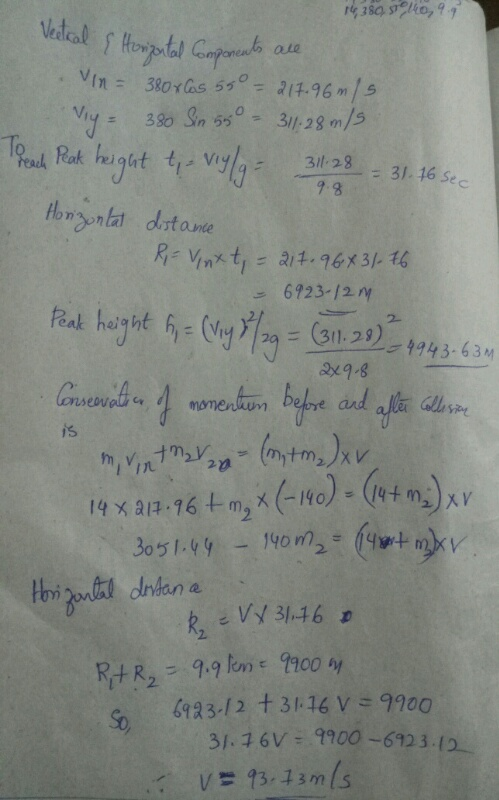
Part A A 14 kg projectile is launched at 380 m/s at a 55 angle to...
A projectile is launched with an initial speed of 58.0 m/s at an angle of 32.0°...
A projectile is launched with an initial speed of 58.0 m/s at an angle of 32.0° above the horizontal. The projectile lands on a hillside 3.80 s later. Neglect air friction. (Assume that the +x-axis is to the right and the +y-axis is up along the page.) (a) What is the projectile's velocity at the highest point of its trajectory? (b) What is the straight-line distance from where the projectile was launched to where it hits its target?
A projectile is launched with an initial speed of 41.0 m/s at an angle of 33.0°...
A projectile is launched with an initial speed of 41.0 m/s at an angle of 33.0° above the horizontal. The projectile lands on a hillside 3.75 s later. Neglect air friction. (Assume that the +x-axis is to the right and the +y-axis is up along the page.) (a) What is the projectile's velocity at the highest point of its trajectory? magnitude m/s direction ° counterclockwise from the +x-axis (b) What is the straight-line distance from where the projectile was launched...
A projectile is launched vertically from the surface of the Moon with an initial speed of...
 A projectile is launched vertically from the surface of the Moon with an initial speed of 1260 m/s. Part A At what altitude is the projectile's speed one-half its initial value? Express your answer using two significant figures. IVO AQ R O 2 ? h= 366 km km Submit Previous Answers Request Answer X Incorrect; Try Again; 3 attempts remaining
A projectile is launched with an initial speed of 51.0 m/s at an angle of 31.0°...
A projectile is launched with an initial speed of 51.0 m/s at an angle of 31.0° above the horizontal. The projectile lands on a hillside 3.65 s later. Neglect air friction. (Assume that the +x-axis is to the right and the +y-axis is up along the page.) (a) What is the projectile's velocity at the highest point of its trajectory? magnitude direction (b) What is the straight-line distance from where the projectile was launched to where it hits its target?
A projectile is launched with an initial speed of 48.0 m/s at an angle of 31.0°...
A projectile is launched with an initial speed of 48.0 m/s at an angle of 31.0° above the horizontal. The projectile lands on a hillside 3.70 s later. Neglect air friction. (Assume that the +x-axis is to the right and the +y-axis is up along the page.) (a) What is the projectile's velocity at the highest point of its trajectory? magnitude _____ m/s direction _______ degrees (counterclockwise from the +x axis) (b) What is the straight-line distance from where the...
A projectile is launched with an initial speed of 55.0 m/s at an angle of 34.0°...
A projectile is launched with an initial speed of 55.0 m/s at an angle of 34.0° above the horizontal. The projectile lands on a hillside 3.90 s later. Neglect air friction. (Assume that the +x-axis is to the right and the +y-axis is up along the page.) (a) What is the projectile's velocity at the highest point of its trajectory? magnitude m/s direction ° counterclockwise from the +x-axis (b) What is the straight-line distance from where the projectile was launched...
A projectile is launched with an initial speed of 59.0 m/s at an angle of 34.0°...
A projectile is launched with an initial speed of 59.0 m/s at an angle of 34.0° above the horizontal. The projectile lands on a hillside 3.60 s later. Neglect air friction. (Assume that the +x-axis is to the right and the +y-axis is up along the page.) (a) What is the projectile's velocity at the highest point of its trajectory? magnitude m/s direction ° counterclockwise from the +x-axis (b) What is the straight-line distance from where the projectile was launched...
A projectile is launched from ground level at 32.7 m/s at an angle of 25.4 °...
A projectile is launched from ground level at 32.7 m/s at an angle of 25.4 ° above horizontal. Use the launch point as the origin of your coordinate system. (a) How much time elapses before the projectile is at a point 3.9 m above the ground and heading downwards toward the ground? (b) How far downrange (the horizontal distance from the origin) was the projectile when it reached the highest point in its flight?
A projectile is launched at 50 m/s at an angle of 30 degrees from the roof...
A projectile is launched at 50 m/s at an angle of 30 degrees from the roof of a 20m tall building. At the peak of its trajectory, what is its speed? How high off the ground is the peak? What will the range of this projectile be?
KHW-34_ch-12 Problem 12.55 4 of 5 Review A projectile is launched vertically from the surface of...
 KHW-34_ch-12 Problem 12.55 4 of 5 Review A projectile is launched vertically from the surface of the Moon with an initial speed of 1510 m/s Part A At what altitude is the projectile's speed one-half its initial value? Express your answer using two significant figures. ΑΣφ 530 h = km Previous Answers Request Answer Submit X Incorrect; Try Again; 15 attempts remaining Provide Feedback Next
 A projectile is launched vertically from the surface of the Moon with an initial speed of 1260 m/s. Part A At what altitude is the projectile's speed one-half its initial value? Express your answer using two significant figures. IVO AQ R O 2 ? h= 366 km km Submit Previous Answers Request Answer X Incorrect; Try Again; 3 attempts remaining
 KHW-34_ch-12 Problem 12.55 4 of 5 Review A projectile is launched vertically from the surface of the Moon with an initial speed of 1510 m/s Part A At what altitude is the projectile's speed one-half its initial value? Express your answer using two significant figures. ΑΣφ 530 h = km Previous Answers Request Answer Submit X Incorrect; Try Again; 15 attempts remaining Provide Feedback Next
Most questions answered within 3 hours.
-
Where is the error in this code sequence?
String s1 = "Hello";
String s2 = "ello";...
asked 11 months ago -
Financial data for Joel de Paris, Inc., for last year
follow:
Joel de Paris, Inc.
Balance...
asked 11 months ago -
Consider this reaction:
Al2(SO4)3 (aq)+ BaCl3
(aq) Al2Cl6 (aq)- +
3BaSO4(s) . What is the...
asked 11 months ago -
Suppose that Savneet is considering increasing her
recent random sample from 20 car rentals to 40...
asked 11 months ago -
Trucks arrive at an unloading terminal at an average rate of 120
per hour.
Trucks arrive...
asked 11 months ago -
Why are methanol and ethanol completely soluble in water while
octanol is not very little soluble....
asked 11 months ago -
A facilities manager at a university reads in a research report
that the mean amount of...
asked 11 months ago -
When the CuSO4 is rehydrated by adding water to the anhydrous
compound, is this an endothermic...
asked 11 months ago -
A ray of sunlight is passing from diamond into crown glass; the
angle of incidence is...
asked 11 months ago -
A block of mass 0.249 kg is placed on top of a light, vertical
spring of...
asked 11 months ago -
how do the kidneys compensate in the presences of acidosis
a) trigger hyperventilate
b) reserve acid...
asked 11 months ago -
Question 501 pts
The rental rate of capital to the firm increases. Which of the
following...
asked 11 months ago