The figure shows a three-particle system, with masses m1 = 3.0 kg, m2 = 4.1 kg, and m3 = 9.3 kg. What are (a) the x coordinate and (b) the y coordinate of the system's center of mass?

Homework Answers

Add Answer to:
The figure shows a three-particle system, with masses
m1 = 3.0 kg, m2 = 4.1 kg,...
The figure shows a three-particle system, with masses m1 = 1.1 kg, m2 = 4.1 kg, and m3 = 7.1 kg. What are (a) the x coo...
 The figure shows a three-particle system, with masses m1 = 1.1 kg, m2 = 4.1 kg, and m3 = 7.1 kg. What are (a) the x coordinate and (b) the y coordinate of the system's center of mass? y (in) 023 - x (m) (a) Number (b) Number Units Units
The figure below shows a three-particle system, with masses m1 = 2.3 kg, m2 = 4.0...
 The figure below shows a three-particle system, with masses m1 = 2.3 kg, m2 = 4.0 kg, and m3 = 9.0 kg. N (a) What are the coordinates of the center of mass? m (x-coordinate) m (y-coordinate) (b) What happens to the center of mass as the mass of the topmost particle is gradually increased? The center of mass shifts toward the particle on the right. The center of mass shifts toward the particle on the left. The center of...
The figure below show three masses m1=1.6 kg, m2=3.0 kg, and m3=4.6 kg which undergo two...
 The
figure below show three masses m1=1.6 kg, m2=3.0 kg, and m3=4.6 kg
which undergo two successive collisions. The first collision
between m1, which has an initial velocity v=6.9 m/s, and m2 (which
is initially at rest) is completely inelastic. The second collision
between the combined mass m1+m2 and m3 (which is initially at rest)
is elastic. What is the velocity of m3 after the second
collision?
V 1 2 co
The
figure below show three masses m1=1.6 kg, m2=3.0 kg, and m3=4.6 kg
which undergo two successive collisions. The first collision
between m1, which has an initial velocity v=6.9 m/s, and m2 (which
is initially at rest) is completely inelastic. The second collision
between the combined mass m1+m2 and m3 (which is initially at rest)
is elastic. What is the velocity of m3 after the second
collision?
V 1 2 co
The figure below show three masses m1=1.6 kg, m2=3.0 kg, and m3=4.6 kg which undergo two...
 The figure below show three masses m1=1.6 kg,
m2=3.0 kg, and m3=4.6 kg which undergo two
successive collisions. The first collision between m1,
which has an initial velocity v=6.9 m/s, and m2 (which
is initially at rest) is completely inelastic. The second collision
between the combined mass m1+m2 and
m3 (which is initially at rest) is elastic. What is the
velocity of m3 after the second collision?
V 1 2 3
The figure below show three masses m1=1.6 kg,
m2=3.0 kg, and m3=4.6 kg which undergo two
successive collisions. The first collision between m1,
which has an initial velocity v=6.9 m/s, and m2 (which
is initially at rest) is completely inelastic. The second collision
between the combined mass m1+m2 and
m3 (which is initially at rest) is elastic. What is the
velocity of m3 after the second collision?
V 1 2 3
The figure below shows two masses m1=4.5 kg and m2=4.1 kg which are connected by a...
The figure below shows two masses m1=4.5 kg and m2=4.1 kg which are connected by a cable and are in contact with frictionless surfaces as shown. The ramp makes an angle θ=35° with the horizontal and m2 is acted on by a force of magnitude F=44 N which acts up the ramp. What is the tension in the cable?
Three masses are in a configuration as follows: M1 = 1.0 kg at coordinate ( 0,...
Three masses are in a configuration as follows: M1 = 1.0 kg at coordinate ( 0, 0) M2 = 2.0 kg at coordinate ( 3.0 m, 0) M3 = 2.0 kg at coordinate ( 0, 4.0 m) What is the total gravitational potential energy of the system?
The figure below shows two masses m1=4.5 kg and m2=4.1 kg which are connected by a...
 The figure below shows two masses m1=4.5 kg and m2=4.1 kg which
are connected by a cable and are in contact with frictionless
surfaces as shown. The ramp makes an angle θ=35° with the
horizontal and m2 is acted on by a force of magnitude F=44 N which
acts up the ramp. What is the tension in the cable? (ANSWER ABOVE
QUESTION, but use figure below)
The figure below shows two masses m1=2.2 kg and m2=4.3 kg which are connected...
The figure below shows two masses m1=4.5 kg and m2=4.1 kg which
are connected by a cable and are in contact with frictionless
surfaces as shown. The ramp makes an angle θ=35° with the
horizontal and m2 is acted on by a force of magnitude F=44 N which
acts up the ramp. What is the tension in the cable? (ANSWER ABOVE
QUESTION, but use figure below)
The figure below shows two masses m1=2.2 kg and m2=4.3 kg which are connected...
The figure below shows two masses m,=4.1 kg and m2=3.0 kg connected to separate ropes which...
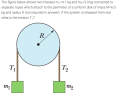 The figure below shows two masses m,=4.1 kg and m2=3.0 kg connected to separate ropes which attach to the perimeter of a uniform disk of mass M=6.0 kg and radius R (not required in answer). If the system is released from rest what is the tension T7? R T TO т1 m2
The figure below shows two masses m1=4.3 kg and m2=3.0 kg connected to separate ropes which...
 The figure below shows two masses m1=4.3 kg and
m2=3.0 kg connected to separate ropes which attach to
the perimeter of a uniform disk of mass M=6.9 kg and radius R (not
required in answer). If the system is released from rest what is
the tension T1?
R T T2 mi m2
The figure below shows two masses m1=4.3 kg and
m2=3.0 kg connected to separate ropes which attach to
the perimeter of a uniform disk of mass M=6.9 kg and radius R (not
required in answer). If the system is released from rest what is
the tension T1?
R T T2 mi m2
The figure below shows two masses m1=4.5 kg and m2=3.0 kg connected to separate ropes which...
 The figure below shows two masses m1=4.5 kg and
m2=3.0 kg connected to separate ropes which attach to
the perimeter of a uniform disk of mass M=6.0 kg and radius R (not
required in answer). If the system is released from rest what is
the tension T1?
R Ti T2 т1 m2
The figure below shows two masses m1=4.5 kg and
m2=3.0 kg connected to separate ropes which attach to
the perimeter of a uniform disk of mass M=6.0 kg and radius R (not
required in answer). If the system is released from rest what is
the tension T1?
R Ti T2 т1 m2
 The figure shows a three-particle system, with masses m1 = 1.1 kg, m2 = 4.1 kg, and m3 = 7.1 kg. What are (a) the x coordinate and (b) the y coordinate of the system's center of mass? y (in) 023 - x (m) (a) Number (b) Number Units Units
 The figure below shows a three-particle system, with masses m1 = 2.3 kg, m2 = 4.0 kg, and m3 = 9.0 kg. N (a) What are the coordinates of the center of mass? m (x-coordinate) m (y-coordinate) (b) What happens to the center of mass as the mass of the topmost particle is gradually increased? The center of mass shifts toward the particle on the right. The center of mass shifts toward the particle on the left. The center of...
 The
figure below show three masses m1=1.6 kg, m2=3.0 kg, and m3=4.6 kg
which undergo two successive collisions. The first collision
between m1, which has an initial velocity v=6.9 m/s, and m2 (which
is initially at rest) is completely inelastic. The second collision
between the combined mass m1+m2 and m3 (which is initially at rest)
is elastic. What is the velocity of m3 after the second
collision?
V 1 2 co
The
figure below show three masses m1=1.6 kg, m2=3.0 kg, and m3=4.6 kg
which undergo two successive collisions. The first collision
between m1, which has an initial velocity v=6.9 m/s, and m2 (which
is initially at rest) is completely inelastic. The second collision
between the combined mass m1+m2 and m3 (which is initially at rest)
is elastic. What is the velocity of m3 after the second
collision?
V 1 2 co
 The figure below show three masses m1=1.6 kg,
m2=3.0 kg, and m3=4.6 kg which undergo two
successive collisions. The first collision between m1,
which has an initial velocity v=6.9 m/s, and m2 (which
is initially at rest) is completely inelastic. The second collision
between the combined mass m1+m2 and
m3 (which is initially at rest) is elastic. What is the
velocity of m3 after the second collision?
V 1 2 3
The figure below show three masses m1=1.6 kg,
m2=3.0 kg, and m3=4.6 kg which undergo two
successive collisions. The first collision between m1,
which has an initial velocity v=6.9 m/s, and m2 (which
is initially at rest) is completely inelastic. The second collision
between the combined mass m1+m2 and
m3 (which is initially at rest) is elastic. What is the
velocity of m3 after the second collision?
V 1 2 3
 The figure below shows two masses m1=4.5 kg and m2=4.1 kg which
are connected by a cable and are in contact with frictionless
surfaces as shown. The ramp makes an angle θ=35° with the
horizontal and m2 is acted on by a force of magnitude F=44 N which
acts up the ramp. What is the tension in the cable? (ANSWER ABOVE
QUESTION, but use figure below)
The figure below shows two masses m1=2.2 kg and m2=4.3 kg which are connected...
The figure below shows two masses m1=4.5 kg and m2=4.1 kg which
are connected by a cable and are in contact with frictionless
surfaces as shown. The ramp makes an angle θ=35° with the
horizontal and m2 is acted on by a force of magnitude F=44 N which
acts up the ramp. What is the tension in the cable? (ANSWER ABOVE
QUESTION, but use figure below)
The figure below shows two masses m1=2.2 kg and m2=4.3 kg which are connected...
 The figure below shows two masses m,=4.1 kg and m2=3.0 kg connected to separate ropes which attach to the perimeter of a uniform disk of mass M=6.0 kg and radius R (not required in answer). If the system is released from rest what is the tension T7? R T TO т1 m2
 The figure below shows two masses m1=4.3 kg and
m2=3.0 kg connected to separate ropes which attach to
the perimeter of a uniform disk of mass M=6.9 kg and radius R (not
required in answer). If the system is released from rest what is
the tension T1?
R T T2 mi m2
The figure below shows two masses m1=4.3 kg and
m2=3.0 kg connected to separate ropes which attach to
the perimeter of a uniform disk of mass M=6.9 kg and radius R (not
required in answer). If the system is released from rest what is
the tension T1?
R T T2 mi m2
 The figure below shows two masses m1=4.5 kg and
m2=3.0 kg connected to separate ropes which attach to
the perimeter of a uniform disk of mass M=6.0 kg and radius R (not
required in answer). If the system is released from rest what is
the tension T1?
R Ti T2 т1 m2
The figure below shows two masses m1=4.5 kg and
m2=3.0 kg connected to separate ropes which attach to
the perimeter of a uniform disk of mass M=6.0 kg and radius R (not
required in answer). If the system is released from rest what is
the tension T1?
R Ti T2 т1 m2
Most questions answered within 3 hours.
-
Where is the error in this code sequence?
String s1 = "Hello";
String s2 = "ello";...
asked 10 months ago -
Financial data for Joel de Paris, Inc., for last year
follow:
Joel de Paris, Inc.
Balance...
asked 10 months ago -
Consider this reaction:
Al2(SO4)3 (aq)+ BaCl3
(aq) Al2Cl6 (aq)- +
3BaSO4(s) . What is the...
asked 10 months ago -
Suppose that Savneet is considering increasing her
recent random sample from 20 car rentals to 40...
asked 10 months ago -
Trucks arrive at an unloading terminal at an average rate of 120
per hour.
Trucks arrive...
asked 10 months ago -
Why are methanol and ethanol completely soluble in water while
octanol is not very little soluble....
asked 10 months ago -
A facilities manager at a university reads in a research report
that the mean amount of...
asked 10 months ago -
When the CuSO4 is rehydrated by adding water to the anhydrous
compound, is this an endothermic...
asked 10 months ago -
A ray of sunlight is passing from diamond into crown glass; the
angle of incidence is...
asked 10 months ago -
A block of mass 0.249 kg is placed on top of a light, vertical
spring of...
asked 10 months ago -
how do the kidneys compensate in the presences of acidosis
a) trigger hyperventilate
b) reserve acid...
asked 10 months ago -
Question 501 pts
The rental rate of capital to the firm increases. Which of the
following...
asked 10 months ago