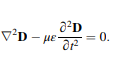
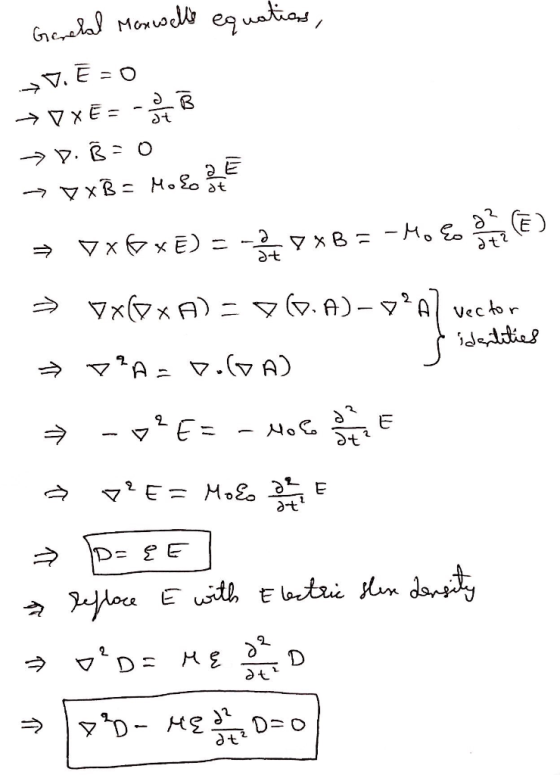
Obtain the homogeneous wave equation in terms of the electric flux density D. Show your work...
Obtain the homogeneous wave equation in terms of the electric flux density D. Show your work please.
The answer is:
Homework Answers
Add Answer to:
Obtain the homogeneous wave equation in terms of the electric
flux density D. Show your work...
Please Show Work Clearly. 12.3 Time-Harmonic Wave Equation. Using the source-free Maxwell's equations, show that a...
 Please Show Work Clearly.
12.3 Time-Harmonic Wave Equation. Using the source-free Maxwell's equations, show that a Helmholtz equation can be obtained in terms of the magnetic vector potential. Use the definition B = V X A and a simple medium (linear, isotropic, homogeneous material). Justify the choice of the divergence of A.
Please Show Work Clearly.
12.3 Time-Harmonic Wave Equation. Using the source-free Maxwell's equations, show that a Helmholtz equation can be obtained in terms of the magnetic vector potential. Use the definition B = V X A and a simple medium (linear, isotropic, homogeneous material). Justify the choice of the divergence of A.
3 Questions Find: a) The electric flux density vector: D=-EVV, where & is a constant =...
 3 Questions Find: a) The electric flux density vector: D=-EVV, where & is a constant = 10 pF/m. b) The electric volume charge density at any point in the region: p, = V D= divergence ofD e) The total charge enclosed by the specified region: Q= fpdv, dv element of volume d) Find Vx D and show that D is irrotational. In the cylindrical region: 0srs2m, 0s0s7/2 0szslm, the potential field V is given by V=50 2 sin volts
3...
3 Questions Find: a) The electric flux density vector: D=-EVV, where & is a constant = 10 pF/m. b) The electric volume charge density at any point in the region: p, = V D= divergence ofD e) The total charge enclosed by the specified region: Q= fpdv, dv element of volume d) Find Vx D and show that D is irrotational. In the cylindrical region: 0srs2m, 0s0s7/2 0szslm, the potential field V is given by V=50 2 sin volts
3...
3 Questions Find a) The electric flux density vector: D-EVV, where s is a constant 10...
 3 Questions Find a) The electric flux density vector: D-EVV, where s is a constant 10 pF/m. b) The electric volume charge density at any point in the region: p, = V. D = divergence of D c) The total charge enclosed by the specified region: Q ffp,dv, dv element of volume d) Find VxD and show that D is irrotational In the cylindrical region: 0srs2m, 0s0s7/2, 0szslm, the potential field Vis given by V=50 sin volts
3 Questions Find...
3 Questions Find a) The electric flux density vector: D-EVV, where s is a constant 10 pF/m. b) The electric volume charge density at any point in the region: p, = V. D = divergence of D c) The total charge enclosed by the specified region: Q ffp,dv, dv element of volume d) Find VxD and show that D is irrotational In the cylindrical region: 0srs2m, 0s0s7/2, 0szslm, the potential field Vis given by V=50 sin volts
3 Questions Find...
Please step by step for D(electric flux density), E(electric field), V(electric potantial), P(polarization vector) ? A...
 Please step by step for
D(electric flux density), E(electric field), V(electric potantial),
P(polarization vector) ?
A positive point charge Q is at the center of a spherical dielectric shell of an inner radius Ri and an outer radius RO. Determine E, V, D, and P as functions of the radial distance R. a)R>RO b)Ri<R<RO c)R<R find it. E1 = 60 €2 = Erzo (E3 = 6,360 = 0 - R + Ro conductive dielectric dielectric
Please step by step for
D(electric flux density), E(electric field), V(electric potantial),
P(polarization vector) ?
A positive point charge Q is at the center of a spherical dielectric shell of an inner radius Ri and an outer radius RO. Determine E, V, D, and P as functions of the radial distance R. a)R>RO b)Ri<R<RO c)R<R find it. E1 = 60 €2 = Erzo (E3 = 6,360 = 0 - R + Ro conductive dielectric dielectric
Please show all work Show that R_1, 0 is a solution of the radial wave equation.
 Please show all work
Show that R_1, 0 is a solution of the radial wave equation.
Please show all work
Show that R_1, 0 is a solution of the radial wave equation.
Show that the following functions are a solution to the wave equation of a lossless electric...
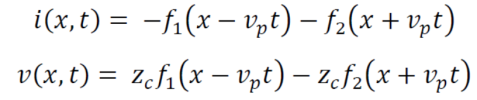 Show that the following functions
are a solution to the wave equation of a lossless electric power
transmission line
Show that the following functions
are a solution to the wave equation of a lossless electric power
transmission line
4. (a) Show the relationship between current density 0) and difisional flux U). (b) Write down...
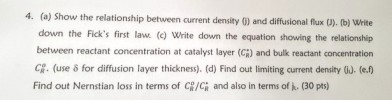 4. (a) Show the relationship between current density 0) and difisional flux U). (b) Write down the Fick's first law. (c) Write down the equation showing the relationship between reactant concentration at catalyst layer (CR) and bulk reactant concentration ??. (use for diffusion layer thickness). (d) Find out limiting current density (i), (ef) Find out Nernstian loss in terms of CR/CR and also in terms of j. (30 pts)
Problem #4 Derive the full vector electromagnetic wave equation in terms of the magnetic field valid...
 Problem #4 Derive the full vector electromagnetic wave equation in terms of the magnetic field valid for linear, inhomogeneous, and isotropic materials. that is Problem #5 From the results above, derive the full vector electromagnetic wave equation in terms of the magnetic field B that is valid for linear, homogeneous, and isotropic materials. From this equation, extract and calculate the speed of light in a vacuum.
1.) (a) State Maxwell’s equation for the curl of the magnetic and the electric field in...
1.) (a) State Maxwell’s equation for the curl of the magnetic and the electric field in free space. State the meaning of all the terms in the equations and identify the displacement current density. Using Maxwell’s equations, derive the wave equations for B. Show that the wave equations admit plane waves for the electric and magnetic fields in free space of the form ? = ??? ?(??−??) , ? = ??? ?(??−??) where ?? and ?? are constant vectors with...
Use Maxwell's Equations to derive a decoupled set of wave equations for electric and magnetic fields...
Use Maxwell's Equations to derive a decoupled set of wave equations for electric and magnetic fields in a linear, homogeneous, isotropic media characterized by (µ, ε, σ) in the absence of sources. Then modify these equations to describe waves propagating in free space. Show all work, please
 Please Show Work Clearly.
12.3 Time-Harmonic Wave Equation. Using the source-free Maxwell's equations, show that a Helmholtz equation can be obtained in terms of the magnetic vector potential. Use the definition B = V X A and a simple medium (linear, isotropic, homogeneous material). Justify the choice of the divergence of A.
Please Show Work Clearly.
12.3 Time-Harmonic Wave Equation. Using the source-free Maxwell's equations, show that a Helmholtz equation can be obtained in terms of the magnetic vector potential. Use the definition B = V X A and a simple medium (linear, isotropic, homogeneous material). Justify the choice of the divergence of A.
 3 Questions Find: a) The electric flux density vector: D=-EVV, where & is a constant = 10 pF/m. b) The electric volume charge density at any point in the region: p, = V D= divergence ofD e) The total charge enclosed by the specified region: Q= fpdv, dv element of volume d) Find Vx D and show that D is irrotational. In the cylindrical region: 0srs2m, 0s0s7/2 0szslm, the potential field V is given by V=50 2 sin volts
3...
3 Questions Find: a) The electric flux density vector: D=-EVV, where & is a constant = 10 pF/m. b) The electric volume charge density at any point in the region: p, = V D= divergence ofD e) The total charge enclosed by the specified region: Q= fpdv, dv element of volume d) Find Vx D and show that D is irrotational. In the cylindrical region: 0srs2m, 0s0s7/2 0szslm, the potential field V is given by V=50 2 sin volts
3...
 3 Questions Find a) The electric flux density vector: D-EVV, where s is a constant 10 pF/m. b) The electric volume charge density at any point in the region: p, = V. D = divergence of D c) The total charge enclosed by the specified region: Q ffp,dv, dv element of volume d) Find VxD and show that D is irrotational In the cylindrical region: 0srs2m, 0s0s7/2, 0szslm, the potential field Vis given by V=50 sin volts
3 Questions Find...
3 Questions Find a) The electric flux density vector: D-EVV, where s is a constant 10 pF/m. b) The electric volume charge density at any point in the region: p, = V. D = divergence of D c) The total charge enclosed by the specified region: Q ffp,dv, dv element of volume d) Find VxD and show that D is irrotational In the cylindrical region: 0srs2m, 0s0s7/2, 0szslm, the potential field Vis given by V=50 sin volts
3 Questions Find...
 Please step by step for
D(electric flux density), E(electric field), V(electric potantial),
P(polarization vector) ?
A positive point charge Q is at the center of a spherical dielectric shell of an inner radius Ri and an outer radius RO. Determine E, V, D, and P as functions of the radial distance R. a)R>RO b)Ri<R<RO c)R<R find it. E1 = 60 €2 = Erzo (E3 = 6,360 = 0 - R + Ro conductive dielectric dielectric
Please step by step for
D(electric flux density), E(electric field), V(electric potantial),
P(polarization vector) ?
A positive point charge Q is at the center of a spherical dielectric shell of an inner radius Ri and an outer radius RO. Determine E, V, D, and P as functions of the radial distance R. a)R>RO b)Ri<R<RO c)R<R find it. E1 = 60 €2 = Erzo (E3 = 6,360 = 0 - R + Ro conductive dielectric dielectric
 Please show all work
Show that R_1, 0 is a solution of the radial wave equation.
Please show all work
Show that R_1, 0 is a solution of the radial wave equation.
 Show that the following functions
are a solution to the wave equation of a lossless electric power
transmission line
Show that the following functions
are a solution to the wave equation of a lossless electric power
transmission line
 4. (a) Show the relationship between current density 0) and difisional flux U). (b) Write down the Fick's first law. (c) Write down the equation showing the relationship between reactant concentration at catalyst layer (CR) and bulk reactant concentration ??. (use for diffusion layer thickness). (d) Find out limiting current density (i), (ef) Find out Nernstian loss in terms of CR/CR and also in terms of j. (30 pts)
 Problem #4 Derive the full vector electromagnetic wave equation in terms of the magnetic field valid for linear, inhomogeneous, and isotropic materials. that is Problem #5 From the results above, derive the full vector electromagnetic wave equation in terms of the magnetic field B that is valid for linear, homogeneous, and isotropic materials. From this equation, extract and calculate the speed of light in a vacuum.
Most questions answered within 3 hours.
-
Where is the error in this code sequence?
String s1 = "Hello";
String s2 = "ello";...
asked 10 months ago -
Financial data for Joel de Paris, Inc., for last year
follow:
Joel de Paris, Inc.
Balance...
asked 10 months ago -
Consider this reaction:
Al2(SO4)3 (aq)+ BaCl3
(aq) Al2Cl6 (aq)- +
3BaSO4(s) . What is the...
asked 10 months ago -
Suppose that Savneet is considering increasing her
recent random sample from 20 car rentals to 40...
asked 10 months ago -
Trucks arrive at an unloading terminal at an average rate of 120
per hour.
Trucks arrive...
asked 10 months ago -
Why are methanol and ethanol completely soluble in water while
octanol is not very little soluble....
asked 10 months ago -
A facilities manager at a university reads in a research report
that the mean amount of...
asked 10 months ago -
When the CuSO4 is rehydrated by adding water to the anhydrous
compound, is this an endothermic...
asked 10 months ago -
A ray of sunlight is passing from diamond into crown glass; the
angle of incidence is...
asked 10 months ago -
A block of mass 0.249 kg is placed on top of a light, vertical
spring of...
asked 10 months ago -
how do the kidneys compensate in the presences of acidosis
a) trigger hyperventilate
b) reserve acid...
asked 10 months ago -
Question 501 pts
The rental rate of capital to the firm increases. Which of the
following...
asked 10 months ago