In a materials testing laboratory, a metal wire made from a new alloy is found to...
In a materials testing laboratory, a metal wire made from a new alloy is found to break when a tensile force of 93.9 N is applied perpendicular to each end.
1- If the diameter of the wire is 1.24 mm , what is the breaking stress of the alloy?
Homework Answers

Add Answer to:
In a materials testing laboratory, a metal wire made from a new
alloy is found to...
(2) You are tasked with testing a new alloy. Previous tensile testing revealed the alloy's Young's...
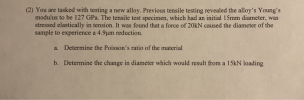 (2) You are tasked with testing a new alloy. Previous tensile testing revealed the alloy's Young's modulus to be 127 GPa. The tensile test specimen, which had an initial 15mm diameter, was stressed elastically in tension. It was found that a force of 20kN caused the diameter of the sample to experience a 4.9um reduction. a. Determine the Poisson's ratio of the material b. Determine the change in diameter which would result from a 15kN loading
Two 40 ft long wires made of different materials are supported from the ceiling of a...
Two 40 ft long wires made of different materials are supported from the ceiling of a testing laboratory. Wire (1) is made of material H and has a diameter of 3/8 in. Wire (2) is made of material K and has a diameter of 3/16 in. When a load of 225 lb is applied to its lower end, wire (1) stretches 0.10 in. When the same 225 lb load is applied to the lower end of wire (2), wire (2)...
2) The 55-mm-diameter cylinder of height 100 mm is made from a magnesium alloy (Am 1004-T61)....
 2) The 55-mm-diameter cylinder of height 100 mm is made from a magnesium alloy (Am 1004-T61). When the temperature is 20° C, the cylinder is placed in a rigid clamp and held snug with a negligible force against the rigid jaws by three A 36-steel carriage bolts (third hidden in back.) Each bolt has a diameter of 10 mm. Determine the stress in the cylinder when the temperature rises to 125° C. Make clear if it is tensile or compressive....
A cylindrical specimen of some metal alloy having an elastic modulus of 121 GPa and an...
A cylindrical specimen of some metal alloy having an elastic modulus of 121 GPa and an original cross-sectional diameter of 4.7 mm will experience only elastic deformation when a tensile load of 2400 N is applied. Calculate the maximum length of the specimen before deformation if the maximum allowable elongation is 0.41 mm.
A cylindrical specimen of some metal alloy having an elastic modulus of 120 GPa and an...
A cylindrical specimen of some metal alloy having an elastic modulus of 120 GPa and an original cross-sectional diameter of 3.0 mm will experience only elastic deformation when a tensile load of 2400 N is applied. Calculate the maximum length of the specimen before deformation if the maximum allowable elongation is 0.47 mm.
Q2a) An 0.80-mm-diameter wire made from a metal alloy (mixture of different metals), has a conductivity...
 Q2a) An 0.80-mm-diameter wire made from a metal alloy (mixture of different metals), has a conductivity that changes with distance from the center as: o(r) = 0,+ ar where s0 = 4.5 x 10⁷ Q1 m1 C = 2.3 x 10¹¹ 22-1 m 2 What is the resistance of a 15-foot piece of this wire? (1 ft +0.305 m). Give your answer to two significant figures, with the units. Q2b) What is the resistivity (p) of this 0.80 mm thick,...
5. A metal wire is 2.5 mm diameter and 2 m long. A force of 12...
 5. A metal wire is 2.5 mm diameter and 2 m long. A force of 12 N is applied to it and it stretches 0.3 mm. Assume the material is elastic. Determine the stress in the wire σ, the strain in the wire ε, and Young's modulus for the wire material.
1. State the difference between I and polycrystalline materials. Deformability of BCC and FCC met...
 1. State the difference between I and polycrystalline materials. Deformability of BCC and FCC metals. Strength and UTS of metals. 2. Determine the slip systems in BCC and FCC materials. Show the calculations that support your determinations. 3. Find the indices that represent the planes in the following cubic unit cell and show the X-Ray diffract-ability of the these planes in FCC and BCC structures: 4. A tensile specimen with a 12 mm initial diameter and 50 mm gauge length...
1. A single crystal sample of a metal with a HCP structure is subjected to an axial tensile force. The sample is of circ...
1. A single crystal sample of a metal with a HCP structure is subjected to an axial tensile force. The sample is of circular cross-section, with a diameter of 4 mm, and is of 50 mm length. An elastic extension of 0.047 mm is measured when an axial tensile force of 1.25 kN is applied. When the tensile force is increased to 2.8 kN plastic deformation commences. (a) Given that Poisson’s ratio for the metal is 0.35, estimate the theoretical...
The 50-mm-diameter cylinder is made from Magnesium Alloy AZ80 and is placed in the clamp When...
 The 50-mm-diameter cylinder is made from Magnesium Alloy AZ80 and is placed in the clamp When the temperature is T1 = 20°C. the two bolts of the clamp each have a diameter 10 mm and made of Steel Structural (ASTM-A36), and they hold the cylinder snug with negligible force against the rigid jaws, the temperature of the all the assembly has been increased to T2 = 130°C. determine the force in the cylinder at this temperature. 10 100 mm 150...
 (2) You are tasked with testing a new alloy. Previous tensile testing revealed the alloy's Young's modulus to be 127 GPa. The tensile test specimen, which had an initial 15mm diameter, was stressed elastically in tension. It was found that a force of 20kN caused the diameter of the sample to experience a 4.9um reduction. a. Determine the Poisson's ratio of the material b. Determine the change in diameter which would result from a 15kN loading
 2) The 55-mm-diameter cylinder of height 100 mm is made from a magnesium alloy (Am 1004-T61). When the temperature is 20° C, the cylinder is placed in a rigid clamp and held snug with a negligible force against the rigid jaws by three A 36-steel carriage bolts (third hidden in back.) Each bolt has a diameter of 10 mm. Determine the stress in the cylinder when the temperature rises to 125° C. Make clear if it is tensile or compressive....
 Q2a) An 0.80-mm-diameter wire made from a metal alloy (mixture of different metals), has a conductivity that changes with distance from the center as: o(r) = 0,+ ar where s0 = 4.5 x 10⁷ Q1 m1 C = 2.3 x 10¹¹ 22-1 m 2 What is the resistance of a 15-foot piece of this wire? (1 ft +0.305 m). Give your answer to two significant figures, with the units. Q2b) What is the resistivity (p) of this 0.80 mm thick,...
 5. A metal wire is 2.5 mm diameter and 2 m long. A force of 12 N is applied to it and it stretches 0.3 mm. Assume the material is elastic. Determine the stress in the wire σ, the strain in the wire ε, and Young's modulus for the wire material.
 1. State the difference between I and polycrystalline materials. Deformability of BCC and FCC metals. Strength and UTS of metals. 2. Determine the slip systems in BCC and FCC materials. Show the calculations that support your determinations. 3. Find the indices that represent the planes in the following cubic unit cell and show the X-Ray diffract-ability of the these planes in FCC and BCC structures: 4. A tensile specimen with a 12 mm initial diameter and 50 mm gauge length...
 The 50-mm-diameter cylinder is made from Magnesium Alloy AZ80 and is placed in the clamp When the temperature is T1 = 20°C. the two bolts of the clamp each have a diameter 10 mm and made of Steel Structural (ASTM-A36), and they hold the cylinder snug with negligible force against the rigid jaws, the temperature of the all the assembly has been increased to T2 = 130°C. determine the force in the cylinder at this temperature. 10 100 mm 150...
Most questions answered within 3 hours.
-
Where is the error in this code sequence?
String s1 = "Hello";
String s2 = "ello";...
asked 10 months ago -
Financial data for Joel de Paris, Inc., for last year
follow:
Joel de Paris, Inc.
Balance...
asked 10 months ago -
Consider this reaction:
Al2(SO4)3 (aq)+ BaCl3
(aq) Al2Cl6 (aq)- +
3BaSO4(s) . What is the...
asked 10 months ago -
Suppose that Savneet is considering increasing her
recent random sample from 20 car rentals to 40...
asked 10 months ago -
Trucks arrive at an unloading terminal at an average rate of 120
per hour.
Trucks arrive...
asked 10 months ago -
Why are methanol and ethanol completely soluble in water while
octanol is not very little soluble....
asked 10 months ago -
A facilities manager at a university reads in a research report
that the mean amount of...
asked 10 months ago -
When the CuSO4 is rehydrated by adding water to the anhydrous
compound, is this an endothermic...
asked 10 months ago -
A ray of sunlight is passing from diamond into crown glass; the
angle of incidence is...
asked 10 months ago -
A block of mass 0.249 kg is placed on top of a light, vertical
spring of...
asked 10 months ago -
how do the kidneys compensate in the presences of acidosis
a) trigger hyperventilate
b) reserve acid...
asked 10 months ago -
Question 501 pts
The rental rate of capital to the firm increases. Which of the
following...
asked 10 months ago