
Homework Answers
1 mol of HCl... -- > 28.6 kJ
but we have 4 mol in reaction so
4*28.6 = 114.4 kJ
since it evolved, this is exothermic, so dH must be negative
dH = -114.4 kJ
Add Answer to:
When HC l(g) reacts with o_2(g) according to the following reaction. 28.6 k t of energy...
When NH3(g) reacts with O2(g) according to the following reaction, 226kj of energy is released for...
When NH3(g) reacts with O2(g) according to the following reaction, 226kj of energy is released for each mole of NH3 (g) that reacts. Complete the following thermochemical equation. 4NH3(G) + 5O2(g) = 4NO(g) + 6H2O ^H = _______ kj
When Fe(s) reacts with Ch() according to the following reaction, 400 J of energy are evolved...
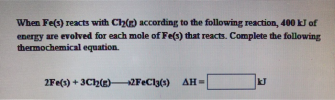 When Fe(s) reacts with Ch() according to the following reaction, 400 J of energy are evolved for each mole of Fe(s) that reacts. Complete the following thermochemical equation 2Fe(s)+3Che)2FeCl3(3) AH= C H
When CH.) reacts with O2(e) according to the following reaction, 1.43x10W of energy are evolved for...
 When CH.) reacts with O2(e) according to the following reaction, 1.43x10W of energy are evolved for each mole of CBCR) that reacts Complete the following thermochemical equation 2CH.(8) + 702(8) --4C02(g) + 6H2O() AH- Submit Answer Retry Entire Group 4 more group attempts remaining
When Na(s) reacts with H2O() according to the following reaction, 184 kJ of energy are evolved...
 When Na(s) reacts with H2O() according to the following reaction, 184 kJ of energy are evolved for each mole of Na(s) that reacts. Complete the following thermochemical equation. 2Na(s) + 2H20(1)—>2NaOH(aq) + H2(e) AH =
Calculate the value of K_p for the reaction 2N_2(g) + O_2(g) reversible 2N_2 O(g) at 298.15...
 Calculate the value of K_p for the reaction 2N_2(g) + O_2(g) reversible 2N_2 O(g) at 298.15 K and 1173 K. Thermodynamic data for N_2 O(g) are: delta H degree_t = 82.05 kJ/mol; S degree = 219.9 J/mol middot K; delta G degree f = 104.2 kJ/mol. 298.15 K Did you consider the stoichiometry of the balanced equation for the reaction? Did you check your signs and units? Would you expect K_p at 1173 K to be greater than or less...
When H2(g) reacts with O2(g) according to the following reaction, 242 kJ of energy are evolved...
 When H2(g) reacts with O2(g) according to the following reaction, 242 kJ of energy are evolved for each mole of H2(g) that reacts. Complete the following thermochemical equation. 2H2(g) + O2(g)— 2H2O(g) AH- The following information is given for bismuth at latm: T = 1627.00°C T. = 271.00°C Specific heat solid = 0.1260 J/g °C Specific heat liquid = 0.1510 J/g °C AHvap (1627.00°C) = 822.9 J/g AH (271.00°C) = 52.60 Jig A 38.40 g sample of liquid bismuth at...
When H2S(g) reacts with H2O(l) to form H2(g) and SO2(g) , 70.5 kcal of energy are...
When H2S(g) reacts with H2O(l) to form H2(g) and SO2(g) , 70.5 kcal of energy are absorbed for each mole of H2S(g) that reacts. Write a balanced equation for the reaction with an energy term in kcal as part of the equation.
When P4010(s) reacts with H2O(1) to form H3PO4(aq), 453 kJ of energy are evolved for each...
 When P4010(s) reacts with H2O(1) to form H3PO4(aq), 453 kJ of energy are evolved for each mole of P,016(s) that reacts. Write a balanced thermochemical equation for the reaction with an energy term in kJ as part of the equation. Note that the answer box for the energy term is case sensitive Use the SMALLEST INTEGER coefficients possible and put the energy term (including the units) in the last box on the appropriate side of the equation. If a box...
When H2S(g) reacts with H20() to form H2(g) and SO2(g), 295 kJ of energy are absorbed for each mole of H2S(g) that reacts. Write a balanced thermochemical equation for the reaction with an energy ter...
 When H2S(g) reacts with H20() to form H2(g) and SO2(g), 295 kJ of energy are absorbed for each mole of H2S(g) that reacts. Write a balanced thermochemical equation for the reaction with an energy term in kJ as part of the equation. Note that the answer box for the energy term is case sensitive Use the SMALLEST INTEGER coefficients possible and put the energy term in the last box on the appropriate side of the equation. If a box is...
Consider the equilibrium reaction: 2NO(g) + O_2(g) 2NO_2(g) Delta H = +114.6 kJ What will be...
 Consider the equilibrium reaction: 2NO(g) + O_2(g) 2NO_2(g) Delta H = +114.6 kJ What will be the change in the equilibrium concentration of NO_2 under each of the following conditions? Considering each change separately, state the effect (increase, I; decrease, D; or no change NC) specified). a) O_2 is added ___ b) energy is added___ c) NO is removed ___ d) a catalyst is added ___ e) it is placed in an ice bath ___ f) the volume is increased...
 When Fe(s) reacts with Ch() according to the following reaction, 400 J of energy are evolved for each mole of Fe(s) that reacts. Complete the following thermochemical equation 2Fe(s)+3Che)2FeCl3(3) AH= C H
 When CH.) reacts with O2(e) according to the following reaction, 1.43x10W of energy are evolved for each mole of CBCR) that reacts Complete the following thermochemical equation 2CH.(8) + 702(8) --4C02(g) + 6H2O() AH- Submit Answer Retry Entire Group 4 more group attempts remaining
 When Na(s) reacts with H2O() according to the following reaction, 184 kJ of energy are evolved for each mole of Na(s) that reacts. Complete the following thermochemical equation. 2Na(s) + 2H20(1)—>2NaOH(aq) + H2(e) AH =
 Calculate the value of K_p for the reaction 2N_2(g) + O_2(g) reversible 2N_2 O(g) at 298.15 K and 1173 K. Thermodynamic data for N_2 O(g) are: delta H degree_t = 82.05 kJ/mol; S degree = 219.9 J/mol middot K; delta G degree f = 104.2 kJ/mol. 298.15 K Did you consider the stoichiometry of the balanced equation for the reaction? Did you check your signs and units? Would you expect K_p at 1173 K to be greater than or less...
 When H2(g) reacts with O2(g) according to the following reaction, 242 kJ of energy are evolved for each mole of H2(g) that reacts. Complete the following thermochemical equation. 2H2(g) + O2(g)— 2H2O(g) AH- The following information is given for bismuth at latm: T = 1627.00°C T. = 271.00°C Specific heat solid = 0.1260 J/g °C Specific heat liquid = 0.1510 J/g °C AHvap (1627.00°C) = 822.9 J/g AH (271.00°C) = 52.60 Jig A 38.40 g sample of liquid bismuth at...
 When P4010(s) reacts with H2O(1) to form H3PO4(aq), 453 kJ of energy are evolved for each mole of P,016(s) that reacts. Write a balanced thermochemical equation for the reaction with an energy term in kJ as part of the equation. Note that the answer box for the energy term is case sensitive Use the SMALLEST INTEGER coefficients possible and put the energy term (including the units) in the last box on the appropriate side of the equation. If a box...
 When H2S(g) reacts with H20() to form H2(g) and SO2(g), 295 kJ of energy are absorbed for each mole of H2S(g) that reacts. Write a balanced thermochemical equation for the reaction with an energy term in kJ as part of the equation. Note that the answer box for the energy term is case sensitive Use the SMALLEST INTEGER coefficients possible and put the energy term in the last box on the appropriate side of the equation. If a box is...
 Consider the equilibrium reaction: 2NO(g) + O_2(g) 2NO_2(g) Delta H = +114.6 kJ What will be the change in the equilibrium concentration of NO_2 under each of the following conditions? Considering each change separately, state the effect (increase, I; decrease, D; or no change NC) specified). a) O_2 is added ___ b) energy is added___ c) NO is removed ___ d) a catalyst is added ___ e) it is placed in an ice bath ___ f) the volume is increased...
Most questions answered within 3 hours.
-
Where is the error in this code sequence?
String s1 = "Hello";
String s2 = "ello";...
asked 11 months ago -
Financial data for Joel de Paris, Inc., for last year
follow:
Joel de Paris, Inc.
Balance...
asked 11 months ago -
Consider this reaction:
Al2(SO4)3 (aq)+ BaCl3
(aq) Al2Cl6 (aq)- +
3BaSO4(s) . What is the...
asked 11 months ago -
Suppose that Savneet is considering increasing her
recent random sample from 20 car rentals to 40...
asked 11 months ago -
Trucks arrive at an unloading terminal at an average rate of 120
per hour.
Trucks arrive...
asked 11 months ago -
Why are methanol and ethanol completely soluble in water while
octanol is not very little soluble....
asked 11 months ago -
A facilities manager at a university reads in a research report
that the mean amount of...
asked 11 months ago -
When the CuSO4 is rehydrated by adding water to the anhydrous
compound, is this an endothermic...
asked 11 months ago -
A ray of sunlight is passing from diamond into crown glass; the
angle of incidence is...
asked 11 months ago -
A block of mass 0.249 kg is placed on top of a light, vertical
spring of...
asked 11 months ago -
how do the kidneys compensate in the presences of acidosis
a) trigger hyperventilate
b) reserve acid...
asked 11 months ago -
Question 501 pts
The rental rate of capital to the firm increases. Which of the
following...
asked 11 months ago