
Homework Answers
Add Answer to:
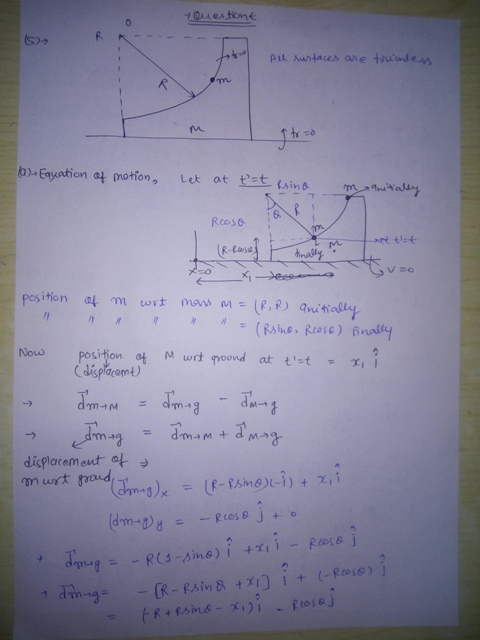
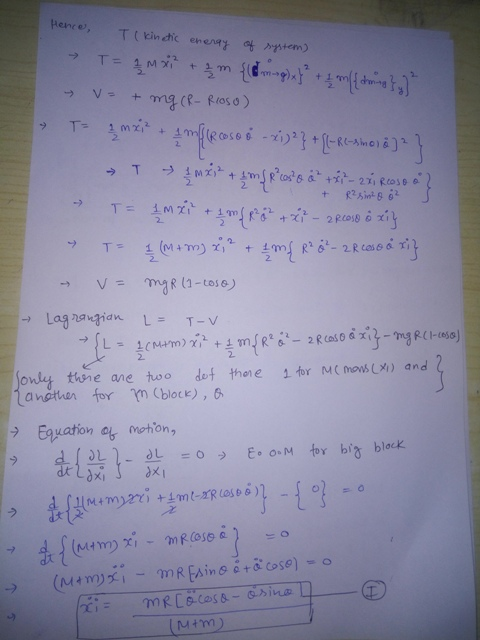
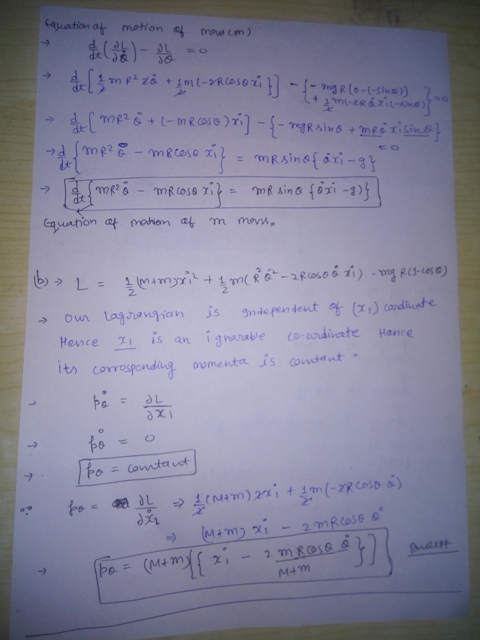
5. A particle of mass m slides without friction and starting from rest down a block...
As shown below (not to scale), a block of mass starts from rest and slides down...
 As shown below (not to scale), a block of mass starts from rest
and slides down a frictionless ramp of height h. Upon reaching the
bottom of the ramp, it continues to slide across a flat
frictionless surface. It then crosses a "rough patch" on the
surface of length d=10m. This rough patch has a coefficient of
kinetic friction uK=.1. After crossing the rough patch, the block's
final speed is vf=2m/s. What is the height of the ramp? Hint: I...
As shown below (not to scale), a block of mass starts from rest
and slides down a frictionless ramp of height h. Upon reaching the
bottom of the ramp, it continues to slide across a flat
frictionless surface. It then crosses a "rough patch" on the
surface of length d=10m. This rough patch has a coefficient of
kinetic friction uK=.1. After crossing the rough patch, the block's
final speed is vf=2m/s. What is the height of the ramp? Hint: I...
A block starts from rest and slides without friction along the surface of a hemisphere of...
 A block starts from rest and slides without friction along the
surface of a hemisphere of radius R = 1.7 m. As the block slides,
eventually it loses contact with the hemisphere.
What is the height, h, when the block loses contact with the
hemisphere?
A block starts from rest and slides without friction along the surface of a hemisphere of radius R = 1.7 m. As the block slides, eventually it loses contact with the hemisphere.What is the height,...
A block starts from rest and slides without friction along the
surface of a hemisphere of radius R = 1.7 m. As the block slides,
eventually it loses contact with the hemisphere.
What is the height, h, when the block loses contact with the
hemisphere?
A block starts from rest and slides without friction along the surface of a hemisphere of radius R = 1.7 m. As the block slides, eventually it loses contact with the hemisphere.What is the height,...
A block of mass m starts from rest and slides down from the top of a...
 A block of mass m starts from rest and slides down from the top of a wedge of height h and length d. The surface of the wedge forms an angle of ? with respect to the horizontal direction. The force of kinetic friction between the block and the wedge is f. How fast is the block traveling when it reaches the bottom of the wedge?
1. The small mass m is to slide down the large mass M without friction. The...
 1. The small mass m is to slide down the large mass M without friction. The track along which the small block slides is a quarter circle with radius R. The large mass itself is free to move on a frictionless horizontal surface. Initially both masses are at rest with the small mass at the top of the quarter circle, as shown in the figure. (a) (5 Pts.) What is the initial total mechanical energy with respect to the horizontal...
a block with a mass of 2.5 kg starts from rest at the top of the...
 a block with a mass of 2.5 kg starts from rest at the top of the
apparatus shown below. it then slides without friction down the
incline, and collides with a spring attached to a wall. The spring
has a spring constant of K=120N/m. Using the principle of energy
conservation,
a. find the initial gravitational potential energy of the block
at point A
b. find the kinetic energy of the block at point B
c. what is the velocity of...
a block with a mass of 2.5 kg starts from rest at the top of the
apparatus shown below. it then slides without friction down the
incline, and collides with a spring attached to a wall. The spring
has a spring constant of K=120N/m. Using the principle of energy
conservation,
a. find the initial gravitational potential energy of the block
at point A
b. find the kinetic energy of the block at point B
c. what is the velocity of...
A plane pendulum of length L and mass m is suspended from a block of mass...
 A plane pendulum of length L and mass m is suspended from a
block of mass M. The block moves without friction and is
constrained to move horizontally only (i.e. along the x axis). You
may assume all motion is confined to the xy plane. At t = 0, both
masses are at rest, the block is at
, and the pendulum has angular deflection
with respect to the y axis.
a) Using
and
as generalized coordinates, find the Lagrangian...
A plane pendulum of length L and mass m is suspended from a
block of mass M. The block moves without friction and is
constrained to move horizontally only (i.e. along the x axis). You
may assume all motion is confined to the xy plane. At t = 0, both
masses are at rest, the block is at
, and the pendulum has angular deflection
with respect to the y axis.
a) Using
and
as generalized coordinates, find the Lagrangian...
A block of mass 4.4 kg slides 18 m from rest down an inclined plane making...
A block of mass 4.4 kg slides 18 m from rest down an inclined plane making an angle of 22 o with the horizontal. If the block takes 10 s to slide down the plane, what is the retarding force due to friction?
A bead of mass m slides without friction along a rod, one end of which is...
 A bead of mass m slides without friction along a rod, one end of which is pivoted in such a way that the rod can be revolved about the z-axis at a constant angle a, as shown in Fig. 2. The rod is driven with constant angular velocity w about Oz. Use Lagrange method to derive the equation of motion for the bead. Use the distance of m from the origin as generalized coordinate and discuss the motion of the...
A block of mass m = 3.00 kg starts from the rest and slides down a...
A block of mass m = 3.00 kg starts from the rest and slides down a 30.0∘ incline which is 3.60 m high. At the bottom, it strikes a block of mass M = 6.40 kg which is at rest on a horizontal surface (Figure 1). (Assume a smooth transition at the bottom of the incline.) The collision is elastic, and friction can be ignored. (A) Determine the speed of the block with mass m = 3.00 kg after the...
 As shown below (not to scale), a block of mass starts from rest
and slides down a frictionless ramp of height h. Upon reaching the
bottom of the ramp, it continues to slide across a flat
frictionless surface. It then crosses a "rough patch" on the
surface of length d=10m. This rough patch has a coefficient of
kinetic friction uK=.1. After crossing the rough patch, the block's
final speed is vf=2m/s. What is the height of the ramp? Hint: I...
As shown below (not to scale), a block of mass starts from rest
and slides down a frictionless ramp of height h. Upon reaching the
bottom of the ramp, it continues to slide across a flat
frictionless surface. It then crosses a "rough patch" on the
surface of length d=10m. This rough patch has a coefficient of
kinetic friction uK=.1. After crossing the rough patch, the block's
final speed is vf=2m/s. What is the height of the ramp? Hint: I...
 A block starts from rest and slides without friction along the
surface of a hemisphere of radius R = 1.7 m. As the block slides,
eventually it loses contact with the hemisphere.
What is the height, h, when the block loses contact with the
hemisphere?
A block starts from rest and slides without friction along the surface of a hemisphere of radius R = 1.7 m. As the block slides, eventually it loses contact with the hemisphere.What is the height,...
A block starts from rest and slides without friction along the
surface of a hemisphere of radius R = 1.7 m. As the block slides,
eventually it loses contact with the hemisphere.
What is the height, h, when the block loses contact with the
hemisphere?
A block starts from rest and slides without friction along the surface of a hemisphere of radius R = 1.7 m. As the block slides, eventually it loses contact with the hemisphere.What is the height,...
 A block of mass m starts from rest and slides down from the top of a wedge of height h and length d. The surface of the wedge forms an angle of ? with respect to the horizontal direction. The force of kinetic friction between the block and the wedge is f. How fast is the block traveling when it reaches the bottom of the wedge?
 1. The small mass m is to slide down the large mass M without friction. The track along which the small block slides is a quarter circle with radius R. The large mass itself is free to move on a frictionless horizontal surface. Initially both masses are at rest with the small mass at the top of the quarter circle, as shown in the figure. (a) (5 Pts.) What is the initial total mechanical energy with respect to the horizontal...
 a block with a mass of 2.5 kg starts from rest at the top of the
apparatus shown below. it then slides without friction down the
incline, and collides with a spring attached to a wall. The spring
has a spring constant of K=120N/m. Using the principle of energy
conservation,
a. find the initial gravitational potential energy of the block
at point A
b. find the kinetic energy of the block at point B
c. what is the velocity of...
a block with a mass of 2.5 kg starts from rest at the top of the
apparatus shown below. it then slides without friction down the
incline, and collides with a spring attached to a wall. The spring
has a spring constant of K=120N/m. Using the principle of energy
conservation,
a. find the initial gravitational potential energy of the block
at point A
b. find the kinetic energy of the block at point B
c. what is the velocity of...
 A plane pendulum of length L and mass m is suspended from a
block of mass M. The block moves without friction and is
constrained to move horizontally only (i.e. along the x axis). You
may assume all motion is confined to the xy plane. At t = 0, both
masses are at rest, the block is at
, and the pendulum has angular deflection
with respect to the y axis.
a) Using
and
as generalized coordinates, find the Lagrangian...
A plane pendulum of length L and mass m is suspended from a
block of mass M. The block moves without friction and is
constrained to move horizontally only (i.e. along the x axis). You
may assume all motion is confined to the xy plane. At t = 0, both
masses are at rest, the block is at
, and the pendulum has angular deflection
with respect to the y axis.
a) Using
and
as generalized coordinates, find the Lagrangian...
 A bead of mass m slides without friction along a rod, one end of which is pivoted in such a way that the rod can be revolved about the z-axis at a constant angle a, as shown in Fig. 2. The rod is driven with constant angular velocity w about Oz. Use Lagrange method to derive the equation of motion for the bead. Use the distance of m from the origin as generalized coordinate and discuss the motion of the...
Most questions answered within 3 hours.
-
Where is the error in this code sequence?
String s1 = "Hello";
String s2 = "ello";...
asked 10 months ago -
Financial data for Joel de Paris, Inc., for last year
follow:
Joel de Paris, Inc.
Balance...
asked 10 months ago -
Consider this reaction:
Al2(SO4)3 (aq)+ BaCl3
(aq) Al2Cl6 (aq)- +
3BaSO4(s) . What is the...
asked 10 months ago -
Suppose that Savneet is considering increasing her
recent random sample from 20 car rentals to 40...
asked 10 months ago -
Trucks arrive at an unloading terminal at an average rate of 120
per hour.
Trucks arrive...
asked 10 months ago -
Why are methanol and ethanol completely soluble in water while
octanol is not very little soluble....
asked 10 months ago -
A facilities manager at a university reads in a research report
that the mean amount of...
asked 10 months ago -
When the CuSO4 is rehydrated by adding water to the anhydrous
compound, is this an endothermic...
asked 10 months ago -
A ray of sunlight is passing from diamond into crown glass; the
angle of incidence is...
asked 10 months ago -
A block of mass 0.249 kg is placed on top of a light, vertical
spring of...
asked 10 months ago -
how do the kidneys compensate in the presences of acidosis
a) trigger hyperventilate
b) reserve acid...
asked 10 months ago -
Question 501 pts
The rental rate of capital to the firm increases. Which of the
following...
asked 10 months ago