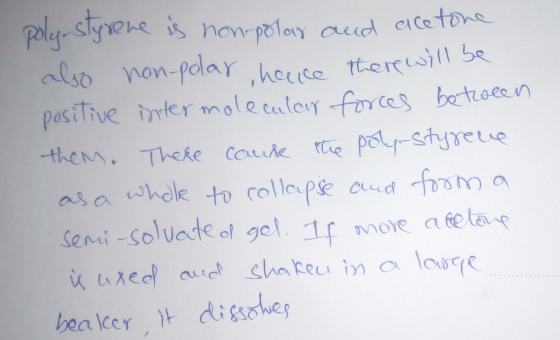
when polystyrene peanuts are added to about 100mL of acetone in a 600 mL beaker, why...
when polystyrene peanuts are added to about 100mL of acetone in a 600 mL beaker, why do they dissolve?
Homework Answers
Add Answer to:
when polystyrene peanuts are added to about 100mL of acetone in
a 600 mL beaker, why...
When NaOH is added to water in a beaker, the beaker will get warm to the...
When NaOH is added to water in a beaker, the beaker will get warm to the touch. Why does this happen? You are asked to prepare an aqueous solution. Which is a better choice for a solute potassium nitrate or the hydrocarbon C4H6, why? How do the manufacturers of carbonated beverages take advantage of Henrys Law? Explain why some solutions have a positive heat of solution and some solutions have a negative heat of solution?
what is the pH when titrating 100 mL of 0.180M HClO with 100mL of KOH, also...
what is the pH when titrating 100 mL of 0.180M HClO with 100mL of KOH, also afer 130 mL of KOH is added. Ka=4x10^-8
2-bromobutane (3.0 ml) in 25 ml of acetone reacts with 80 ml of a 20 wt%...
2-bromobutane (3.0 ml) in 25 ml of acetone reacts with 80 ml of a 20 wt% solution of Nal in acetone. After work up, you obtain 3.9 g of 2-iodobutane. What is the limiting reagent and percent yield of this reaction? Why when finding the mass of Nal in acetone do you use the density of acetone and not Nal?
Part A of lab: pour 30 ml of 0.150 M Fe(NO3)3 into a 50 ml beaker...
Part A of lab: pour 30 ml of 0.150 M Fe(NO3)3 into a 50 ml beaker and pipette 10 ml of this solution into a 25 ml volumetric flask. This is the standard reagent blank Part B of lab: pour 30 ml of 1.50*10^-3 M Fe(NO3)3 into a 25 ml volumetric flask. This is the reagent blank. Why is a large excess of Fe3+ added to make the standard solution, and why do you NOT add a large excess of...
tration : Use a small beaker. I00-mL or 150-ml beaker and fill about ½ full of...
 tration : Use a small beaker. I00-mL or 150-ml beaker and fill about ½ full of water. Cut a small piece of potassium metal, about the size of a small pea, place on a paper towel and quickly wipe off the mineral oil. Drop the small piece of metal into the Phenolphthalein may be added to indicate the formation of a basic solution. The may be lit. gas Hazard: Do not allow the potassium metal to be exposed to air...
One mole of sodium chloride is added to 100 ml of water in beaker A. One...
 One mole of sodium chloride is added to 100 ml of water in beaker A. One mole of glucose, C_6H_12O_6, is added to 100ml of water in beaker B. How much more will the freezing point of water be lowered in beaker A than in beaker B? Two thirds as much twice as much three times as much Beakers A and B will experience the same degree of freezing point depression. It is impossible to determine. Which of the following...
Step 1. Obtain a 600 mL beaker, andadd 300 mL of water. Step 2. Add 30...
 Step 1. Obtain
a 600 mL beaker, andadd 300 mL of water.
Step 2. Add 30 mL
of HCl (2M) to the beaker, and stir.
Step 3. Add 10 mg
of magnesium metal to the beaker.
Step 4. Allow
thehydrogen gas to evolve. All of the magnesium should be
consumed.
Step 5. Record
the amount of hydrogen gas that has evolved using the chemical
property dialog.
questions:
In your lab report, include the following information in the
Discussion section of...
Step 1. Obtain
a 600 mL beaker, andadd 300 mL of water.
Step 2. Add 30 mL
of HCl (2M) to the beaker, and stir.
Step 3. Add 10 mg
of magnesium metal to the beaker.
Step 4. Allow
thehydrogen gas to evolve. All of the magnesium should be
consumed.
Step 5. Record
the amount of hydrogen gas that has evolved using the chemical
property dialog.
questions:
In your lab report, include the following information in the
Discussion section of...
You place a piece of gold into a beaker containing 100 mL of water. When you...
You place a piece of gold into a beaker containing 100 mL of water. When you do, the water level increases to 110.5 mL. (Note: One mL = 1 cm3) a. What is the mass of the gold in grams? b. You now add a piece of lead to the same beaker with the gold and the water level increases from 110.5 mL to 113 mL. What is the mass of the lead in grams? c. Write a proportionality equation...
6. (20 pts) You have a beaker containing 100 mL of water. The initial temperature of...
 6. (20 pts) You have a beaker containing 100 mL of water. The initial temperature of the water is 20°C. (Note: Onc ml = 1 cm'). 2. You place a piece of copper into the beakct containing. When you do, the water level increases to 110.5 m... What is the mass of the copper in grams? b. If the temperature of the water increases to 35°C, how much heat (in calories) did the copper add to the water? c. You...
buffer is HC2H3O2/NaC2H3O2 difference in PH: big change when added to buffer. small change when added...
 buffer is HC2H3O2/NaC2H3O2
difference in PH: big change when added to buffer. small
change when added to water. why?
why such a bug change when you add an acud or base to water
but not to butfer?
1. a) Describe the difference in observed pH changes upon adding a small amount of strong acid or base to 25.0 mL of water vs to 25.0 mL of your buffer. b) Explain why there was a difference. 6.0M HC,H,O, is corrosive. Prevent...
buffer is HC2H3O2/NaC2H3O2
difference in PH: big change when added to buffer. small
change when added to water. why?
why such a bug change when you add an acud or base to water
but not to butfer?
1. a) Describe the difference in observed pH changes upon adding a small amount of strong acid or base to 25.0 mL of water vs to 25.0 mL of your buffer. b) Explain why there was a difference. 6.0M HC,H,O, is corrosive. Prevent...
 tration : Use a small beaker. I00-mL or 150-ml beaker and fill about ½ full of water. Cut a small piece of potassium metal, about the size of a small pea, place on a paper towel and quickly wipe off the mineral oil. Drop the small piece of metal into the Phenolphthalein may be added to indicate the formation of a basic solution. The may be lit. gas Hazard: Do not allow the potassium metal to be exposed to air...
 One mole of sodium chloride is added to 100 ml of water in beaker A. One mole of glucose, C_6H_12O_6, is added to 100ml of water in beaker B. How much more will the freezing point of water be lowered in beaker A than in beaker B? Two thirds as much twice as much three times as much Beakers A and B will experience the same degree of freezing point depression. It is impossible to determine. Which of the following...
 Step 1. Obtain
a 600 mL beaker, andadd 300 mL of water.
Step 2. Add 30 mL
of HCl (2M) to the beaker, and stir.
Step 3. Add 10 mg
of magnesium metal to the beaker.
Step 4. Allow
thehydrogen gas to evolve. All of the magnesium should be
consumed.
Step 5. Record
the amount of hydrogen gas that has evolved using the chemical
property dialog.
questions:
In your lab report, include the following information in the
Discussion section of...
Step 1. Obtain
a 600 mL beaker, andadd 300 mL of water.
Step 2. Add 30 mL
of HCl (2M) to the beaker, and stir.
Step 3. Add 10 mg
of magnesium metal to the beaker.
Step 4. Allow
thehydrogen gas to evolve. All of the magnesium should be
consumed.
Step 5. Record
the amount of hydrogen gas that has evolved using the chemical
property dialog.
questions:
In your lab report, include the following information in the
Discussion section of...
 6. (20 pts) You have a beaker containing 100 mL of water. The initial temperature of the water is 20°C. (Note: Onc ml = 1 cm'). 2. You place a piece of copper into the beakct containing. When you do, the water level increases to 110.5 m... What is the mass of the copper in grams? b. If the temperature of the water increases to 35°C, how much heat (in calories) did the copper add to the water? c. You...
 buffer is HC2H3O2/NaC2H3O2
difference in PH: big change when added to buffer. small
change when added to water. why?
why such a bug change when you add an acud or base to water
but not to butfer?
1. a) Describe the difference in observed pH changes upon adding a small amount of strong acid or base to 25.0 mL of water vs to 25.0 mL of your buffer. b) Explain why there was a difference. 6.0M HC,H,O, is corrosive. Prevent...
buffer is HC2H3O2/NaC2H3O2
difference in PH: big change when added to buffer. small
change when added to water. why?
why such a bug change when you add an acud or base to water
but not to butfer?
1. a) Describe the difference in observed pH changes upon adding a small amount of strong acid or base to 25.0 mL of water vs to 25.0 mL of your buffer. b) Explain why there was a difference. 6.0M HC,H,O, is corrosive. Prevent...
Most questions answered within 3 hours.
-
Where is the error in this code sequence?
String s1 = "Hello";
String s2 = "ello";...
asked 11 months ago -
Financial data for Joel de Paris, Inc., for last year
follow:
Joel de Paris, Inc.
Balance...
asked 11 months ago -
Consider this reaction:
Al2(SO4)3 (aq)+ BaCl3
(aq) Al2Cl6 (aq)- +
3BaSO4(s) . What is the...
asked 11 months ago -
Suppose that Savneet is considering increasing her
recent random sample from 20 car rentals to 40...
asked 11 months ago -
Trucks arrive at an unloading terminal at an average rate of 120
per hour.
Trucks arrive...
asked 11 months ago -
Why are methanol and ethanol completely soluble in water while
octanol is not very little soluble....
asked 11 months ago -
A facilities manager at a university reads in a research report
that the mean amount of...
asked 11 months ago -
When the CuSO4 is rehydrated by adding water to the anhydrous
compound, is this an endothermic...
asked 11 months ago -
A ray of sunlight is passing from diamond into crown glass; the
angle of incidence is...
asked 11 months ago -
A block of mass 0.249 kg is placed on top of a light, vertical
spring of...
asked 11 months ago -
how do the kidneys compensate in the presences of acidosis
a) trigger hyperventilate
b) reserve acid...
asked 11 months ago -
Question 501 pts
The rental rate of capital to the firm increases. Which of the
following...
asked 11 months ago