Explain the cost curves of the firm. In terms of economies of scale, why would a...
Explain the cost curves of the firm. In terms of economies of scale, why would a firm sometimes want to expand output and sometimes not want to expand output?
Homework Answers
With the increase in production levels if the average cost curve
goes on decreasing or having a negative slope then it can be
considered as economies of scale and with increase in production
levels if the average cost curve goes on increasing or having a
positive slope at a point then it can be considered that the firm
is experiencing diseconomies of scale. This is shown in the figure
below. during diseconomies of scale the average cost keeps on
increasing and if the average cost level certainly exceeds the
price of the product then the firm will incur a loss on the whole
and this is the reason why beyond a point where a firm is
experiencing diseconomies of scale the form does not want to
increase its output and as long as the price is less than average
total cost the form keeps on increasing to get more and more
revenue. 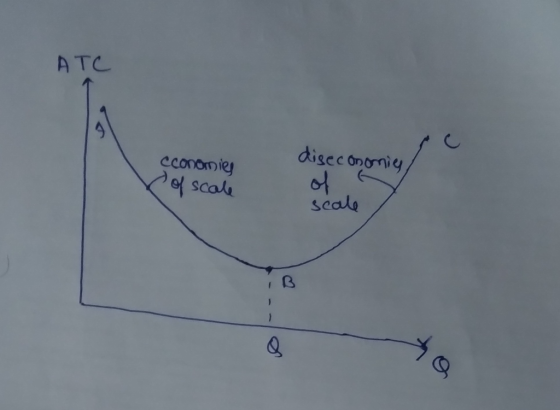
Add Answer to:
Explain the cost curves of the firm. In terms of economies of
scale, why would a...
If there are internal economies of scale, why would it ever make sense for a firm...
If there are internal economies of scale, why would it ever make sense for a firm to produce the same good in more than one production facility?
define economies of scale. Explain why economies of scale are so important.
define economies of scale. Explain why economies of scale are so important.
(a) List four reasons why a firm might experience increasing returns to scale (or economies of...
(a) List four reasons why a firm might experience increasing returns to scale (or economies of scale). (b) A firm has the following production function, where Q is output, L is labor and K is physical capital: Q = 30K0.5L0.7 Is this firm operating under increasing, constant, or diminishing returns to scale, and why?
Economies of scale will lead to only one firm in the industry because A. by increasing...
Economies of scale will lead to only one firm in the industry because A. by increasing output a firm is able to lower the cost per unit and change lower prices driving smaller firms out of business. B. one firm has an average cost curve, which has shifted below the average cost curves of its competitors. C. of government licensing. D. there are governmental entry restrictions.
22. Which of the following is true for a firm that enjoys economies of scale? a. Marginal cost is increasing as output i...
22. Which of the following is true for a firm that enjoys economies of scale? a. Marginal cost is increasing as output increases. b. Average total cost is falling as output increases. c. Marginal cost is constant as output increases. d. Marginal revenue is falling as output increases. 23. The figure below shows short-run average total cost curves for a firm under four different production technologies. Assume that there are only four different technologies that the firm could use. Refer...
(Click to select) economies of scale a. Long-run average total cost falls as the firm realize: rises when the firm...
 (Click to select) economies of scale a. Long-run average total cost falls as the firm realize: rises when the firm experiences [ (Click to select) diseconomies of scale diminishing marginal returns increasing marginal returns b. The minimum efficient scale is the level of output produced by the smallest firm in the industry. smallest level of output at which a firm can produce. only level of output where long-run average total costs are minimized. smallest level of output needed to attain...
1) What is internal economies of scale? And why would it be a source of trade?...
1) What is internal economies of scale? And why would it be a source of trade? What are the gains of trade in the presence of internal economies of scale? 2) Using graph please explain how performance differences in an industry with internal economies of scale creates winners and losers after trade? Explain step by step.
Suppose you are the owner of a firm, and your firm is experiencing "economies of scale"...
Suppose you are the owner of a firm, and your firm is experiencing "economies of scale" in production. If this is the case, will the average total cost increase, decrease or remain unchanged as you increase the level of output?
Increasing returns to scale is characterized by: a. economies of scale; that is, the average cost...
Increasing returns to scale is characterized by: a. economies of scale; that is, the average cost falls as output rises. b. constantly declining fixed costs. c. diseconomies of scale; that is, the average cost is constant as output rises. d. diseconomies of scale; that is, the average cost falls as output rises. e. economies of scale; that is, the average cost rises as output rises.
What are economies of scale and why are such economies available only in the long run?...
What are economies of scale and why are such economies available only in the long run? (in about 600-800 words giving references) Since economies of scale exist, why do long-run marginal costs increase, ultimately, as output increases? (in about 600-800 words giving references)
 (Click to select) economies of scale a. Long-run average total cost falls as the firm realize: rises when the firm experiences [ (Click to select) diseconomies of scale diminishing marginal returns increasing marginal returns b. The minimum efficient scale is the level of output produced by the smallest firm in the industry. smallest level of output at which a firm can produce. only level of output where long-run average total costs are minimized. smallest level of output needed to attain...
Most questions answered within 3 hours.
-
Where is the error in this code sequence?
String s1 = "Hello";
String s2 = "ello";...
asked 11 months ago -
Financial data for Joel de Paris, Inc., for last year
follow:
Joel de Paris, Inc.
Balance...
asked 11 months ago -
Consider this reaction:
Al2(SO4)3 (aq)+ BaCl3
(aq) Al2Cl6 (aq)- +
3BaSO4(s) . What is the...
asked 11 months ago -
Suppose that Savneet is considering increasing her
recent random sample from 20 car rentals to 40...
asked 11 months ago -
Trucks arrive at an unloading terminal at an average rate of 120
per hour.
Trucks arrive...
asked 11 months ago -
Why are methanol and ethanol completely soluble in water while
octanol is not very little soluble....
asked 11 months ago -
A facilities manager at a university reads in a research report
that the mean amount of...
asked 11 months ago -
When the CuSO4 is rehydrated by adding water to the anhydrous
compound, is this an endothermic...
asked 11 months ago -
A ray of sunlight is passing from diamond into crown glass; the
angle of incidence is...
asked 11 months ago -
A block of mass 0.249 kg is placed on top of a light, vertical
spring of...
asked 11 months ago -
how do the kidneys compensate in the presences of acidosis
a) trigger hyperventilate
b) reserve acid...
asked 11 months ago -
Question 501 pts
The rental rate of capital to the firm increases. Which of the
following...
asked 11 months ago