
Homework Answers
Add Answer to:
Please answer 9 as well.
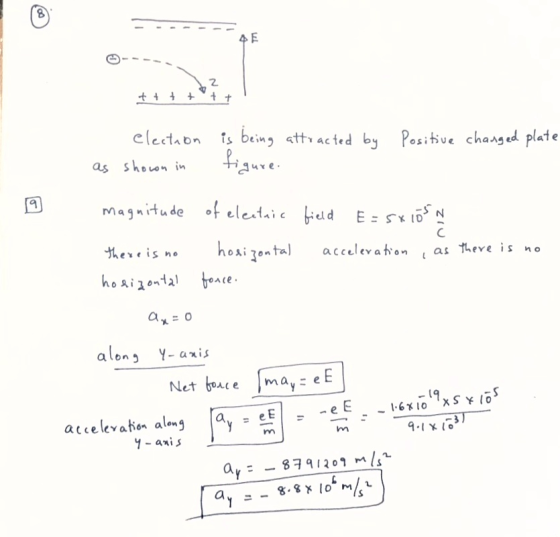
8) An electron is initially moving to the right when it...
E + Question 15 1 pts An electron is initially moving to the right when it...
 E + Question 15 1 pts An electron is initially moving to the right when it enters a uniform electric field directed upwards. Which trajectory shown below will the electron follow? Trajectory Y OTrajectory Z Trajectory W Trajectory X
An electron with kinetic energy 228 eV is moving in a horizontal direction. The electron moves...
An electron with kinetic energy 228 eV is moving in a horizontal direction. The electron moves into a region where there is a uniform vertical electric field which has magnitude 3990 N/C. Find the smallest magnitude of a magnetic field that will cause the electron to continue to move horizontally. (1eV=1.6^10^(-19)J;mass of the electron=9.11*10^(-31)kg)
7. An electron with a charge of -1.60 x 10⁻¹⁹ C and a mass of 9.10...
 7. An electron with a charge of -1.60 x 10⁻¹⁹ C and a mass of 9.10 x 10⁻³¹ kg passes between two charged metal plates. The electric field in the region between the plates is directed downward with a magnitude of 100. N/C (see figure below). The electron enters the uniform electric field region between the plates with an initial horizontal velocity of 3.00 x 10⁶ m/s, and traverses a horizontal distance of 4.00 cm before exiting the plates. (a)...
An electron enters an electric field between two horizontal parallel plates. If the field causes the electron to...
 An electron enters an electric field between two horizontal parallel plates. If the field causes the electron to accelerate vertically upwards, what direction is the electric field? O vertically downwards outward O completely horizontal vertically upwards inward Question 5 (10 points) An electron experiences an acceleration of 1.3 x 10 m/s2 in a uniform electric field. If the electron starts from rest, how long does it take for the electron to travel 0.022 4.5 x 10⁻⁸ 5.8 x 10-65 3.4...
An electron gun creates a beam of electrons moving horizontally with a speed of 3.3 x...
 An electron gun creates a beam of electrons moving horizontally with a speed of 3.3 x 10' m/s. The electrons enter a 2.0-cm-long gap between two parallel, horizontal electrodes where the electric field is E = 5.0 x 10⁴ N/C. In what direction and by what angle is the electron beam deflected by these electrodes?
1 of 2 1 (a) What type of motion does an electron initially moving at 15...
 1 of 2 1 (a) What type of motion does an electron initially moving at 15 x 10 m/s parallel to the 2 Vequipotential line in an ideal capacitor (as shown abowe how? Explain, referring to the acceleration and similarity to a metion in a gravitationall force (b) When the electron reaches the 7 Vequipotential line, what angle 8 does its velacity vector make with the equipobential inees 1602 10 c 9.11 x 10 kg 2. (a) At what initial...
Question 20 A charged particle moving to the right along the x-axis enters a region with...
 Question 20 A charged particle moving to the right along the x-axis enters a region with a uniform electric field that is directed along the y-axis from the top of the page to the bottom of the page, as shown in the figure below. Which of the following statements is NOT true about the subsequent motion of the charged particle? You may neglect the effects of gravity and air resistance for this question. Select the correct aneu Select the correct...
An electron traveling toward the north with speed 4.0 x 10 m/s enters a region where...
 An electron traveling toward the north with speed 4.0 x 10 m/s enters a region where the Earth's magnetic field has the magnitude 5.0 x 10 ST and is directed downward at 45° below horizontal. What is the magnitude of the acceleration of the electron? (e = 1.60 10-19 C, mel = 9.11 10-31 kg) 9.8 m/s2 2.5 1012 m/s2 6.3 X 10⁻³⁰ m/s2 3.2 x 10⁻¹⁸ m/s2
1. An electron moving along the +X-axis with a speed of 3x10⁵ m/s when it enters...
 1. An electron moving along the +X-axis with a speed of 3x10⁵ m/s when it enters a region of uniform magnetic field with strength of 10 T in the +y- direction. What is the Electric field in the region if the electron maintains its initial velocity? Give your answer in component form.
An electron is shot through a varying electrical field. Initially the electron is moving in the...
An electron is shot through a varying electrical field. Initially the electron is moving in the x-direction with a velocity V_x = 100 m/s.The electron enters the field when it passes the origin. The field varies with time, causing an accele(ration of the electron that varies in time: a(t) = (-20 m/s^2 - 10 m/s^3*t) Already calculated information: V_y = -20t - 5t^2 (velocity - y-axis) r_x = 100*t (position - x-axis) r_y = -10t^2 - 5/3*t^3 (position - y-axis)...
 E + Question 15 1 pts An electron is initially moving to the right when it enters a uniform electric field directed upwards. Which trajectory shown below will the electron follow? Trajectory Y OTrajectory Z Trajectory W Trajectory X
 7. An electron with a charge of -1.60 x 10⁻¹⁹ C and a mass of 9.10 x 10⁻³¹ kg passes between two charged metal plates. The electric field in the region between the plates is directed downward with a magnitude of 100. N/C (see figure below). The electron enters the uniform electric field region between the plates with an initial horizontal velocity of 3.00 x 10⁶ m/s, and traverses a horizontal distance of 4.00 cm before exiting the plates. (a)...
 An electron enters an electric field between two horizontal parallel plates. If the field causes the electron to accelerate vertically upwards, what direction is the electric field? O vertically downwards outward O completely horizontal vertically upwards inward Question 5 (10 points) An electron experiences an acceleration of 1.3 x 10 m/s2 in a uniform electric field. If the electron starts from rest, how long does it take for the electron to travel 0.022 4.5 x 10⁻⁸ 5.8 x 10-65 3.4...
 An electron gun creates a beam of electrons moving horizontally with a speed of 3.3 x 10' m/s. The electrons enter a 2.0-cm-long gap between two parallel, horizontal electrodes where the electric field is E = 5.0 x 10⁴ N/C. In what direction and by what angle is the electron beam deflected by these electrodes?
 1 of 2 1 (a) What type of motion does an electron initially moving at 15 x 10 m/s parallel to the 2 Vequipotential line in an ideal capacitor (as shown abowe how? Explain, referring to the acceleration and similarity to a metion in a gravitationall force (b) When the electron reaches the 7 Vequipotential line, what angle 8 does its velacity vector make with the equipobential inees 1602 10 c 9.11 x 10 kg 2. (a) At what initial...
 Question 20 A charged particle moving to the right along the x-axis enters a region with a uniform electric field that is directed along the y-axis from the top of the page to the bottom of the page, as shown in the figure below. Which of the following statements is NOT true about the subsequent motion of the charged particle? You may neglect the effects of gravity and air resistance for this question. Select the correct aneu Select the correct...
 An electron traveling toward the north with speed 4.0 x 10 m/s enters a region where the Earth's magnetic field has the magnitude 5.0 x 10 ST and is directed downward at 45° below horizontal. What is the magnitude of the acceleration of the electron? (e = 1.60 10-19 C, mel = 9.11 10-31 kg) 9.8 m/s2 2.5 1012 m/s2 6.3 X 10⁻³⁰ m/s2 3.2 x 10⁻¹⁸ m/s2
 1. An electron moving along the +X-axis with a speed of 3x10⁵ m/s when it enters a region of uniform magnetic field with strength of 10 T in the +y- direction. What is the Electric field in the region if the electron maintains its initial velocity? Give your answer in component form.
Most questions answered within 3 hours.
-
Where is the error in this code sequence?
String s1 = "Hello";
String s2 = "ello";...
asked 10 months ago -
Financial data for Joel de Paris, Inc., for last year
follow:
Joel de Paris, Inc.
Balance...
asked 10 months ago -
Consider this reaction:
Al2(SO4)3 (aq)+ BaCl3
(aq) Al2Cl6 (aq)- +
3BaSO4(s) . What is the...
asked 10 months ago -
Suppose that Savneet is considering increasing her
recent random sample from 20 car rentals to 40...
asked 10 months ago -
Trucks arrive at an unloading terminal at an average rate of 120
per hour.
Trucks arrive...
asked 10 months ago -
Why are methanol and ethanol completely soluble in water while
octanol is not very little soluble....
asked 10 months ago -
A facilities manager at a university reads in a research report
that the mean amount of...
asked 10 months ago -
When the CuSO4 is rehydrated by adding water to the anhydrous
compound, is this an endothermic...
asked 10 months ago -
A ray of sunlight is passing from diamond into crown glass; the
angle of incidence is...
asked 10 months ago -
A block of mass 0.249 kg is placed on top of a light, vertical
spring of...
asked 10 months ago -
how do the kidneys compensate in the presences of acidosis
a) trigger hyperventilate
b) reserve acid...
asked 10 months ago -
Question 501 pts
The rental rate of capital to the firm increases. Which of the
following...
asked 10 months ago