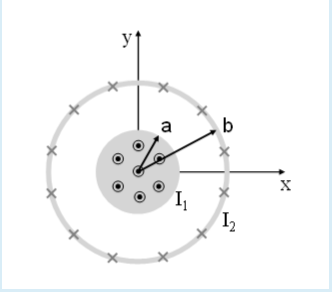
An infinite solid cylinder conductor of radius a = 3cm centered on the z-axis carries a current I1 = 1A. The current is evenly distributed along the cross section and is directed out of the screen (positive z-axis direction). An infinite coaxial conductive surface of radius b = 8 cm carries a current I2 = 4A, towards the inside of the screen (negative direction z).
What is the magnitude of the magnetic field B inside the inner cylinder at a radius of 2cm from the central axis?
Homework Answers
Request Answer!
We need at least 10 more requests to produce the answer.
0 / 10 have requested this problem solution
The more requests, the faster the answer.
Add Answer to:
An infinite solid cylinder conductor of radius a = 3cm centered
on the z-axis carries a...
A long, hollow, cylindrical conductor (inner radius 2.0 mm, outer radius 4.0 mm) carries a current of 49
A long, hollow, cylindrical conductor (inner radius 2.0 mm, outer radius 4.0 mm) carries a current of 49 A distributed uniformly across its cross section. A long thin wire that is coaxial with the cylinder carries a current of 55 A in the opposite direction. What is the magnitude of the magnetic field (a) 1.2 mm. (b) 2.1 mm, and (c) 4.0 mm from the central axis of the wire and cylinder?
A long, hollow, cylindrical conductor (inner radius 3.4 mm, outer radius 4.6 mm) carries a current...
 A long, hollow, cylindrical conductor (inner radius 3.4 mm, outer radius 4.6 mm) carries a current of 49 A distributed uniformly across its cross section. A long thin wire that is coaxial with the cylinder carries a current of 52 A in the opposite direction. What is the magnitude of the magnetic field (a) 1.0 mm, (b) 3.5 mm, and (c) 5.3 mm from the central axis of the wire and cylinder? Number Units Number Units Number Units
A long, hollow, cylindrical conductor (inner radius 8.0 mm, outer radius 16.0 mm) carries a current...
 A long, hollow, cylindrical conductor (inner radius 8.0 mm, outer radius 16.0 mm) carries a current of 14 A distributed uniformly across its cross section. A long thin wire that is coaxial with the cylinder carries a current of 14 A in the opposite direction. What is the magnitude of the magnetic field at the following distances from the central axis of the wire and cylinder? (a) 4.0 mm 0.00071 (b) 12.0 mm 0.0002333 X T (c) 20.0 mm 0.00014...
A hollow, circular cylindrical conductor in freespace of infinite length. The inner and outer radius are...
A hollow, circular cylindrical conductor in freespace of infinite length. The inner and outer radius are b and c respectively, from the center z axis. It carries a current I in z direction. (a) Find the vector current density J. (b) Use Ampere's Law to find the magnetic field B and H outside the conductor(r>c). (c) Find B inside the hollow interior(r<b). (d) Find B in the conductor(b<r<c).
An infinite horizontal slab of thickness 2w is perpendicular to the z-axis and centered on the...
An infinite horizontal slab of thickness 2w is perpendicular to the z-axis and centered on the xy-plane. It carries a uniform current density J in the x-direction. There is a cylindrical hole in the slab with radius w centered on the x-axis. Find the B-field a distance z from the origin along the z-axis such that z<w. Answer in terms of µ.
A coaxial cable consists of an inner cylindrical conductor of radius R1 -0.040 m on the...
 A coaxial cable consists of an inner cylindrical conductor of radius R1 -0.040 m on the axis of an outer hollow cylindrical conductor of inner radius R2 -0.080 m and outer radius R3 = 0.090 m. The inner conductor carries current 11 = 4,40 A in one direction, and the outer conductor carries current 12-4.40A in the opposite direction. What is the magnitude of the magnetic field at the following distances from the central axis of the cable? (0 =...
Two parallel long (infinite for our purposes) wires are oriented along the z-axis. The figure below...
 Two parallel long (infinite for our purposes) wires are oriented
along the z-axis. The figure below shows the
(xy)-plane perpendicular to the wires, including
the positions where the wires cross this plane. The wires carry
some unknown electric currents I1 and
I2, which you need to find from a
single measurement of the magnetic field
B=Bxi
+
Byj
at point A, whose position in the plane is also indicated. We will
treat the currents algebraically: the current I
is positive...
Two parallel long (infinite for our purposes) wires are oriented
along the z-axis. The figure below shows the
(xy)-plane perpendicular to the wires, including
the positions where the wires cross this plane. The wires carry
some unknown electric currents I1 and
I2, which you need to find from a
single measurement of the magnetic field
B=Bxi
+
Byj
at point A, whose position in the plane is also indicated. We will
treat the currents algebraically: the current I
is positive...
Two parallel long (infinite for our purposes) wires are oriented along the z-axis. The figure below...
 Two parallel long (infinite for our purposes) wires are oriented
along the z-axis. The figure below shows the
(xy)-plane perpendicular to the wires, including
the positions where the wires cross this plane. The wires carry
some unknown electric currents I1 and
I2, which you need to find from a
single measurement of the magnetic field
B=Bxi
+
Byj
at point A, whose position in the plane is also indicated. We will
treat the currents algebraically: the current I
is positive...
Two parallel long (infinite for our purposes) wires are oriented
along the z-axis. The figure below shows the
(xy)-plane perpendicular to the wires, including
the positions where the wires cross this plane. The wires carry
some unknown electric currents I1 and
I2, which you need to find from a
single measurement of the magnetic field
B=Bxi
+
Byj
at point A, whose position in the plane is also indicated. We will
treat the currents algebraically: the current I
is positive...
Two parallel long (infinite for our purposes) wires are oriented along the z-axis. The figure below...
 Two parallel long (infinite for our purposes) wires are oriented
along the z-axis. The figure below shows the
(xy)-plane perpendicular to the wires, including
the positions where the wires cross this plane. The wires carry
some unknown electric currents I1 and
I2, which you need to find from a
single measurement of the magnetic field
B=Bxi
+
Byj
at point A, whose position in the plane is also indicated. We will
treat the currents algebraically: the current I
is positive...
Two parallel long (infinite for our purposes) wires are oriented
along the z-axis. The figure below shows the
(xy)-plane perpendicular to the wires, including
the positions where the wires cross this plane. The wires carry
some unknown electric currents I1 and
I2, which you need to find from a
single measurement of the magnetic field
B=Bxi
+
Byj
at point A, whose position in the plane is also indicated. We will
treat the currents algebraically: the current I
is positive...
Two parallel long (infinite for our purposes) wires are oriented along the z-axis. The figure below...
 Two parallel long (infinite for our purposes) wires are oriented
along the z-axis. The figure below shows the
(xy)-plane perpendicular to the wires, including
the positions where the wires cross this plane. The wires carry
some unknown electric currents I1 and
I2, which you need to find from a
single measurement of the magnetic field
B=Bxi
+
Byj
at point A, whose position in the plane is also indicated. We will
treat the currents algebraically: the current I
is positive...
Two parallel long (infinite for our purposes) wires are oriented
along the z-axis. The figure below shows the
(xy)-plane perpendicular to the wires, including
the positions where the wires cross this plane. The wires carry
some unknown electric currents I1 and
I2, which you need to find from a
single measurement of the magnetic field
B=Bxi
+
Byj
at point A, whose position in the plane is also indicated. We will
treat the currents algebraically: the current I
is positive...
 A long, hollow, cylindrical conductor (inner radius 3.4 mm, outer radius 4.6 mm) carries a current of 49 A distributed uniformly across its cross section. A long thin wire that is coaxial with the cylinder carries a current of 52 A in the opposite direction. What is the magnitude of the magnetic field (a) 1.0 mm, (b) 3.5 mm, and (c) 5.3 mm from the central axis of the wire and cylinder? Number Units Number Units Number Units
 A long, hollow, cylindrical conductor (inner radius 8.0 mm, outer radius 16.0 mm) carries a current of 14 A distributed uniformly across its cross section. A long thin wire that is coaxial with the cylinder carries a current of 14 A in the opposite direction. What is the magnitude of the magnetic field at the following distances from the central axis of the wire and cylinder? (a) 4.0 mm 0.00071 (b) 12.0 mm 0.0002333 X T (c) 20.0 mm 0.00014...
 A coaxial cable consists of an inner cylindrical conductor of radius R1 -0.040 m on the axis of an outer hollow cylindrical conductor of inner radius R2 -0.080 m and outer radius R3 = 0.090 m. The inner conductor carries current 11 = 4,40 A in one direction, and the outer conductor carries current 12-4.40A in the opposite direction. What is the magnitude of the magnetic field at the following distances from the central axis of the cable? (0 =...
 Two parallel long (infinite for our purposes) wires are oriented
along the z-axis. The figure below shows the
(xy)-plane perpendicular to the wires, including
the positions where the wires cross this plane. The wires carry
some unknown electric currents I1 and
I2, which you need to find from a
single measurement of the magnetic field
B=Bxi
+
Byj
at point A, whose position in the plane is also indicated. We will
treat the currents algebraically: the current I
is positive...
Two parallel long (infinite for our purposes) wires are oriented
along the z-axis. The figure below shows the
(xy)-plane perpendicular to the wires, including
the positions where the wires cross this plane. The wires carry
some unknown electric currents I1 and
I2, which you need to find from a
single measurement of the magnetic field
B=Bxi
+
Byj
at point A, whose position in the plane is also indicated. We will
treat the currents algebraically: the current I
is positive...
 Two parallel long (infinite for our purposes) wires are oriented
along the z-axis. The figure below shows the
(xy)-plane perpendicular to the wires, including
the positions where the wires cross this plane. The wires carry
some unknown electric currents I1 and
I2, which you need to find from a
single measurement of the magnetic field
B=Bxi
+
Byj
at point A, whose position in the plane is also indicated. We will
treat the currents algebraically: the current I
is positive...
Two parallel long (infinite for our purposes) wires are oriented
along the z-axis. The figure below shows the
(xy)-plane perpendicular to the wires, including
the positions where the wires cross this plane. The wires carry
some unknown electric currents I1 and
I2, which you need to find from a
single measurement of the magnetic field
B=Bxi
+
Byj
at point A, whose position in the plane is also indicated. We will
treat the currents algebraically: the current I
is positive...
 Two parallel long (infinite for our purposes) wires are oriented
along the z-axis. The figure below shows the
(xy)-plane perpendicular to the wires, including
the positions where the wires cross this plane. The wires carry
some unknown electric currents I1 and
I2, which you need to find from a
single measurement of the magnetic field
B=Bxi
+
Byj
at point A, whose position in the plane is also indicated. We will
treat the currents algebraically: the current I
is positive...
Two parallel long (infinite for our purposes) wires are oriented
along the z-axis. The figure below shows the
(xy)-plane perpendicular to the wires, including
the positions where the wires cross this plane. The wires carry
some unknown electric currents I1 and
I2, which you need to find from a
single measurement of the magnetic field
B=Bxi
+
Byj
at point A, whose position in the plane is also indicated. We will
treat the currents algebraically: the current I
is positive...
 Two parallel long (infinite for our purposes) wires are oriented
along the z-axis. The figure below shows the
(xy)-plane perpendicular to the wires, including
the positions where the wires cross this plane. The wires carry
some unknown electric currents I1 and
I2, which you need to find from a
single measurement of the magnetic field
B=Bxi
+
Byj
at point A, whose position in the plane is also indicated. We will
treat the currents algebraically: the current I
is positive...
Two parallel long (infinite for our purposes) wires are oriented
along the z-axis. The figure below shows the
(xy)-plane perpendicular to the wires, including
the positions where the wires cross this plane. The wires carry
some unknown electric currents I1 and
I2, which you need to find from a
single measurement of the magnetic field
B=Bxi
+
Byj
at point A, whose position in the plane is also indicated. We will
treat the currents algebraically: the current I
is positive...
Most questions answered within 3 hours.
-
Where is the error in this code sequence?
String s1 = "Hello";
String s2 = "ello";...
asked 10 months ago -
Financial data for Joel de Paris, Inc., for last year
follow:
Joel de Paris, Inc.
Balance...
asked 10 months ago -
Consider this reaction:
Al2(SO4)3 (aq)+ BaCl3
(aq) Al2Cl6 (aq)- +
3BaSO4(s) . What is the...
asked 10 months ago -
Suppose that Savneet is considering increasing her
recent random sample from 20 car rentals to 40...
asked 10 months ago -
Trucks arrive at an unloading terminal at an average rate of 120
per hour.
Trucks arrive...
asked 10 months ago -
Why are methanol and ethanol completely soluble in water while
octanol is not very little soluble....
asked 10 months ago -
A facilities manager at a university reads in a research report
that the mean amount of...
asked 10 months ago -
When the CuSO4 is rehydrated by adding water to the anhydrous
compound, is this an endothermic...
asked 10 months ago -
A ray of sunlight is passing from diamond into crown glass; the
angle of incidence is...
asked 10 months ago -
A block of mass 0.249 kg is placed on top of a light, vertical
spring of...
asked 10 months ago -
how do the kidneys compensate in the presences of acidosis
a) trigger hyperventilate
b) reserve acid...
asked 10 months ago -
Question 501 pts
The rental rate of capital to the firm increases. Which of the
following...
asked 10 months ago