
Homework Answers

Add Answer to:
(B) predict how an increase in temp will affect the value of
AG
7. Using values...
Using values of AG f calculate AG rxn for the following reaction. Is the reaction product-favored...
 Using values of AG f calculate AG rxn for the following reaction. Is the reaction product-favored or reactant-favored? SiC14(9) + 2 Mg(s) + 2 MgCl2(s) + Si(s) AG°f (kJ/mol) -50.6 -300.13 HgS(s) SO2(g) H2S(g) H2O(C) -33.56 -228.59 -622.76 Sici_(g) MgCl2(s) -591.59 kJ/mol product-favored reactant-favored
Using values of AG°f, calculate AGºrxn for the following reaction. Is the reaction product-favored or reactant-favored?...
 Using values of AG°f, calculate AGºrxn for the following reaction. Is the reaction product-favored or reactant-favored? SiC14(g) + 2 Mg(s) → 2 MgCl2(s) + Si(s) AG°f (kJ/mol) HgS(s) | -50.6 SO2(g) -300.13 H2S(g) -33.56 H2O(l) -228.59 SiCl4(8) -622.76 MgCl2(s) -591.59 kJ/mol O product-favored O reactant-favored
19. Predict how the following will affect the solubility of Al(OH)s a. In solution of 0.1 MA b. p...
 19. Predict how the following will affect the solubility of Al(OH)s a. In solution of 0.1 MA b. pH of 4.0 c. pOH of 4.0-Al(OH)s is amphoteric-Al(OH)s (aq) + OH, (aq)-→ [Al(OH) (aq) 20. Predict how the following will affect the solubility of AgBr a. Addition of Na S2Os complex forms in Ag' (a) 2S20 (aq) [Ag(S 0s)2l (aq) 21. Calculate the molar solubility for the following solutions of LiF (Ksp 3.8 103) a. In 0.1 M NaF . In...
1. Calculate AG°for the following reaction at 25°C using AG ° = AH ° - TAS°...
 1. Calculate AG°for the following reaction at 25°C using AG ° = AH ° - TAS° Fe2O3 (s) + 3 H2(g) → 2 Fe (s) + 3 H2O (1) 2. Calculate AG ° for the same reaction using AG°f values Fe2O3 (s) 3 H2(g) → 2 Fe (s) + + 3 H20 (1) + 3. Calculate AGº of the following reaction: 2C (s) H 2 (g) → C2H 2 (g) Use Hess' Law, AG° = AG°1 + AG°2 + AG°3...
4. Predict if the following reaction is spontaneous. Calculate the AGº system from AG°f values for...
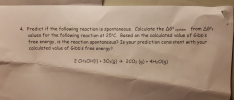 4. Predict if the following reaction is spontaneous. Calculate the AGº system from AG°f values for the following reaction at 25°C. Based on the calculated value of Gibb's free energy, is the reaction spontaneous? Is your prediction consistent with your calculated value of Gibb's free energy?. 2 CH3OH(I) + 302(g) → 2CO2 (g) + 4H2O(9)
7 Consider the following reaction at 298 K: NH3(g) +HCI(g)NH4CI(s) Using the thermochemical data at 298 K given below (a) Determine the AH for the reaction. (2 marks) (b) Determine the AG for the...
 7 Consider the following reaction at 298 K: NH3(g) +HCI(g)NH4CI(s) Using the thermochemical data at 298 K given below (a) Determine the AH for the reaction. (2 marks) (b) Determine the AG for the reaction and comment on its value. (3 marks) (c) Determine the maximum work done available in the reaction. (3 marks) An equilibrium mixture, consisting of 0.5 atm of NHy(), 0.5 atm of HCKg) and excessive of NH Cl(s), is enclosed in a container at 298 K...
Solve 1-3 Using what you know about electricity, predict how parallel resistors would affect current flow....
 Solve 1-3
Using what you know about electricity, predict how parallel resistors would affect current flow. What would you expect the effective resistance of two equal resistors in parallel to be, compared to the resistance of a single resistor? Using what you know about electricity, predict how parallel resistors would affect current flow. What would you expect the effective resistance of two equal resistors in parallel to be, compared to the resistance of one alone? For each of the three...
Solve 1-3
Using what you know about electricity, predict how parallel resistors would affect current flow. What would you expect the effective resistance of two equal resistors in parallel to be, compared to the resistance of a single resistor? Using what you know about electricity, predict how parallel resistors would affect current flow. What would you expect the effective resistance of two equal resistors in parallel to be, compared to the resistance of one alone? For each of the three...
7. (8 pts each) For the following reactions, (a) Provide the products. (b) Provide the pk,...
 7. (8 pts each) For the following reactions, (a) Provide the products. (b) Provide the pk, values for the acid and conjugate acid in the reaction. (c) Indicate which side of the equilibrium is favored. 0 + CHESH + Na coz R CH3 2 H20
q7 Using the activity series, predict whether a reaction occurs or no reaction occurs for each...
 q7
Using the activity series, predict whether a reaction occurs or no reaction occurs for each of the following single-replacement reactions: a) Cu(NO3)2(aq) + Ni(s) - [Select] b) Au(s) + H2SO4(aq) — [ Select] c) FeSO4(aq) + Ag(s) – [Select Using the activity series, predict whether a reaction occurs or no reaction occurs for each of the following single-replacement reactions: a) Cu(NO3)2(aq) + Ni(s) - [Select] [Select] Reaction Occurs No Reaction b) Au(s) + H2SO4(aq) → [ Select] c) FeSO4(aq)...
q7
Using the activity series, predict whether a reaction occurs or no reaction occurs for each of the following single-replacement reactions: a) Cu(NO3)2(aq) + Ni(s) - [Select] b) Au(s) + H2SO4(aq) — [ Select] c) FeSO4(aq) + Ag(s) – [Select Using the activity series, predict whether a reaction occurs or no reaction occurs for each of the following single-replacement reactions: a) Cu(NO3)2(aq) + Ni(s) - [Select] [Select] Reaction Occurs No Reaction b) Au(s) + H2SO4(aq) → [ Select] c) FeSO4(aq)...
4) (a) Use the standard entropy values (AS") in the Appendix to solve for ?5° of...
 4) (a) Use the standard entropy values (AS") in the Appendix to solve for ?5° of each reaction at 25°C. (b) Solve for AG° ron for both reactions as well using the standard free energy values. (AG) 2H20(liquid)2H2(g) + O2(g) Al2O3(s) 3 H2(g) 2 Al(s)3 H20(g) 5) AH° 180.7 kJ; AS 24.7 JIK 25°C N2(8) O2(g)-2 NO(g) (a)Calculate the standard free-energy change for the reaction at 25°C. (b) Calculate ?G at 500°C using the ?G° value calculated from part a.
 Using values of AG f calculate AG rxn for the following reaction. Is the reaction product-favored or reactant-favored? SiC14(9) + 2 Mg(s) + 2 MgCl2(s) + Si(s) AG°f (kJ/mol) -50.6 -300.13 HgS(s) SO2(g) H2S(g) H2O(C) -33.56 -228.59 -622.76 Sici_(g) MgCl2(s) -591.59 kJ/mol product-favored reactant-favored
 Using values of AG°f, calculate AGºrxn for the following reaction. Is the reaction product-favored or reactant-favored? SiC14(g) + 2 Mg(s) → 2 MgCl2(s) + Si(s) AG°f (kJ/mol) HgS(s) | -50.6 SO2(g) -300.13 H2S(g) -33.56 H2O(l) -228.59 SiCl4(8) -622.76 MgCl2(s) -591.59 kJ/mol O product-favored O reactant-favored
 19. Predict how the following will affect the solubility of Al(OH)s a. In solution of 0.1 MA b. pH of 4.0 c. pOH of 4.0-Al(OH)s is amphoteric-Al(OH)s (aq) + OH, (aq)-→ [Al(OH) (aq) 20. Predict how the following will affect the solubility of AgBr a. Addition of Na S2Os complex forms in Ag' (a) 2S20 (aq) [Ag(S 0s)2l (aq) 21. Calculate the molar solubility for the following solutions of LiF (Ksp 3.8 103) a. In 0.1 M NaF . In...
 1. Calculate AG°for the following reaction at 25°C using AG ° = AH ° - TAS° Fe2O3 (s) + 3 H2(g) → 2 Fe (s) + 3 H2O (1) 2. Calculate AG ° for the same reaction using AG°f values Fe2O3 (s) 3 H2(g) → 2 Fe (s) + + 3 H20 (1) + 3. Calculate AGº of the following reaction: 2C (s) H 2 (g) → C2H 2 (g) Use Hess' Law, AG° = AG°1 + AG°2 + AG°3...
 4. Predict if the following reaction is spontaneous. Calculate the AGº system from AG°f values for the following reaction at 25°C. Based on the calculated value of Gibb's free energy, is the reaction spontaneous? Is your prediction consistent with your calculated value of Gibb's free energy?. 2 CH3OH(I) + 302(g) → 2CO2 (g) + 4H2O(9)
 7 Consider the following reaction at 298 K: NH3(g) +HCI(g)NH4CI(s) Using the thermochemical data at 298 K given below (a) Determine the AH for the reaction. (2 marks) (b) Determine the AG for the reaction and comment on its value. (3 marks) (c) Determine the maximum work done available in the reaction. (3 marks) An equilibrium mixture, consisting of 0.5 atm of NHy(), 0.5 atm of HCKg) and excessive of NH Cl(s), is enclosed in a container at 298 K...
 Solve 1-3
Using what you know about electricity, predict how parallel resistors would affect current flow. What would you expect the effective resistance of two equal resistors in parallel to be, compared to the resistance of a single resistor? Using what you know about electricity, predict how parallel resistors would affect current flow. What would you expect the effective resistance of two equal resistors in parallel to be, compared to the resistance of one alone? For each of the three...
Solve 1-3
Using what you know about electricity, predict how parallel resistors would affect current flow. What would you expect the effective resistance of two equal resistors in parallel to be, compared to the resistance of a single resistor? Using what you know about electricity, predict how parallel resistors would affect current flow. What would you expect the effective resistance of two equal resistors in parallel to be, compared to the resistance of one alone? For each of the three...
 7. (8 pts each) For the following reactions, (a) Provide the products. (b) Provide the pk, values for the acid and conjugate acid in the reaction. (c) Indicate which side of the equilibrium is favored. 0 + CHESH + Na coz R CH3 2 H20
 q7
Using the activity series, predict whether a reaction occurs or no reaction occurs for each of the following single-replacement reactions: a) Cu(NO3)2(aq) + Ni(s) - [Select] b) Au(s) + H2SO4(aq) — [ Select] c) FeSO4(aq) + Ag(s) – [Select Using the activity series, predict whether a reaction occurs or no reaction occurs for each of the following single-replacement reactions: a) Cu(NO3)2(aq) + Ni(s) - [Select] [Select] Reaction Occurs No Reaction b) Au(s) + H2SO4(aq) → [ Select] c) FeSO4(aq)...
q7
Using the activity series, predict whether a reaction occurs or no reaction occurs for each of the following single-replacement reactions: a) Cu(NO3)2(aq) + Ni(s) - [Select] b) Au(s) + H2SO4(aq) — [ Select] c) FeSO4(aq) + Ag(s) – [Select Using the activity series, predict whether a reaction occurs or no reaction occurs for each of the following single-replacement reactions: a) Cu(NO3)2(aq) + Ni(s) - [Select] [Select] Reaction Occurs No Reaction b) Au(s) + H2SO4(aq) → [ Select] c) FeSO4(aq)...
 4) (a) Use the standard entropy values (AS") in the Appendix to solve for ?5° of each reaction at 25°C. (b) Solve for AG° ron for both reactions as well using the standard free energy values. (AG) 2H20(liquid)2H2(g) + O2(g) Al2O3(s) 3 H2(g) 2 Al(s)3 H20(g) 5) AH° 180.7 kJ; AS 24.7 JIK 25°C N2(8) O2(g)-2 NO(g) (a)Calculate the standard free-energy change for the reaction at 25°C. (b) Calculate ?G at 500°C using the ?G° value calculated from part a.
Most questions answered within 3 hours.
-
Where is the error in this code sequence?
String s1 = "Hello";
String s2 = "ello";...
asked 10 months ago -
Financial data for Joel de Paris, Inc., for last year
follow:
Joel de Paris, Inc.
Balance...
asked 10 months ago -
Consider this reaction:
Al2(SO4)3 (aq)+ BaCl3
(aq) Al2Cl6 (aq)- +
3BaSO4(s) . What is the...
asked 10 months ago -
Suppose that Savneet is considering increasing her
recent random sample from 20 car rentals to 40...
asked 10 months ago -
Trucks arrive at an unloading terminal at an average rate of 120
per hour.
Trucks arrive...
asked 10 months ago -
Why are methanol and ethanol completely soluble in water while
octanol is not very little soluble....
asked 10 months ago -
A facilities manager at a university reads in a research report
that the mean amount of...
asked 10 months ago -
When the CuSO4 is rehydrated by adding water to the anhydrous
compound, is this an endothermic...
asked 10 months ago -
A ray of sunlight is passing from diamond into crown glass; the
angle of incidence is...
asked 10 months ago -
A block of mass 0.249 kg is placed on top of a light, vertical
spring of...
asked 10 months ago -
how do the kidneys compensate in the presences of acidosis
a) trigger hyperventilate
b) reserve acid...
asked 10 months ago -
Question 501 pts
The rental rate of capital to the firm increases. Which of the
following...
asked 10 months ago