
Homework Answers

For an ideal gas, prove that...
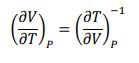 For an ideal gas, prove that...
If 33.5 mol of an ideal gas occupies 87.5 L at 13.00 °C, what is the...
 If 33.5 mol of an ideal gas occupies 87.5 L at 13.00 °C, what is the pressure of the gas? < Feedback The ideal gas law is pressure: presure: 6832 6832.2 PV = nRT When using 0.083145 L bar/mol K) as the value of R, the pressure (P) must be in bar, the volume (V) must be in liters, and the temperature (T) must be in kelvins. The symbol n represents the number of moles of gas. Rearrange the ideal...
prove that the internal energy of a monatomic ideal gas depends only on its temperature (start...
prove that the internal energy of a monatomic ideal gas depends only on its temperature (start with the change of momentum of one gas particle after its collision with a wall of the container where the ideal gas is filled in, look for the link between the pressure and the kinetic energy of the ideal gas)
An ideal gas is compressed at a constant pressure of 0.80 atm from 19.0 L to...
 An ideal gas is compressed at a constant pressure of 0.80 atm from 19.0 L to 12.0 L. The initial temperature of the gas is 27°C. 1 atm (atmosphere) = 1.013 ~ 10% Pa, 1 L (liter) = 10² m². What is the final temperature of the gas in °C? Hint: pV / T = nR, and n does not change, so you can use piVi / T1 = p2V2 / T2. Do not forget to convert the unit of...
pressure (p) of an ideal gas is (n/v) 9. Pressure (P) of an Ideal gas is...
 pressure (p) of an ideal gas is (n/v)
9. Pressure (P) of an Ideal gas is (a) 5/2 (N/V) (W/2mv2) (b) 2/3 (N/V) (1/2mv2) 3/2 (N/V) (1/2mv2) (d) None
pressure (p) of an ideal gas is (n/v)
9. Pressure (P) of an Ideal gas is (a) 5/2 (N/V) (W/2mv2) (b) 2/3 (N/V) (1/2mv2) 3/2 (N/V) (1/2mv2) (d) None
The ideal gas law describes the relationship among the volume of an ideal gas (V), its...
The ideal gas law describes the relationship among the volume of an ideal gas (V), its pressure (P), its absolute temperature (T), and number of moles (n): PV=nRT Under standard conditions, the ideal gas law does a good job of approximating these properties for any gas. However, the ideal gas law does not account for all the properties of real gases such as intermolecular attraction and molecular volume, which become more pronounced at low temperatures and high pressures. The van...
Ideal Gas Decompression at Constant Volume. State Functions. An ideal gas sealed in a rigid 5.38-L...
Ideal Gas Decompression at Constant Volume. State Functions. An ideal gas sealed in a rigid 5.38-L cylinder, initially at pressure Pi=11.10 atm, is cooled until the pressure in the cylinder is Pf=1.42 atm. What is the enthalpy change for this process? ΔH = 1pts Tries 0/6 What is the change in internal energy for this process? ΔE = 1pts
Using the Ideal Gas Law, what volume in L would 1 mole of an ideal gas occupy at standard temperature and pressure? Reme...
Using the Ideal Gas Law, what volume in L would 1 mole of an ideal gas occupy at standard temperature and pressure? Remember: STP is 273.15 K and 101.325 kPa.
The volume of an ideal gas is adiabatically reduced from 184 L to 87.5 L. The...
The volume of an ideal gas is adiabatically reduced from 184 L to 87.5 L. The initial pressure and temperature are 1.60 atm and 340 K. The final pressure is 4.53 atm. (a) Is the gas monatomic, diatomic, or polyatomic? (b) What is the final temperature? (c) How many moles are in the gas?
The volume of an ideal gas is adiabatically reduced from 196 L to 89.0 L. The...
The volume of an ideal gas is adiabatically reduced from 196 L to 89.0 L. The initial pressure and temperature are 1.30 atm and 350 K. The final pressure is 3.93 atm. (a) Is the gas monatomic, diatomic, or polyatomic? (b) What is the final temperature? (c) How many moles are in the gas?
 For an ideal gas, prove that...
 If 33.5 mol of an ideal gas occupies 87.5 L at 13.00 °C, what is the pressure of the gas? < Feedback The ideal gas law is pressure: presure: 6832 6832.2 PV = nRT When using 0.083145 L bar/mol K) as the value of R, the pressure (P) must be in bar, the volume (V) must be in liters, and the temperature (T) must be in kelvins. The symbol n represents the number of moles of gas. Rearrange the ideal...
 An ideal gas is compressed at a constant pressure of 0.80 atm from 19.0 L to 12.0 L. The initial temperature of the gas is 27°C. 1 atm (atmosphere) = 1.013 ~ 10% Pa, 1 L (liter) = 10² m². What is the final temperature of the gas in °C? Hint: pV / T = nR, and n does not change, so you can use piVi / T1 = p2V2 / T2. Do not forget to convert the unit of...
 pressure (p) of an ideal gas is (n/v)
9. Pressure (P) of an Ideal gas is (a) 5/2 (N/V) (W/2mv2) (b) 2/3 (N/V) (1/2mv2) 3/2 (N/V) (1/2mv2) (d) None
pressure (p) of an ideal gas is (n/v)
9. Pressure (P) of an Ideal gas is (a) 5/2 (N/V) (W/2mv2) (b) 2/3 (N/V) (1/2mv2) 3/2 (N/V) (1/2mv2) (d) None
Most questions answered within 3 hours.
-
Where is the error in this code sequence?
String s1 = "Hello";
String s2 = "ello";...
asked 10 months ago -
Financial data for Joel de Paris, Inc., for last year
follow:
Joel de Paris, Inc.
Balance...
asked 10 months ago -
Consider this reaction:
Al2(SO4)3 (aq)+ BaCl3
(aq) Al2Cl6 (aq)- +
3BaSO4(s) . What is the...
asked 10 months ago -
Suppose that Savneet is considering increasing her
recent random sample from 20 car rentals to 40...
asked 10 months ago -
Trucks arrive at an unloading terminal at an average rate of 120
per hour.
Trucks arrive...
asked 10 months ago -
Why are methanol and ethanol completely soluble in water while
octanol is not very little soluble....
asked 10 months ago -
A facilities manager at a university reads in a research report
that the mean amount of...
asked 10 months ago -
When the CuSO4 is rehydrated by adding water to the anhydrous
compound, is this an endothermic...
asked 10 months ago -
A ray of sunlight is passing from diamond into crown glass; the
angle of incidence is...
asked 10 months ago -
A block of mass 0.249 kg is placed on top of a light, vertical
spring of...
asked 10 months ago -
how do the kidneys compensate in the presences of acidosis
a) trigger hyperventilate
b) reserve acid...
asked 10 months ago -
Question 501 pts
The rental rate of capital to the firm increases. Which of the
following...
asked 10 months ago