
Homework Answers
Add Answer to:
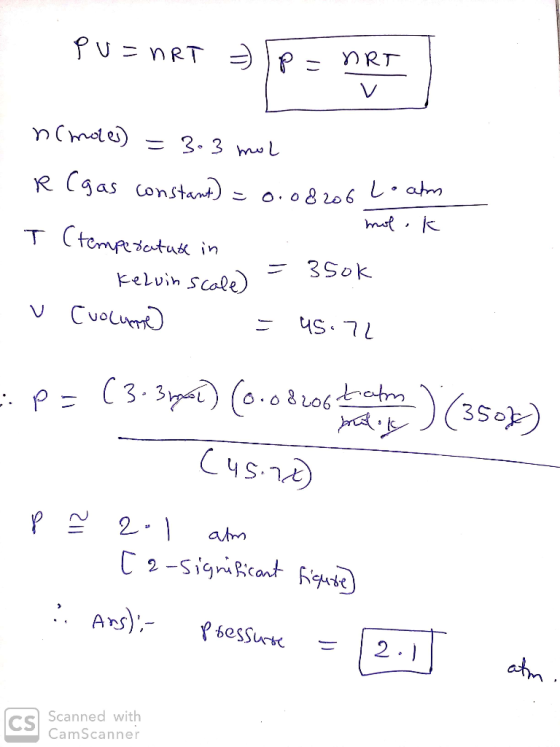
The volume of 3.3 mol of ideal gas is 45.7 L at 350 K. Calculate its...
How many moles of gas are in a container that has a volume of 20.5 mL,...
 How many moles of gas are in a container that has a volume of 20.5 mL, temperature of 303 K, and pressure of 1.10 atm? Assume ideal gas behavior. L atm L kPa • Use R-0.08206 mol K vor 8.314 v for the ideal gas constant. mol K • Your answer should have three significant figures.
The ideal gas law describes the relationship among the volume of an ideal gas (V), its...
The ideal gas law describes the relationship among the volume of an ideal gas (V), its pressure (P), its absolute temperature (T), and number of moles (n): PV=nRT Under standard conditions, the ideal gas law does a good job of approximating these properties for any gas. However, the ideal gas law does not account for all the properties of real gases such as intermolecular attraction and molecular volume, which become more pronounced at low temperatures and high pressures. The van...
Calculate the volume of the gas when the pressure of the gas is 2.00 atm at...
Calculate the volume of the gas when the pressure of the gas is 2.00 atm at a temperature of 298 K. There are 110. mol of gas in the cylinder. The value for the universal gas constant R is 0.08206 L⋅atm/(mol⋅K) . Express your answer numerically to four significant figures.
The van der Waals equation gives a relationship between the pressure p (atm), volume V(L), and temperature T(K) for a real gas: .2 where n is the number of moles, R 0.08206(L atm)(mol K) is the gas c...
 The van der Waals equation gives a relationship between the pressure p (atm), volume V(L), and temperature T(K) for a real gas: .2 where n is the number of moles, R 0.08206(L atm)(mol K) is the gas con- stant, and a (L- atm/mol-) and b (L/mol) are material constants. Determine the volume of 1.5 mol of nitrogen (a .39 L2 atm/mol2. b = 0.03913 L/mol) at temperature of 350 K and pressure of 70 atm.
The van der Waals equation...
The van der Waals equation gives a relationship between the pressure p (atm), volume V(L), and temperature T(K) for a real gas: .2 where n is the number of moles, R 0.08206(L atm)(mol K) is the gas con- stant, and a (L- atm/mol-) and b (L/mol) are material constants. Determine the volume of 1.5 mol of nitrogen (a .39 L2 atm/mol2. b = 0.03913 L/mol) at temperature of 350 K and pressure of 70 atm.
The van der Waals equation...
An engine using 1 mol of an ideal gas initially at 22.3 L and 454 K...
An engine using 1 mol of an ideal gas initially at 22.3 L and 454 K performs a cycle consisting of four steps: 1) an isothermal expansion at 454 K from 22.3 L to 40 L ; 2) cooling at constant volume to 270 K ; 3) an isothermal compression to its original volume of 22.3 L; and 4) heating at constant volume to its original temperature of 454 K . Find its efficiency. Assume that the heat capacity is...
An engine using 1 mol of an ideal gas initially at 22.3 L and 353 K...
An engine using 1 mol of an ideal gas initially at 22.3 L and 353 K performs a cycle consisting of four steps: 1) an isothermal expansion at 353 K from 22.3 L to 41.5 L; 2) cooling at constant volume to 170 K; 3) an isothermal compression to its original volume of 22.3 L; and 4) heating at constant volume to its original temperature of 353 K. Find its efficiency. Assume that the heat capacity is 21 J/K and...
Learning Goal: To apply the ideal gas law to problems involving temperature, pressure, volume, and moles...
 Learning Goal: To apply the ideal gas law to problems involving
temperature, pressure, volume, and moles of a gas. The four
properties of gases (pressure P, volume V, temperature T, and moles
of gas n) are related by a single expression known as the ideal gas
law: PV=nRT The variable R is known as the universal gas constant
and has the value R=0.0821 L⋅atm/(mole⋅K). The units of R dictate
the units for all other quantities, so when using this value...
Learning Goal: To apply the ideal gas law to problems involving
temperature, pressure, volume, and moles of a gas. The four
properties of gases (pressure P, volume V, temperature T, and moles
of gas n) are related by a single expression known as the ideal gas
law: PV=nRT The variable R is known as the universal gas constant
and has the value R=0.0821 L⋅atm/(mole⋅K). The units of R dictate
the units for all other quantities, so when using this value...
Find the volume of 4.50 mol of an ideal gas at 25.0°C and a pressure of...
Find the volume of 4.50 mol of an ideal gas at 25.0°C and a pressure of 419 kPa. Use the ideal gas law and R = 0.0821 atm • L/mol • K.
Suppose the temperature of 4.33 L of ideal gas drops from 350 K to 275 K...
 Suppose the temperature of 4.33 L of ideal gas drops from 350 K to 275 K (a) If the volume remains constant and the initial pressure is atmospheric pressure, find the final pressure What are you using for the initial pressure? What are your units? Is the volume constant or changing? It might help to reread the problem description. Pa (b) Find the number of moles of gas mol
Find the volume of 2.50 mol of an ideal gas at 26.0 °C and a pressure of 413 kPa
Find the volume of 2.50 mol of an ideal gas at 26.0 °C and a pressure of 413 kPa Use the ideal gas law and R = 0.0821 atm l/mol k.
 How many moles of gas are in a container that has a volume of 20.5 mL, temperature of 303 K, and pressure of 1.10 atm? Assume ideal gas behavior. L atm L kPa • Use R-0.08206 mol K vor 8.314 v for the ideal gas constant. mol K • Your answer should have three significant figures.
 The van der Waals equation gives a relationship between the pressure p (atm), volume V(L), and temperature T(K) for a real gas: .2 where n is the number of moles, R 0.08206(L atm)(mol K) is the gas con- stant, and a (L- atm/mol-) and b (L/mol) are material constants. Determine the volume of 1.5 mol of nitrogen (a .39 L2 atm/mol2. b = 0.03913 L/mol) at temperature of 350 K and pressure of 70 atm.
The van der Waals equation...
The van der Waals equation gives a relationship between the pressure p (atm), volume V(L), and temperature T(K) for a real gas: .2 where n is the number of moles, R 0.08206(L atm)(mol K) is the gas con- stant, and a (L- atm/mol-) and b (L/mol) are material constants. Determine the volume of 1.5 mol of nitrogen (a .39 L2 atm/mol2. b = 0.03913 L/mol) at temperature of 350 K and pressure of 70 atm.
The van der Waals equation...
 Learning Goal: To apply the ideal gas law to problems involving
temperature, pressure, volume, and moles of a gas. The four
properties of gases (pressure P, volume V, temperature T, and moles
of gas n) are related by a single expression known as the ideal gas
law: PV=nRT The variable R is known as the universal gas constant
and has the value R=0.0821 L⋅atm/(mole⋅K). The units of R dictate
the units for all other quantities, so when using this value...
Learning Goal: To apply the ideal gas law to problems involving
temperature, pressure, volume, and moles of a gas. The four
properties of gases (pressure P, volume V, temperature T, and moles
of gas n) are related by a single expression known as the ideal gas
law: PV=nRT The variable R is known as the universal gas constant
and has the value R=0.0821 L⋅atm/(mole⋅K). The units of R dictate
the units for all other quantities, so when using this value...
 Suppose the temperature of 4.33 L of ideal gas drops from 350 K to 275 K (a) If the volume remains constant and the initial pressure is atmospheric pressure, find the final pressure What are you using for the initial pressure? What are your units? Is the volume constant or changing? It might help to reread the problem description. Pa (b) Find the number of moles of gas mol
Most questions answered within 3 hours.
-
Where is the error in this code sequence?
String s1 = "Hello";
String s2 = "ello";...
asked 11 months ago -
Financial data for Joel de Paris, Inc., for last year
follow:
Joel de Paris, Inc.
Balance...
asked 11 months ago -
Consider this reaction:
Al2(SO4)3 (aq)+ BaCl3
(aq) Al2Cl6 (aq)- +
3BaSO4(s) . What is the...
asked 11 months ago -
Suppose that Savneet is considering increasing her
recent random sample from 20 car rentals to 40...
asked 11 months ago -
Trucks arrive at an unloading terminal at an average rate of 120
per hour.
Trucks arrive...
asked 11 months ago -
Why are methanol and ethanol completely soluble in water while
octanol is not very little soluble....
asked 11 months ago -
A facilities manager at a university reads in a research report
that the mean amount of...
asked 11 months ago -
When the CuSO4 is rehydrated by adding water to the anhydrous
compound, is this an endothermic...
asked 11 months ago -
A ray of sunlight is passing from diamond into crown glass; the
angle of incidence is...
asked 11 months ago -
A block of mass 0.249 kg is placed on top of a light, vertical
spring of...
asked 11 months ago -
how do the kidneys compensate in the presences of acidosis
a) trigger hyperventilate
b) reserve acid...
asked 11 months ago -
Question 501 pts
The rental rate of capital to the firm increases. Which of the
following...
asked 11 months ago