
Homework Answers
Add Answer to:
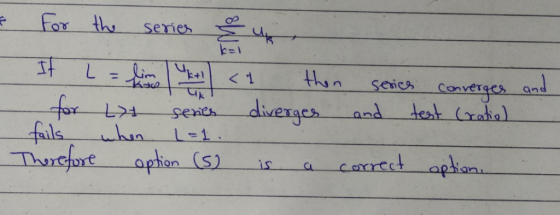
lim k+ +oo For the series k, let L Which of the following statements does NOT...
Consider the series 2 Which of the following statements are true? (Select all that apply). Yanitiniz:...
 Consider the series 2 Which of the following statements are true? (Select all that apply). Yanitiniz: The series absolutely converges. (-1)" lim 8+ = 0 The series converges conditionally It is an alternating series. The series converges to some finite number The series conditionally and absolutely converges. tale) diverse diverges. It is not an alternating series. The ratio test is inconclusive.
Problem 1 Let {ak} and {bk} be sequences of positive real numbers. Assume that lim “k...
 Problem 1 Let {ak} and {bk} be sequences of positive real numbers. Assume that lim “k = 0. k+oo bk 1. Prove that if ) bk converges, so does 'ak k=1 k=1 2. If ) bk diverges, is it necessary that ) ak diverges? k=1 k=1
Consider the series
 Consider the series \(\sum_{n=1} a_{n}\) whereIn this problem you must attempt to use the Ratio Test to decide whether the series converges.Compute$$ L=\lim _{n \rightarrow \infty}\left|\frac{a_{n+1}}{a_{n}}\right| $$Enter the numerical value of the limit \(L\) if it converges, INF if it diverges to infinity, -INF if it diverges to negative infinity, or DIV if it diverges but not to infinity or negative infinity.L= _______Which of the following statements is true?A. The Ratio Test says that the series converges absolutely.B. The Ratio...
Consider the series
 Consider the series \(\sum_{n=1} a_{n}\) whereIn this problem you must attempt to use the Ratio Test to decide whether the series converges.Compute$$ L=\lim _{n \rightarrow \infty}\left|\frac{a_{n+1}}{a_{n}}\right| $$Enter the numerical value of the limit \(L\) if it converges, INF if it diverges to infinity, -INF if it diverges to negative infinity, or DIV if it diverges but not to infinity or negative infinity.L= _______Which of the following statements is true?A. The Ratio Test says that the series converges absolutely.B. The Ratio...
Consider the series
 Consider the series \(\sum_{n=1} a_{n}\) whereIn this problem you must attempt to use the Ratio Test to decide whether the series converges.Compute$$ L=\lim _{n \rightarrow \infty}\left|\frac{a_{n+1}}{a_{n}}\right| $$Enter the numerical value of the limit \(L\) if it converges, INF if it diverges to infinity, -INF if it diverges to negative infinity, or DIV if it diverges but not to infinity or negative infinity.L= _______Which of the following statements is true?A. The Ratio Test says that the series converges absolutely.B. The Ratio...
Consider the series
 Consider the series \(\sum_{n=1} a_{n}\) whereIn this problem you must attempt to use the Ratio Test to decide whether the series converges.Compute$$ L=\lim _{n \rightarrow \infty}\left|\frac{a_{n+1}}{a_{n}}\right| $$Enter the numerical value of the limit \(L\) if it converges, INF if it diverges to infinity, -INF if it diverges to negative infinity, or DIV if it diverges but not to infinity or negative infinity.L= _______Which of the following statements is true?A. The Ratio Test says that the series converges absolutely.B. The Ratio...
Determine whether the following series converges absolutely, converges conditionally, or diverges. 00 (-1)+1e 3k Σ-11: -Σ...
 Determine whether the following series converges absolutely, converges conditionally, or diverges. 00 (-1)+1e 3k Σ-11: -Σ ak (k 17 k 1 k 1 Find lim a. Select the correct choice below and, if necessary, fill in the answer box to complete your choice. koo O A. lim ak koo O B. The Ilimit does not exist. (1)* 1 (k 17) 3k e Σ. Now, let denote What can be concluded from this result using the Divergence Test? k 1 O...
Consider the series
Consider the series \(\sum_{n=1} a_{n}\) where$$ a_{n}=\frac{(-1)^{n} n^{2}}{n^{2}+4 n+3} $$In this problem you must attempt to use the Ratio Test to decide whether the series converges.Compute$$ L=\lim _{n \rightarrow \infty}\left|\frac{a_{n+1}}{a_{n}}\right| $$Enter the numerical value of the limit \(L\) if it converges, INF if it diverges to infinity, -INF if it diverges to negative infinity, or DIV if it diverges but not to infinity or negative infinity.L= _______Which of the following statements is true?A. The Ratio Test says that the series...
Cansider the series
Cansider the series \(\sum_{n=1}^{\infty} a_{n}\) where$$ a_{n}=\frac{\left(6 n^{2}+2\right)(-7)^{n}}{5^{n+1}} $$In this problem you must attempt to use the Ratio Test to decide whether the series converges.Compute$$ L=\lim _{n \rightarrow \infty}\left|\frac{a_{n+1}}{a_{n}}\right| $$Enter the numerical value of the limit \(L\) if it converges, INF if it diverges to infinity, -INF if it diverges to negative infinity, or DIV if it diverges but not to infinity or negative infinity.L= _______Which of the following statements is true?A. The Ratio Test says that the series converges absolutely.B. The...
10.4.16 Use the Divergence Test to determine whether the following series diverges 249 Σ k= 1...
 10.4.16 Use the Divergence Test to determine whether the following series diverges 249 Σ k= 1 Choose the correct answer below. O A. The series diverges because lim k-00 2k9 k! = 0. B. The series converges because lim K00 2K K! 0. OC. The series converges because lim K+00 2kº -0. D. The series diverges because lim 2k k! *0 00 The mai
 Consider the series 2 Which of the following statements are true? (Select all that apply). Yanitiniz: The series absolutely converges. (-1)" lim 8+ = 0 The series converges conditionally It is an alternating series. The series converges to some finite number The series conditionally and absolutely converges. tale) diverse diverges. It is not an alternating series. The ratio test is inconclusive.
 Problem 1 Let {ak} and {bk} be sequences of positive real numbers. Assume that lim “k = 0. k+oo bk 1. Prove that if ) bk converges, so does 'ak k=1 k=1 2. If ) bk diverges, is it necessary that ) ak diverges? k=1 k=1
 Determine whether the following series converges absolutely, converges conditionally, or diverges. 00 (-1)+1e 3k Σ-11: -Σ ak (k 17 k 1 k 1 Find lim a. Select the correct choice below and, if necessary, fill in the answer box to complete your choice. koo O A. lim ak koo O B. The Ilimit does not exist. (1)* 1 (k 17) 3k e Σ. Now, let denote What can be concluded from this result using the Divergence Test? k 1 O...
 10.4.16 Use the Divergence Test to determine whether the following series diverges 249 Σ k= 1 Choose the correct answer below. O A. The series diverges because lim k-00 2k9 k! = 0. B. The series converges because lim K00 2K K! 0. OC. The series converges because lim K+00 2kº -0. D. The series diverges because lim 2k k! *0 00 The mai
Most questions answered within 3 hours.
-
Where is the error in this code sequence?
String s1 = "Hello";
String s2 = "ello";...
asked 11 months ago -
Financial data for Joel de Paris, Inc., for last year
follow:
Joel de Paris, Inc.
Balance...
asked 11 months ago -
Consider this reaction:
Al2(SO4)3 (aq)+ BaCl3
(aq) Al2Cl6 (aq)- +
3BaSO4(s) . What is the...
asked 11 months ago -
Suppose that Savneet is considering increasing her
recent random sample from 20 car rentals to 40...
asked 11 months ago -
Trucks arrive at an unloading terminal at an average rate of 120
per hour.
Trucks arrive...
asked 11 months ago -
Why are methanol and ethanol completely soluble in water while
octanol is not very little soluble....
asked 11 months ago -
A facilities manager at a university reads in a research report
that the mean amount of...
asked 11 months ago -
When the CuSO4 is rehydrated by adding water to the anhydrous
compound, is this an endothermic...
asked 11 months ago -
A ray of sunlight is passing from diamond into crown glass; the
angle of incidence is...
asked 11 months ago -
A block of mass 0.249 kg is placed on top of a light, vertical
spring of...
asked 11 months ago -
how do the kidneys compensate in the presences of acidosis
a) trigger hyperventilate
b) reserve acid...
asked 11 months ago -
Question 501 pts
The rental rate of capital to the firm increases. Which of the
following...
asked 11 months ago