
Homework Answers
Pole of the system is at ......
s = 0.75 + 1.39j , 0.75 - 1.39j
and zero of the system is at......
s = 1
Both poles lies in the right half plane so system is unstable
System frequency response can not be evaluated, since the system is unstable.
Add Answer to:
QUESTION 2 If the transfer function is 2s-3s +5 select the correct answer OSystem frequency response...
Some system has the transfer function shown. Choose the correct answer regarding the stability of the...
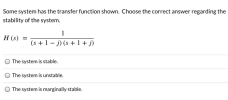 Some system has the transfer function shown. Choose the correct answer regarding the stability of the system. 1 H(s) = (s + 1 - j) (s + 1 + i) The system is stable. The system is unstable. The system is marginally stable.
a continuous time causal LTI system has a transfer function: H(s)=(s+3)/(s^2 +3s +2) a) find the...
a continuous time causal LTI system has a transfer function: H(s)=(s+3)/(s^2 +3s +2) a) find the poles and zeros b) indicate the poles and the zeros on the s-plane indicate the region of convergence (ROC) c) write the differential equation of the system. d) determine the gain of the system at dc (ie the transfer function at w=0) e) is the system described by H(s) stable? explain f) for the system described by H(s), does the Fourier transform H(jw) exist?...
Question 2. The transfer Function of a feedback control loop is given by: C(s)- R(s) (3s...
 Question 2. The transfer Function of a feedback control loop is given by: C(s)- R(s) (3s + where Ke is the controller gain. Derive the relationships between the gain, time constant, and damping ratio of the second-order transfer function to the controller gain. Find the ranges of the controller gain for which the response is (i) overdamped, (ii) underdamped, and (iii) undamped. Can the response be unstable for any positive values of the controller gain? x (s) y(s) = {1...
Frequency Response of Unknown Dynamic System Determine the system transfer function from the 2 -5 following...
 Frequency Response of Unknown Dynamic System Determine the system transfer function from the 2 -5 following Bode plot: 10 o -15 -20 -25 -30 0 10%2 10 10 10 Frequency (rad/s)
Problem 2 (3 points) Given the unilateral Laplace transform of the impulse response for a causal...
 Problem 2 (3 points) Given the unilateral Laplace transform of the impulse response for a causal system H(s) Determine h(t) the impulse response? Hint synthetic division! (s+10) 40 t-10 Problem 3 a) (2 points) What is the initial value of time function f(t) corresponding to the one sided Laplace Transform F(s) = (i.e. f(t) is causal) s(s+10)(2+4) lim f(t) = 0 40 lim f(t) = 1. t-0 10 x 4 lim f(t) = 0 t-0 lim f(t) cannot be computed...
Signal and Systems Problem 2 (3 points) Given the unilateral Laplace transform of the impulse response...
 Signal and Systems
Problem 2 (3 points) Given the unilateral Laplace transform of the impulse response for a causal system H(s) Determine h(t) the impulse response? Hint synthetic division! (s+10) 40 t-10 Problem 3 a) (2 points) What is the initial value of time function f(t) corresponding to the one sided Laplace Transform F(s) = (i.e. f(t) is causal) s(s+10)(2+4) lim f(t) = 0 40 lim f(t) = 1. t-0 10 x 4 lim f(t) = 0 t-0 lim f(t)...
Signal and Systems
Problem 2 (3 points) Given the unilateral Laplace transform of the impulse response for a causal system H(s) Determine h(t) the impulse response? Hint synthetic division! (s+10) 40 t-10 Problem 3 a) (2 points) What is the initial value of time function f(t) corresponding to the one sided Laplace Transform F(s) = (i.e. f(t) is causal) s(s+10)(2+4) lim f(t) = 0 40 lim f(t) = 1. t-0 10 x 4 lim f(t) = 0 t-0 lim f(t)...
1 a the system stable. For example, in Chapter 2 we derived the transfer function for the inverte...
 1 a the system stable. For example, in Chapter 2 we derived the transfer function for the inverted pendulum, which, for simple values, might be G(s) for which we have bs)1 and as)-s2-1-(s+)(s 1). Suppose we try Dcl (s) = K Istn . The characteristic equation that results for the system is (4.17) This is the problem that Maxwell faced in his study of governors: Under what conditions on the parameters will all the roots of this equation be in...
1. Answer the multiple-choice with the correct response. Select the correct answer. 2. In the space...
 1. Answer the multiple-choice with the correct response. Select
the correct answer.
2. In the space given for an explanation, you may: (a) choose a
second-best answer and explain why it is second best. (b) choose
one of the incorrect answers and rewrite the question so that it is
correct.
on part 2 of each question is based on the quality of your answer.
You do not need to write a lot but it must be clear that you
understand...
1. Answer the multiple-choice with the correct response. Select
the correct answer.
2. In the space given for an explanation, you may: (a) choose a
second-best answer and explain why it is second best. (b) choose
one of the incorrect answers and rewrite the question so that it is
correct.
on part 2 of each question is based on the quality of your answer.
You do not need to write a lot but it must be clear that you
understand...
5 pts D Question 1 A system has the following impulse response: .2 Sample number, n From the choices below, select the frequency response of this system. H (eju)-e(1.5 ) (2 sin( 1.5ώ) +...
 5 pts D Question 1 A system has the following impulse response: .2 Sample number, n From the choices below, select the frequency response of this system. H (eju)-e(1.5 ) (2 sin( 1.5ώ) + 4 sin(0.δώ)) H (ee) = e-j(1.5e-5) (cos( 1.5 ) +2 cos(0.54)) @ H (ee)-e-n1.si) (sin( 1.54) t. 2 sin(0.δώ)) (sin(l.50) +4sin(0.0) H (ee)-e-j(1.5i) (2 cos( 1.5ώ) + 4 cos(0.5a)) H (efo)-e-n1.5u) (cos( 1.50) + 2 cos(0.50)) https://rmitinstructure.comcoursesy 5 pts DQuestion 2 A system has the following...
Problem 5. (20pts) The open-loop transfer function of a unity feedback system G(8) -- +2) a)...
 Problem 5. (20pts) The open-loop transfer function of a unity feedback system G(8) -- +2) a) Locate open-loop zeros and open-loop poles. b) Construct the root-locus diagram as 0 <K <oo. Mark the portions of the real axis that belong to the root locus - Mark with K =0 the point where the root locus bra O the point where the root locus branches start and with K = oo the point where the branches end. - Find break-away and/or...
 Some system has the transfer function shown. Choose the correct answer regarding the stability of the system. 1 H(s) = (s + 1 - j) (s + 1 + i) The system is stable. The system is unstable. The system is marginally stable.
 Question 2. The transfer Function of a feedback control loop is given by: C(s)- R(s) (3s + where Ke is the controller gain. Derive the relationships between the gain, time constant, and damping ratio of the second-order transfer function to the controller gain. Find the ranges of the controller gain for which the response is (i) overdamped, (ii) underdamped, and (iii) undamped. Can the response be unstable for any positive values of the controller gain? x (s) y(s) = {1...
 Frequency Response of Unknown Dynamic System Determine the system transfer function from the 2 -5 following Bode plot: 10 o -15 -20 -25 -30 0 10%2 10 10 10 Frequency (rad/s)
 Problem 2 (3 points) Given the unilateral Laplace transform of the impulse response for a causal system H(s) Determine h(t) the impulse response? Hint synthetic division! (s+10) 40 t-10 Problem 3 a) (2 points) What is the initial value of time function f(t) corresponding to the one sided Laplace Transform F(s) = (i.e. f(t) is causal) s(s+10)(2+4) lim f(t) = 0 40 lim f(t) = 1. t-0 10 x 4 lim f(t) = 0 t-0 lim f(t) cannot be computed...
 Signal and Systems
Problem 2 (3 points) Given the unilateral Laplace transform of the impulse response for a causal system H(s) Determine h(t) the impulse response? Hint synthetic division! (s+10) 40 t-10 Problem 3 a) (2 points) What is the initial value of time function f(t) corresponding to the one sided Laplace Transform F(s) = (i.e. f(t) is causal) s(s+10)(2+4) lim f(t) = 0 40 lim f(t) = 1. t-0 10 x 4 lim f(t) = 0 t-0 lim f(t)...
Signal and Systems
Problem 2 (3 points) Given the unilateral Laplace transform of the impulse response for a causal system H(s) Determine h(t) the impulse response? Hint synthetic division! (s+10) 40 t-10 Problem 3 a) (2 points) What is the initial value of time function f(t) corresponding to the one sided Laplace Transform F(s) = (i.e. f(t) is causal) s(s+10)(2+4) lim f(t) = 0 40 lim f(t) = 1. t-0 10 x 4 lim f(t) = 0 t-0 lim f(t)...
 1 a the system stable. For example, in Chapter 2 we derived the transfer function for the inverted pendulum, which, for simple values, might be G(s) for which we have bs)1 and as)-s2-1-(s+)(s 1). Suppose we try Dcl (s) = K Istn . The characteristic equation that results for the system is (4.17) This is the problem that Maxwell faced in his study of governors: Under what conditions on the parameters will all the roots of this equation be in...
 1. Answer the multiple-choice with the correct response. Select
the correct answer.
2. In the space given for an explanation, you may: (a) choose a
second-best answer and explain why it is second best. (b) choose
one of the incorrect answers and rewrite the question so that it is
correct.
on part 2 of each question is based on the quality of your answer.
You do not need to write a lot but it must be clear that you
understand...
1. Answer the multiple-choice with the correct response. Select
the correct answer.
2. In the space given for an explanation, you may: (a) choose a
second-best answer and explain why it is second best. (b) choose
one of the incorrect answers and rewrite the question so that it is
correct.
on part 2 of each question is based on the quality of your answer.
You do not need to write a lot but it must be clear that you
understand...
 5 pts D Question 1 A system has the following impulse response: .2 Sample number, n From the choices below, select the frequency response of this system. H (eju)-e(1.5 ) (2 sin( 1.5ώ) + 4 sin(0.δώ)) H (ee) = e-j(1.5e-5) (cos( 1.5 ) +2 cos(0.54)) @ H (ee)-e-n1.si) (sin( 1.54) t. 2 sin(0.δώ)) (sin(l.50) +4sin(0.0) H (ee)-e-j(1.5i) (2 cos( 1.5ώ) + 4 cos(0.5a)) H (efo)-e-n1.5u) (cos( 1.50) + 2 cos(0.50)) https://rmitinstructure.comcoursesy 5 pts DQuestion 2 A system has the following...
 Problem 5. (20pts) The open-loop transfer function of a unity feedback system G(8) -- +2) a) Locate open-loop zeros and open-loop poles. b) Construct the root-locus diagram as 0 <K <oo. Mark the portions of the real axis that belong to the root locus - Mark with K =0 the point where the root locus bra O the point where the root locus branches start and with K = oo the point where the branches end. - Find break-away and/or...
Most questions answered within 3 hours.
-
Where is the error in this code sequence?
String s1 = "Hello";
String s2 = "ello";...
asked 10 months ago -
Financial data for Joel de Paris, Inc., for last year
follow:
Joel de Paris, Inc.
Balance...
asked 10 months ago -
Consider this reaction:
Al2(SO4)3 (aq)+ BaCl3
(aq) Al2Cl6 (aq)- +
3BaSO4(s) . What is the...
asked 10 months ago -
Suppose that Savneet is considering increasing her
recent random sample from 20 car rentals to 40...
asked 10 months ago -
Trucks arrive at an unloading terminal at an average rate of 120
per hour.
Trucks arrive...
asked 10 months ago -
Why are methanol and ethanol completely soluble in water while
octanol is not very little soluble....
asked 10 months ago -
A facilities manager at a university reads in a research report
that the mean amount of...
asked 10 months ago -
When the CuSO4 is rehydrated by adding water to the anhydrous
compound, is this an endothermic...
asked 10 months ago -
A ray of sunlight is passing from diamond into crown glass; the
angle of incidence is...
asked 10 months ago -
A block of mass 0.249 kg is placed on top of a light, vertical
spring of...
asked 10 months ago -
how do the kidneys compensate in the presences of acidosis
a) trigger hyperventilate
b) reserve acid...
asked 10 months ago -
Question 501 pts
The rental rate of capital to the firm increases. Which of the
following...
asked 10 months ago