
Homework Answers
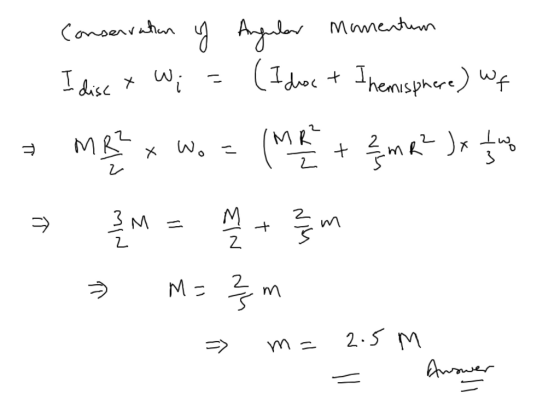
Add Answer to:
specify equations used please
Part I: A disk of mass M and radius R is rotating...
A turntable has a radius R and mass M (considered as a disk) and is rotating...
A turntable has a radius R and mass M (considered as a disk) and is rotating at an angular velocity W 0 about a frictionless vertical axis. A piece of clay is tossed onto the turntable and sticks d from the rotational axis. The clay hits with horizontal vel ocity component vc at right angle to the turntable’s radius, and in a direction that opposes the rotation. After the clay lands, the turntable has slowed to angular velocity W1 ....
A disk of mass M and radius R is rotating with an angular velocity ω. A...
A disk of mass M and radius R is rotating with an angular velocity ω. A rod also of mass M but length 2R is initially not rotating. It is dropped vertically onto the rotating disk. After the collision, the disk and rod rotate together with an angular velocity of? What fraction of the initial kinetic energy was lost in the collision?
A uniform disk with mass M and radius R is rotating about an axis through its center-of-mass.
 A uniform disk with mass M and radius R is rotating about an axis through its center-of-mass. The axis is perpendicular to the disk. The moment of inertial for the disk with a central axis is I MR2. Two non-rotating smaller disks, each with mass M2 and radius R/4, are glued on the original disk as shown in the figure. (a) Show that the ratio of the moments of inertia is given by I'/I = 35/16, where I' is the moment...
9. A disk of mass M and radius R is rotating with an angular velocity o....
 9. A disk of mass M and radius R is rotating with an angular velocity o. A rod also of mass M but length 2R is initially not rotating. It is dropped vertically onto the rotating disk as shown in the figure (page above). After the collision, the disk and rod rotate together with an angular velocity of c) 30/4 f) none of the above 10. What fraction of the initial kinetic energy was lost in the collision in question...
A disk of mass 5 kg and radius 1 m is rotating with an angular velocity...
A disk of mass 5 kg and radius 1 m is rotating with an angular velocity of ?0 = 11 rad/s . A lump of clay of mass 3 kg is dropped onto the disk at a radius of 0.5 m , sticking to the disk. What is the final angular velocity of the disk? (Idisk = MR2/2 )
A solid disk of mass m = 9.2 kg and radius R = 0.2 m is...
 A solid disk of mass m = 9.2 kg and radius R = 0.2 m is rotating with a constant angular velocity of w = 38 rad/s. A thin rectangular rod with mass m2 = 3.7 kg and length L = 2R = 0.4 m begins at rest above the disk and is dropped on the disk where it begins to spin with the disk. 1) What is the initial angular momentum of the rod and disk system? kg-m2/s Submit...
A gramophone record consists of a uniform circular disk of radius R and total mass M...
A gramophone record consists of a uniform circular disk of radius R and total mass M with a hole punched through it's center with a radius r. a) Show that the moment of inertia of the record about the perpendicular axis passing through it's center is 1/2 M(R^2 + r^2). b)A gramophone record having a mass of m=100g, radius =15cm and hole of radius 3cm is rotating freely on a turntable at 33 revolutions per minute with no friction. A...
of mass m and radius R is freely rotating at angular velocityw,spinning clockwise The moment of...
 of mass m and radius R is freely rotating at angular velocityw,spinning clockwise The moment of inertia of a disk is ImR2.) While it is rotating, someone when seen from above. ( ps a thin ring of mass m and also of radius R on top of it. When the ring lands, it is initially ot otating, but friction quickly causes it to rotate along with the disk, but the rotation of the disk slows down. a) What principle of...
Please help Points: 10 12) A 18 kg solid disk pulley of radius 0.11 m rotates...
 Please help
Points: 10 12) A 18 kg solid disk pulley of radius 0.11 m rotates about an axis through its center (a) What is its moment of inertia? (b) Starting from rest, a torque of 0.22 m-N will produce what angular acceleration? FIGURE 8-5 13) A solid disk with diameter 2.00 meters and mass 4.0 kg freely rotates about a vertical axis at 36.rpm. A 0.50 kg hunk of bubblegum is dropped onto the disk and sticks to the...
Please help
Points: 10 12) A 18 kg solid disk pulley of radius 0.11 m rotates about an axis through its center (a) What is its moment of inertia? (b) Starting from rest, a torque of 0.22 m-N will produce what angular acceleration? FIGURE 8-5 13) A solid disk with diameter 2.00 meters and mass 4.0 kg freely rotates about a vertical axis at 36.rpm. A 0.50 kg hunk of bubblegum is dropped onto the disk and sticks to the...
Part A A uniform disk has a mass of 2.3 kg and a radius of 0.24...
 Part A A uniform disk has a mass of 2.3 kg and a radius of 0.24 m. The disk is mounted on frictionless bearings and is used as a turntable. The turntable is initially rotating at 20 rpm. A thin-walled hollow cylinder has the same mass and radius as the disk. It is released from rest, just above the turntable, and on the same vertical axis. The hollow cylinder slips on the turntable for 0.20 s until it acquires the...
 9. A disk of mass M and radius R is rotating with an angular velocity o. A rod also of mass M but length 2R is initially not rotating. It is dropped vertically onto the rotating disk as shown in the figure (page above). After the collision, the disk and rod rotate together with an angular velocity of c) 30/4 f) none of the above 10. What fraction of the initial kinetic energy was lost in the collision in question...
 A solid disk of mass m = 9.2 kg and radius R = 0.2 m is rotating with a constant angular velocity of w = 38 rad/s. A thin rectangular rod with mass m2 = 3.7 kg and length L = 2R = 0.4 m begins at rest above the disk and is dropped on the disk where it begins to spin with the disk. 1) What is the initial angular momentum of the rod and disk system? kg-m2/s Submit...
 of mass m and radius R is freely rotating at angular velocityw,spinning clockwise The moment of inertia of a disk is ImR2.) While it is rotating, someone when seen from above. ( ps a thin ring of mass m and also of radius R on top of it. When the ring lands, it is initially ot otating, but friction quickly causes it to rotate along with the disk, but the rotation of the disk slows down. a) What principle of...
 Please help
Points: 10 12) A 18 kg solid disk pulley of radius 0.11 m rotates about an axis through its center (a) What is its moment of inertia? (b) Starting from rest, a torque of 0.22 m-N will produce what angular acceleration? FIGURE 8-5 13) A solid disk with diameter 2.00 meters and mass 4.0 kg freely rotates about a vertical axis at 36.rpm. A 0.50 kg hunk of bubblegum is dropped onto the disk and sticks to the...
Please help
Points: 10 12) A 18 kg solid disk pulley of radius 0.11 m rotates about an axis through its center (a) What is its moment of inertia? (b) Starting from rest, a torque of 0.22 m-N will produce what angular acceleration? FIGURE 8-5 13) A solid disk with diameter 2.00 meters and mass 4.0 kg freely rotates about a vertical axis at 36.rpm. A 0.50 kg hunk of bubblegum is dropped onto the disk and sticks to the...
 Part A A uniform disk has a mass of 2.3 kg and a radius of 0.24 m. The disk is mounted on frictionless bearings and is used as a turntable. The turntable is initially rotating at 20 rpm. A thin-walled hollow cylinder has the same mass and radius as the disk. It is released from rest, just above the turntable, and on the same vertical axis. The hollow cylinder slips on the turntable for 0.20 s until it acquires the...
Most questions answered within 3 hours.
-
Where is the error in this code sequence?
String s1 = "Hello";
String s2 = "ello";...
asked 10 months ago -
Financial data for Joel de Paris, Inc., for last year
follow:
Joel de Paris, Inc.
Balance...
asked 10 months ago -
Consider this reaction:
Al2(SO4)3 (aq)+ BaCl3
(aq) Al2Cl6 (aq)- +
3BaSO4(s) . What is the...
asked 10 months ago -
Suppose that Savneet is considering increasing her
recent random sample from 20 car rentals to 40...
asked 10 months ago -
Trucks arrive at an unloading terminal at an average rate of 120
per hour.
Trucks arrive...
asked 10 months ago -
Why are methanol and ethanol completely soluble in water while
octanol is not very little soluble....
asked 10 months ago -
A facilities manager at a university reads in a research report
that the mean amount of...
asked 10 months ago -
When the CuSO4 is rehydrated by adding water to the anhydrous
compound, is this an endothermic...
asked 10 months ago -
A ray of sunlight is passing from diamond into crown glass; the
angle of incidence is...
asked 10 months ago -
A block of mass 0.249 kg is placed on top of a light, vertical
spring of...
asked 10 months ago -
how do the kidneys compensate in the presences of acidosis
a) trigger hyperventilate
b) reserve acid...
asked 10 months ago -
Question 501 pts
The rental rate of capital to the firm increases. Which of the
following...
asked 10 months ago