 prove that the
wavefunction
prove that the
wavefunctionHomework Answers
Add Answer to:
prove that the
wavefunction
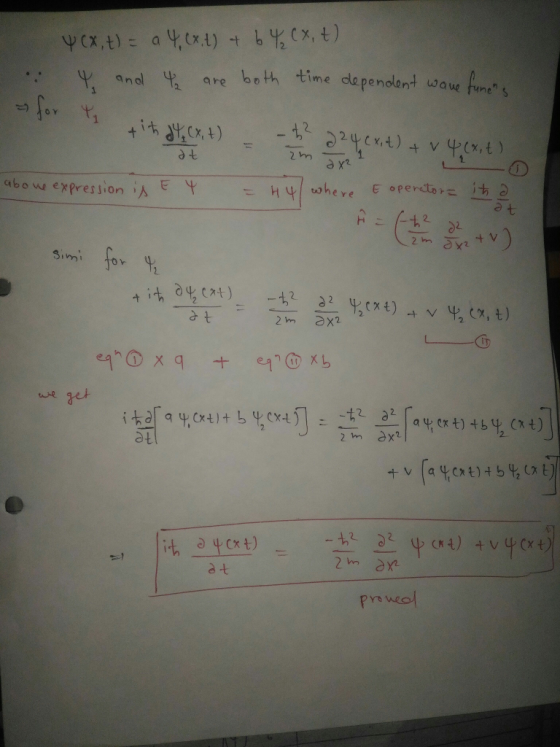
?(xi t): u at (xit)-bat Crt), where a, b=Gwshd, Q : 2)...
(7) 112 ptsl Let Xi,..., XT denote a random sample of size T from X, where...
 (7) 112 ptsl Let Xi,..., XT denote a random sample of size T from X, where VIX] < oo. a +bX, and for each t define Zt a +bX, for some Define a new random variable Z constants a and b. (a) Show that Z = a + bX and 03-b2q, where the sample me an X and sample variance x of the original sample are as defined in class (b) Prove that Z is an unbiased estimator of E[Z]...
2. Show that W can be written as where U is the number of pairs (Xi,...
 2. Show that W can be written as where U is the number of pairs (Xi, Yj) with X, < Y,. In other words n m U=ΣΣ1," where ,j -(0 otherwise. i=1 j=1 Hint: Let Yi),Ya),... , Ym) be the order statistics for the y-sample. Then U is the number of pairs (Xi,Yu)) with Xi 〈 YG). For fixed j , the number of Xi with Xi 〈 Yu) is just the rank of Y (j) minus the number of...
Problem 4: (Numerical Integration) Given: u(x)-f (x)+K(x.t) u(t) dr Where a and b and the function f and K are given. To approximate the function u on the interval [a, b]. a partition j a < xi <...
 Problem 4: (Numerical Integration) Given: u(x)-f (x)+K(x.t) u(t) dr Where a and b and the function f and K are given. To approximate the function u on the interval [a, b]. a partition j a < xi < < x-1 < x-= b is selected and the equation: u(x)- f(xK(x,t) u(t) dt. for eaci 0-.m Are solved for u(xo).ux)u(). The integrals are approximated using quadrature formulas based on the nodes tgIn this problem, a-0, b1, f (x)-, and In this...
Recall that the time evolution of a wavefunction y(x, t) is determined by the Schrödinger equation,...
 Recall that the time evolution of a wavefunction y(x, t) is determined by the Schrödinger equation, which in position space reads iħ 4(x, t) = -24(x, t) + V(x, t)(x, t). ih vrt - h ? a) Consider any two normalized solutions to the Schrödinger equation, 41(2, t) and 02(3,t). Prove that their inner product is independent of time, doo 1 Vi (2, t)u2(x, t) dc = 0. dt J-00 Hint: prove the useful intermediate result, a 202 201 -...
1. For differentiable vector functions u and v, prove: u'(t) X v(t)+ u(t) X v'(t) lu(t) X v(t)] 2. For the diff...
 1. For differentiable vector functions u and v, prove: u'(t) X v(t)+ u(t) X v'(t) lu(t) X v(t)] 2. For the differentiable vector function u and real-valued function f, prove: lu(f(t)))= f(t)u' (f (t))
1. For differentiable vector functions u and v, prove: u'(t) X v(t)+ u(t) X v'(t) lu(t) X v(t)] 2. For the differentiable vector function u and real-valued function f, prove: lu(f(t)))= f(t)u' (f (t))
1. For differentiable vector functions u and v, prove: u'(t) X v(t)+ u(t) X v'(t) lu(t) X v(t)] 2. For the differentiable vector function u and real-valued function f, prove: lu(f(t)))= f(t)u' (f (t))
Signals and Systems 1. A continuous time system is given inputs x1(t), r2 (t), and x3(t), from which the outputs yi (t), y2(t), and y3( arise, respectively, where 1(t)u(t) u(t-1) i(t)2u(t) -e20-u(t -...
 Signals and Systems
1. A continuous time system is given inputs x1(t), r2 (t), and x3(t), from which the outputs yi (t), y2(t), and y3( arise, respectively, where 1(t)u(t) u(t-1) i(t)2u(t) -e20-u(t - 1) 2(t)u(t) - u(t- 3 T3 0 otherwise sin(5t) te,1 y3(t) 0 otherwise e-5t (u(t)-a(t-1)) ya(t) = (a) Is this system causal? Prove your answer. (b) Is this system linear? Prove your answer. c) Is this system time-invariant? Prove your answer.
1. A continuous time system is...
Signals and Systems
1. A continuous time system is given inputs x1(t), r2 (t), and x3(t), from which the outputs yi (t), y2(t), and y3( arise, respectively, where 1(t)u(t) u(t-1) i(t)2u(t) -e20-u(t - 1) 2(t)u(t) - u(t- 3 T3 0 otherwise sin(5t) te,1 y3(t) 0 otherwise e-5t (u(t)-a(t-1)) ya(t) = (a) Is this system causal? Prove your answer. (b) Is this system linear? Prove your answer. c) Is this system time-invariant? Prove your answer.
1. A continuous time system is...
Find the value of the constant A that normalizes the wavefunction (x) = Are-2, where -...
 Find the value of the constant A that normalizes the wavefunction (x) = Are-2, where - <<< +. The commutator is defined as (A, B] = AB - BA. Show that the commutator [, p = ih. Use an arbitrary wavefunction () in your calculation.
xercise 7.5: Suppose Xi, X2, ..., Xn are a random sample from the u distribution U(9-2 ,0+ ), where θ e (-00, Exercise...
 xercise 7.5: Suppose Xi, X2, ..., Xn are a random sample from the u distribution U(9-2 ,0+ ), where θ e (-00, Exercise 7.5: Suppose X1, X2, . .. , sufficient for θ. a) Show that the smallest and largest of Xi, ..., Xn are jointliy (b) If p@-constant, θ e (-00, oo), is the prior distribution of θ, find its posterior distribution
xercise 7.5: Suppose Xi, X2, ..., Xn are a random sample from the u distribution U(9-2 ,0+...
xercise 7.5: Suppose Xi, X2, ..., Xn are a random sample from the u distribution U(9-2 ,0+ ), where θ e (-00, Exercise 7.5: Suppose X1, X2, . .. , sufficient for θ. a) Show that the smallest and largest of Xi, ..., Xn are jointliy (b) If p@-constant, θ e (-00, oo), is the prior distribution of θ, find its posterior distribution
xercise 7.5: Suppose Xi, X2, ..., Xn are a random sample from the u distribution U(9-2 ,0+...
3. Prove the theorem for t he normal conjugate distributi on Theorem. Suppose that Xi,... ,Xn...
 3. Prove the theorem for t he normal conjugate distributi on Theorem. Suppose that Xi,... ,Xn form a random sample from a normal distribution for which the value of the mean θ is unknown and the value of the variance σ2 > 0 is known. Suppose also that the prior distribution of θ is the normal distribution with mean 140 and variance v . Then the posterior distribution of θ given that Xi-Xi,1-1, . . . , n, is the...
2(a). Compute and plot the convolution of ytryh)x where h(t) t)-u(t-4), x(t)u(t)-u(t-1) and zero else b)....
 2(a). Compute and plot the convolution of ytryh)x where h(t) t)-u(t-4), x(t)u(t)-u(t-1) and zero else b). Compute and plot the convolution y(n) h(n)*x (n) where h(n)-1, for 0Sns4, x(n) 1, n 0, 1 and zero else.
 (7) 112 ptsl Let Xi,..., XT denote a random sample of size T from X, where VIX] < oo. a +bX, and for each t define Zt a +bX, for some Define a new random variable Z constants a and b. (a) Show that Z = a + bX and 03-b2q, where the sample me an X and sample variance x of the original sample are as defined in class (b) Prove that Z is an unbiased estimator of E[Z]...
 2. Show that W can be written as where U is the number of pairs (Xi, Yj) with X, < Y,. In other words n m U=ΣΣ1," where ,j -(0 otherwise. i=1 j=1 Hint: Let Yi),Ya),... , Ym) be the order statistics for the y-sample. Then U is the number of pairs (Xi,Yu)) with Xi 〈 YG). For fixed j , the number of Xi with Xi 〈 Yu) is just the rank of Y (j) minus the number of...
 Problem 4: (Numerical Integration) Given: u(x)-f (x)+K(x.t) u(t) dr Where a and b and the function f and K are given. To approximate the function u on the interval [a, b]. a partition j a < xi < < x-1 < x-= b is selected and the equation: u(x)- f(xK(x,t) u(t) dt. for eaci 0-.m Are solved for u(xo).ux)u(). The integrals are approximated using quadrature formulas based on the nodes tgIn this problem, a-0, b1, f (x)-, and In this...
 Recall that the time evolution of a wavefunction y(x, t) is determined by the Schrödinger equation, which in position space reads iħ 4(x, t) = -24(x, t) + V(x, t)(x, t). ih vrt - h ? a) Consider any two normalized solutions to the Schrödinger equation, 41(2, t) and 02(3,t). Prove that their inner product is independent of time, doo 1 Vi (2, t)u2(x, t) dc = 0. dt J-00 Hint: prove the useful intermediate result, a 202 201 -...
 1. For differentiable vector functions u and v, prove: u'(t) X v(t)+ u(t) X v'(t) lu(t) X v(t)] 2. For the differentiable vector function u and real-valued function f, prove: lu(f(t)))= f(t)u' (f (t))
1. For differentiable vector functions u and v, prove: u'(t) X v(t)+ u(t) X v'(t) lu(t) X v(t)] 2. For the differentiable vector function u and real-valued function f, prove: lu(f(t)))= f(t)u' (f (t))
1. For differentiable vector functions u and v, prove: u'(t) X v(t)+ u(t) X v'(t) lu(t) X v(t)] 2. For the differentiable vector function u and real-valued function f, prove: lu(f(t)))= f(t)u' (f (t))
 Signals and Systems
1. A continuous time system is given inputs x1(t), r2 (t), and x3(t), from which the outputs yi (t), y2(t), and y3( arise, respectively, where 1(t)u(t) u(t-1) i(t)2u(t) -e20-u(t - 1) 2(t)u(t) - u(t- 3 T3 0 otherwise sin(5t) te,1 y3(t) 0 otherwise e-5t (u(t)-a(t-1)) ya(t) = (a) Is this system causal? Prove your answer. (b) Is this system linear? Prove your answer. c) Is this system time-invariant? Prove your answer.
1. A continuous time system is...
Signals and Systems
1. A continuous time system is given inputs x1(t), r2 (t), and x3(t), from which the outputs yi (t), y2(t), and y3( arise, respectively, where 1(t)u(t) u(t-1) i(t)2u(t) -e20-u(t - 1) 2(t)u(t) - u(t- 3 T3 0 otherwise sin(5t) te,1 y3(t) 0 otherwise e-5t (u(t)-a(t-1)) ya(t) = (a) Is this system causal? Prove your answer. (b) Is this system linear? Prove your answer. c) Is this system time-invariant? Prove your answer.
1. A continuous time system is...
 Find the value of the constant A that normalizes the wavefunction (x) = Are-2, where - <<< +. The commutator is defined as (A, B] = AB - BA. Show that the commutator [, p = ih. Use an arbitrary wavefunction () in your calculation.
 xercise 7.5: Suppose Xi, X2, ..., Xn are a random sample from the u distribution U(9-2 ,0+ ), where θ e (-00, Exercise 7.5: Suppose X1, X2, . .. , sufficient for θ. a) Show that the smallest and largest of Xi, ..., Xn are jointliy (b) If p@-constant, θ e (-00, oo), is the prior distribution of θ, find its posterior distribution
xercise 7.5: Suppose Xi, X2, ..., Xn are a random sample from the u distribution U(9-2 ,0+...
xercise 7.5: Suppose Xi, X2, ..., Xn are a random sample from the u distribution U(9-2 ,0+ ), where θ e (-00, Exercise 7.5: Suppose X1, X2, . .. , sufficient for θ. a) Show that the smallest and largest of Xi, ..., Xn are jointliy (b) If p@-constant, θ e (-00, oo), is the prior distribution of θ, find its posterior distribution
xercise 7.5: Suppose Xi, X2, ..., Xn are a random sample from the u distribution U(9-2 ,0+...
 3. Prove the theorem for t he normal conjugate distributi on Theorem. Suppose that Xi,... ,Xn form a random sample from a normal distribution for which the value of the mean θ is unknown and the value of the variance σ2 > 0 is known. Suppose also that the prior distribution of θ is the normal distribution with mean 140 and variance v . Then the posterior distribution of θ given that Xi-Xi,1-1, . . . , n, is the...
 2(a). Compute and plot the convolution of ytryh)x where h(t) t)-u(t-4), x(t)u(t)-u(t-1) and zero else b). Compute and plot the convolution y(n) h(n)*x (n) where h(n)-1, for 0Sns4, x(n) 1, n 0, 1 and zero else.
Most questions answered within 3 hours.
-
Where is the error in this code sequence?
String s1 = "Hello";
String s2 = "ello";...
asked 10 months ago -
Financial data for Joel de Paris, Inc., for last year
follow:
Joel de Paris, Inc.
Balance...
asked 10 months ago -
Consider this reaction:
Al2(SO4)3 (aq)+ BaCl3
(aq) Al2Cl6 (aq)- +
3BaSO4(s) . What is the...
asked 10 months ago -
Suppose that Savneet is considering increasing her
recent random sample from 20 car rentals to 40...
asked 10 months ago -
Trucks arrive at an unloading terminal at an average rate of 120
per hour.
Trucks arrive...
asked 10 months ago -
Why are methanol and ethanol completely soluble in water while
octanol is not very little soluble....
asked 10 months ago -
A facilities manager at a university reads in a research report
that the mean amount of...
asked 10 months ago -
When the CuSO4 is rehydrated by adding water to the anhydrous
compound, is this an endothermic...
asked 10 months ago -
A ray of sunlight is passing from diamond into crown glass; the
angle of incidence is...
asked 10 months ago -
A block of mass 0.249 kg is placed on top of a light, vertical
spring of...
asked 10 months ago -
how do the kidneys compensate in the presences of acidosis
a) trigger hyperventilate
b) reserve acid...
asked 10 months ago -
Question 501 pts
The rental rate of capital to the firm increases. Which of the
following...
asked 10 months ago