
Homework Answers
Add Answer to:
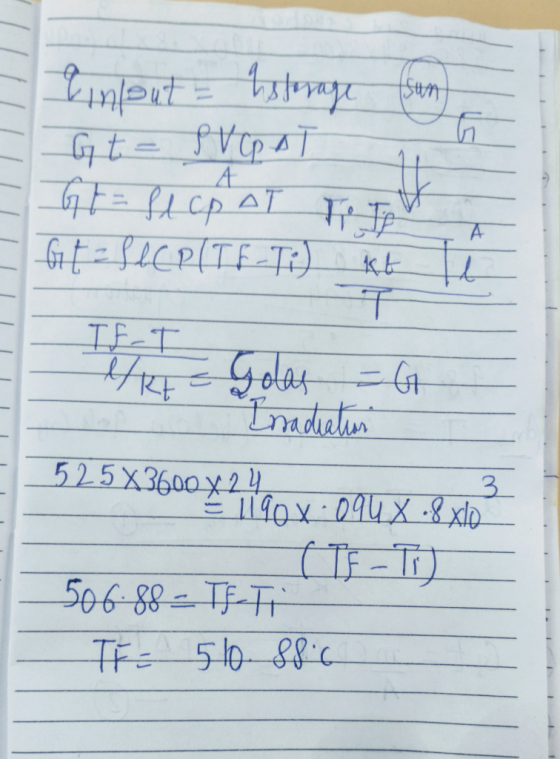
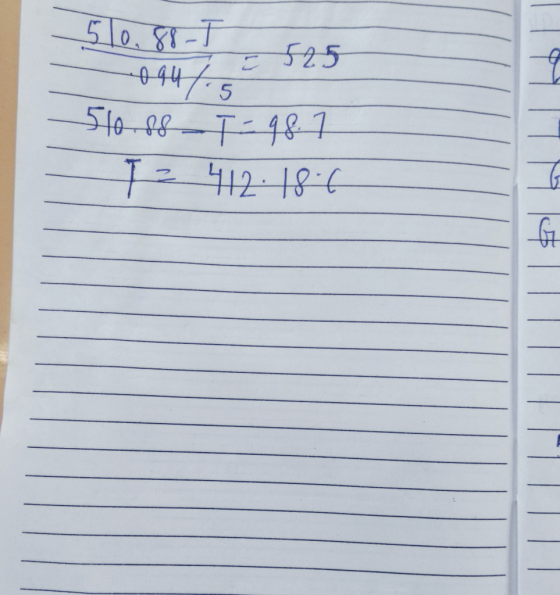
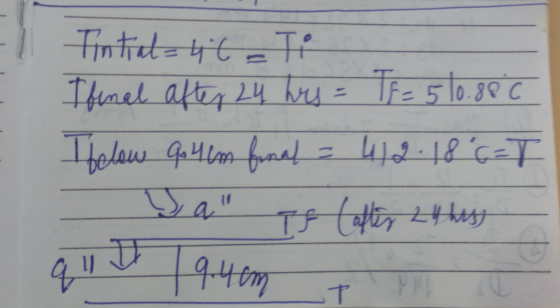
6. Solar radiation (525 W/m?) hits a concrete (p=1190 kg/m', k=0.5 W/m-K, Cp = 0.8 kJ/kg-K,...
A silver sphere (k = 429 W/m.°C.p = 10,500 kg/m", Cp=0.235 kJ/kg-°C) is initially at 0°C....
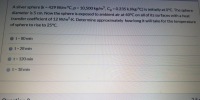 A silver sphere (k = 429 W/m.°C.p = 10,500 kg/m", Cp=0.235 kJ/kg-°C) is initially at 0°C. The sphere diameter is 5 cm. Now the sphere is exposed to ambient air at 40°C on all of its surfaces with a heat transfer coefficient of 12 W/ m K. Determine approximately how long it will take for the temperature of sphere to rise to 25°C. Ot=80 min t=28 min O t = 120 min o t= 18 min
A flat and wide sheet material (cp = 283 J/kg K, P = 3700 kg/m", a...
 A flat and wide sheet material (cp = 283 J/kg K, P = 3700 kg/m", a = 6.76 x 10 m/s) of thickness 20 mm is initially uniformly heated to 1600 °C. It is then hardened by quenching it in an oil bath that is maintained at 35 °C. The convection coefficient for the oil is 460 W/m2K. Quenching is to occur for 50 seconds. Determine the Blot number used in the Hiesler charts. This may or may not be...
Problem 2. A long 6.5 cm diameter solid cylinder steel (K 16.3 W/m. K,p 7817 kg/m3,...
 Problem 2. A long 6.5 cm diameter solid cylinder steel (K 16.3 W/m. K,p 7817 kg/m3, Cp 460 J/kg.k). It's initially at a uniform temperature of T 150°C. It is suddenly exposed to a convection environment with h-285 W/m2 K and Too 50°C. Calculate the temperature at 1.) the axis of the cylinder, and 2.) a 2.5 cm radial distance after 5 min of exposure to the cooling flow. (20%)
a. 2–96 The inner and outer surfaces of a 0.5-cm-thick 2-m x 2-m window glass in...
a. 2–96 The inner and outer surfaces of a 0.5-cm-thick 2-m x 2-m window glass in winter are 10°C and 3°C, respectively. If the thermal conductivity of the glass is 0.78 W/m · °C, determine the amount of heat loss, in kJ, through the glass over a period of 5 h. What would your answer be if the glass were 1-cm thick? (Points 8+7=15) b. 2–107 The outer surface of a spacecraft in space has an emissivity of 0.8 and...
A large wall made of 10-cm-thick solid brick (k = 0.8 W/m.K, p 2000 kg/m3, and p 800 J/kg.K) is o...
 Heat transfer question.
A large wall made of 10-cm-thick solid brick (k = 0.8 W/m.K, p 2000 kg/m3, and p 800 J/kg.K) is originally at a uniform temperature of 30°C. The wall is adiabatic (well insulated) on one side as shown in the figure. The other surface is suddenly exposed to convection air flow at 10°C, resulting in a heat transfer coefficient h=40W/m2.K. Fluid (4.1) Determine the temperature of both surfaces Gr 0 and x 10 cm) after 5 hr...
Heat transfer question.
A large wall made of 10-cm-thick solid brick (k = 0.8 W/m.K, p 2000 kg/m3, and p 800 J/kg.K) is originally at a uniform temperature of 30°C. The wall is adiabatic (well insulated) on one side as shown in the figure. The other surface is suddenly exposed to convection air flow at 10°C, resulting in a heat transfer coefficient h=40W/m2.K. Fluid (4.1) Determine the temperature of both surfaces Gr 0 and x 10 cm) after 5 hr...
A long steel bar of radius R=2.5 cm, k =50 W/(m °C), p= 7800 kg/m), and...
 A long steel bar of radius R=2.5 cm, k =50 W/(m °C), p= 7800 kg/m), and c = 0.5 kJ/(kg. . °C) is to be annealed by cooling slowly from 800.°C to 100.°C in an environment at temperature 50.°C. If the heat transfer coefficient between the environment and the surface of the bars is h = 45 W/(m .°C), determine the time required for the annealing process using lumped system analysis.
An argon (Cp = 0.518 KJ/kg. K, and K=1.67) has velocity V = 750 m/s, pressure P =120 kPa
An argon (Cp = 0.518 KJ/kg. K, and K=1.67) has velocity V = 750 m/s, pressure P =120 kPa, and temperature T = 175 °C. If the argon is at stagnation state, calculate the pressure (P0) and temperature (T0).
Consider liquid water flowing over a flat plate of length L = 1 m. The water has the following properties: ρ-1000 kg/m3, Cp-4000 J/kgK. 10 3 kg/ ms, k 0.6 W/m . C μ Midway through the plate at x...
 Consider liquid water flowing over a flat plate of length L = 1 m. The water has the following properties: ρ-1000 kg/m3, Cp-4000 J/kgK. 10 3 kg/ ms, k 0.6 W/m . C μ Midway through the plate at x = 0.5 m, you measure a heat flux to the surface of: 05 m 3181 W/m2 You also measure an average heat flux to the surface over the length of the plate of: "4500 W/m2 Knowing the latter, and knowing...
QUESTION TWO Carbon steel balls (p 7833 kg/m3, k-54 W/m K, cp 0.465 kJ/kg.0C and a-1.474...
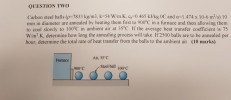 QUESTION TWO Carbon steel balls (p 7833 kg/m3, k-54 W/m K, cp 0.465 kJ/kg.0C and a-1.474 x 10⁻⁶ m2/s) 10 mm in diameter are annealed by heating them first to 900'C in a furnace and then allowing them to cool slowly to 100°C in ambient air at 35°C. If the average heat transfer coefficient is 75 W/m2 K, determine how long the annealing process will take. If 2500 balls are to be annealed per hour, determine the total rate of...
Consider a 1000-W iron whose base plate is made of 0.5-cm-thick aluminum alloy 2024-T6 (0-2770 kg/m...
 Consider a 1000-W iron whose base plate is made of 0.5-cm-thick aluminum alloy 2024-T6 (0-2770 kg/m and Cp=875 J/kg:"C). The base plate has a surface area of 0.03 m2 Initially, the iron is in thermal equilibrium with the ambient air at 22°C. Assuming 90 percent of the heat generated in the resistance wires is transferred to the plate, determine the minimum time needed for the plate temperature to reach 220°C The minimum time needed for the plate temperature to reach...
 A silver sphere (k = 429 W/m.°C.p = 10,500 kg/m", Cp=0.235 kJ/kg-°C) is initially at 0°C. The sphere diameter is 5 cm. Now the sphere is exposed to ambient air at 40°C on all of its surfaces with a heat transfer coefficient of 12 W/ m K. Determine approximately how long it will take for the temperature of sphere to rise to 25°C. Ot=80 min t=28 min O t = 120 min o t= 18 min
 A flat and wide sheet material (cp = 283 J/kg K, P = 3700 kg/m", a = 6.76 x 10 m/s) of thickness 20 mm is initially uniformly heated to 1600 °C. It is then hardened by quenching it in an oil bath that is maintained at 35 °C. The convection coefficient for the oil is 460 W/m2K. Quenching is to occur for 50 seconds. Determine the Blot number used in the Hiesler charts. This may or may not be...
 Problem 2. A long 6.5 cm diameter solid cylinder steel (K 16.3 W/m. K,p 7817 kg/m3, Cp 460 J/kg.k). It's initially at a uniform temperature of T 150°C. It is suddenly exposed to a convection environment with h-285 W/m2 K and Too 50°C. Calculate the temperature at 1.) the axis of the cylinder, and 2.) a 2.5 cm radial distance after 5 min of exposure to the cooling flow. (20%)
 Heat transfer question.
A large wall made of 10-cm-thick solid brick (k = 0.8 W/m.K, p 2000 kg/m3, and p 800 J/kg.K) is originally at a uniform temperature of 30°C. The wall is adiabatic (well insulated) on one side as shown in the figure. The other surface is suddenly exposed to convection air flow at 10°C, resulting in a heat transfer coefficient h=40W/m2.K. Fluid (4.1) Determine the temperature of both surfaces Gr 0 and x 10 cm) after 5 hr...
Heat transfer question.
A large wall made of 10-cm-thick solid brick (k = 0.8 W/m.K, p 2000 kg/m3, and p 800 J/kg.K) is originally at a uniform temperature of 30°C. The wall is adiabatic (well insulated) on one side as shown in the figure. The other surface is suddenly exposed to convection air flow at 10°C, resulting in a heat transfer coefficient h=40W/m2.K. Fluid (4.1) Determine the temperature of both surfaces Gr 0 and x 10 cm) after 5 hr...
 A long steel bar of radius R=2.5 cm, k =50 W/(m °C), p= 7800 kg/m), and c = 0.5 kJ/(kg. . °C) is to be annealed by cooling slowly from 800.°C to 100.°C in an environment at temperature 50.°C. If the heat transfer coefficient between the environment and the surface of the bars is h = 45 W/(m .°C), determine the time required for the annealing process using lumped system analysis.
 Consider liquid water flowing over a flat plate of length L = 1 m. The water has the following properties: ρ-1000 kg/m3, Cp-4000 J/kgK. 10 3 kg/ ms, k 0.6 W/m . C μ Midway through the plate at x = 0.5 m, you measure a heat flux to the surface of: 05 m 3181 W/m2 You also measure an average heat flux to the surface over the length of the plate of: "4500 W/m2 Knowing the latter, and knowing...
 QUESTION TWO Carbon steel balls (p 7833 kg/m3, k-54 W/m K, cp 0.465 kJ/kg.0C and a-1.474 x 10⁻⁶ m2/s) 10 mm in diameter are annealed by heating them first to 900'C in a furnace and then allowing them to cool slowly to 100°C in ambient air at 35°C. If the average heat transfer coefficient is 75 W/m2 K, determine how long the annealing process will take. If 2500 balls are to be annealed per hour, determine the total rate of...
 Consider a 1000-W iron whose base plate is made of 0.5-cm-thick aluminum alloy 2024-T6 (0-2770 kg/m and Cp=875 J/kg:"C). The base plate has a surface area of 0.03 m2 Initially, the iron is in thermal equilibrium with the ambient air at 22°C. Assuming 90 percent of the heat generated in the resistance wires is transferred to the plate, determine the minimum time needed for the plate temperature to reach 220°C The minimum time needed for the plate temperature to reach...
Most questions answered within 3 hours.
-
Where is the error in this code sequence?
String s1 = "Hello";
String s2 = "ello";...
asked 11 months ago -
Financial data for Joel de Paris, Inc., for last year
follow:
Joel de Paris, Inc.
Balance...
asked 11 months ago -
Consider this reaction:
Al2(SO4)3 (aq)+ BaCl3
(aq) Al2Cl6 (aq)- +
3BaSO4(s) . What is the...
asked 11 months ago -
Suppose that Savneet is considering increasing her
recent random sample from 20 car rentals to 40...
asked 11 months ago -
Trucks arrive at an unloading terminal at an average rate of 120
per hour.
Trucks arrive...
asked 11 months ago -
Why are methanol and ethanol completely soluble in water while
octanol is not very little soluble....
asked 11 months ago -
A facilities manager at a university reads in a research report
that the mean amount of...
asked 11 months ago -
When the CuSO4 is rehydrated by adding water to the anhydrous
compound, is this an endothermic...
asked 11 months ago -
A ray of sunlight is passing from diamond into crown glass; the
angle of incidence is...
asked 11 months ago -
A block of mass 0.249 kg is placed on top of a light, vertical
spring of...
asked 11 months ago -
how do the kidneys compensate in the presences of acidosis
a) trigger hyperventilate
b) reserve acid...
asked 11 months ago -
Question 501 pts
The rental rate of capital to the firm increases. Which of the
following...
asked 11 months ago