
Homework Answers
entropy increases with the increase of number of moles of gaseous substances.
In the reaction "B" all the substances are gases and moreover it leads to the formation of gaseous products.
So the reaction "B" has highest entropy
Add Answer to:
Which reaction is accompanied by an increase in entropy? A. ZnS_(s) + 3/2O_2_(g) rightarrow ZnO_(s) +...
Which reaction is accompanied by an increase in entropy? A N2(g) + 3 H2(g) – 2...
 Which reaction is accompanied by an increase in entropy? A N2(g) + 3 H2(g) – 2 NH3(g) B. Ba(OH)2(s) + CO2(g) → BaCO3(s) + H2O(1) C. NH4NO2(s) – N2(g) + 2 H20(0) D.2 C2H2(g) + 5 O2(g) – 4 CO2(g) + 2 H2O(s) E. C8H16(1) + 12 O2(g) — 8 CO2(g) + 8 H 20(1)
Which reaction is accompanied by an increase in entropy? A. (CH3)2CO() + 4 O2(g) → 3...
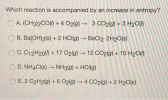 Which reaction is accompanied by an increase in entropy? A. (CH3)2CO() + 4 O2(g) → 3 CO2(g) + 3 H2011) B. Ba(OH)2(s) + 2 HCl(g) → BaCl2.2H2O(s) OC.C12H20() + 17 O2(g) → 12 CO2(g) + 10 H2O() D. NH4Cl(s) + NH3(g) + HCl(g) E. 2 C2H2(g) + 5 O2(g) → 4 CO2(g) + 2 H2O(s)
Which of the following following processes are accompanied by an increase in entropy of the system?...
Which of the following following processes are accompanied by an increase in entropy of the system? (select all that Apply) A. I2(s) → I2(g) B. 2 I(g) → I2(g) C. 2 NH3(g) → N2(g) + 3H2(g) D. Mg2+(aq) + 2OH–(aq) → Mg(OH)2(s) E. All decrease in entropy
Question 14 Which reaction is accompanied by an increase in entropy? A. Ba(OH)2(s) + 2 HCl(g)...
 Question 14 Which reaction is accompanied by an increase in entropy? A. Ba(OH)2(s) + 2 HCl(g) → BaCl2.2H2O(s) B. C12H20() + 17 O2(g) - 12 CO2(g) + 10 H200) OC. NH4Cl(s) → NH3(g) + HCl(g) OD.2 C2H2(g) + 5 O2() → 4 CO2() + 2 H2O(s) E. (CH3)2CO(l) + 4 O2(g) + 3 CO2(g) + 3 H2011)
Which statement is true? A. Spontaneous changes are always accompanied by an increase in the enthalpy...
Which statement is true? A. Spontaneous changes are always accompanied by an increase in the enthalpy of the system. B. Spontaneous changes are always accompanied by a decrease in the entropy of the system. C. Spontaneous changes are always accompanied by a decrease in the enthalpy of the system. D. Most highly exothermic chemical reactions are also spontaneous chemical reactions. E. Spontaneous changes are always accompanied by an increase in the entropy of the system. For a certain chemical reaction,...
Which of the following is so oxidation-reduction reaction? A) Cu (s) + 2AgNO_3(aq) rightarrow 2Ag (s)...
 Which of the following is so oxidation-reduction reaction? A) Cu (s) + 2AgNO_3(aq) rightarrow 2Ag (s) + Cu(NO_3)_2 (aq) B) HCl(aq) + NaOH(aq) rightarrow H_2O (l) + NaCl(aq) C) AgNO_3(aq) + HCl (aq) rightarrow AgCl (s) + N\HNO_3(aq) E) H_2CO_3(aQ) + Ca(NO_3)_2 (aq) rightarrow 2HNO_3(aq) + CaCO_3(s) How many moles of K^+ are present in 343 mL of a 1.27 M solution of K_3PO_4? A) 0.436 B) 1.31 C) 0.145 D) 3.70 E) 11.1 What is the concentration (M) of...
Hello , please help me to answer the following 3 questions: Fe_2O_3(s) + CO_(g) rightarrow Fe_(S)...
 Hello , please help me to answer the following 3
questions:
Fe_2O_3(s) + CO_(g) rightarrow Fe_(S) + CO_2(g) (unbalanced) Calculate the number of grams of CO that can react with 0.517 kg of Fe_2O_3. Consider the following equation: N_2(g) + 3 H_2(g) rightarrow 2 NH_3(g), how many molecules of ammonia are produced when 36.5 liters of hydrogen react at STP (in excess nitrogen)? Given C_3H_8 + O_2 rightarrow CO_2 + H_2O (balance the equation) When 25.0 grams of C_3H_8 react...
Hello , please help me to answer the following 3
questions:
Fe_2O_3(s) + CO_(g) rightarrow Fe_(S) + CO_2(g) (unbalanced) Calculate the number of grams of CO that can react with 0.517 kg of Fe_2O_3. Consider the following equation: N_2(g) + 3 H_2(g) rightarrow 2 NH_3(g), how many molecules of ammonia are produced when 36.5 liters of hydrogen react at STP (in excess nitrogen)? Given C_3H_8 + O_2 rightarrow CO_2 + H_2O (balance the equation) When 25.0 grams of C_3H_8 react...
For the following equilibrium: N_2(g) + H_2(g) rightarrow NH_3(g) delta H= -386 kJ/mole Predict the direction...
 For the following equilibrium: N_2(g) + H_2(g) rightarrow NH_3(g) delta H= -386 kJ/mole Predict the direction the equilibrium will shift if: N_2 is added? H_2 is removed? NH_3 is added? NH_3 is removed? the volume of the container is decreased? the pressure is increased by adding Argon gas? the reaction is cooled? equal number of moles of H_2 and NH_3 are added? a catalyst is added The equilibrium constant for the following reaction is 5.0 at 400 degree C. CO_(g)...
All four please thank you Which of the following is necessary for a process to be...
 All four please thank you
Which of the following is necessary for a process to be spontaneous? A) Delta H_sys < 0 B) Delta S_sys > 0 C) Delta S < 0 D) Delta S_univ > 0 E) Delta G_sys = 0 Which reaction has the largest Delta S degree? A) 2 N_2H_4(g) rightarrow 2 NH_3(g) + H_2(g) B) O_2(g) + 2 H_2(g) rightarrow 2 H_2O(l) C) O_2(g) + 2 H_2(g) rightarrow 2H_2O(g) D) N_2(g) + 3H_2(g) rightarrow 2NH_3(g) E)...
All four please thank you
Which of the following is necessary for a process to be spontaneous? A) Delta H_sys < 0 B) Delta S_sys > 0 C) Delta S < 0 D) Delta S_univ > 0 E) Delta G_sys = 0 Which reaction has the largest Delta S degree? A) 2 N_2H_4(g) rightarrow 2 NH_3(g) + H_2(g) B) O_2(g) + 2 H_2(g) rightarrow 2 H_2O(l) C) O_2(g) + 2 H_2(g) rightarrow 2H_2O(g) D) N_2(g) + 3H_2(g) rightarrow 2NH_3(g) E)...
Consider the reaction 2CO(g) + 2NO(g) rightarrow 2CO_2(g) + N_2(g) for which Delta H degree =...
 Consider the reaction 2CO(g) + 2NO(g) rightarrow 2CO_2(g) + N_2(g) for which Delta H degree = -746.6 kJ and Delta S degree = -198.0 J/K at 298.15 K. (1) Calculate the entropy change of the UNIVERSE when 1.514 moles of CO(g) react under standard conditions at 298.15 K. (2) Is this reaction reactant or product favored under standard conditions? (3) If the reaction is product favored, is it enthalpy favored, entropy favored, or favored by both enthalpy and entropy? If...
 Which reaction is accompanied by an increase in entropy? A N2(g) + 3 H2(g) – 2 NH3(g) B. Ba(OH)2(s) + CO2(g) → BaCO3(s) + H2O(1) C. NH4NO2(s) – N2(g) + 2 H20(0) D.2 C2H2(g) + 5 O2(g) – 4 CO2(g) + 2 H2O(s) E. C8H16(1) + 12 O2(g) — 8 CO2(g) + 8 H 20(1)
 Which reaction is accompanied by an increase in entropy? A. (CH3)2CO() + 4 O2(g) → 3 CO2(g) + 3 H2011) B. Ba(OH)2(s) + 2 HCl(g) → BaCl2.2H2O(s) OC.C12H20() + 17 O2(g) → 12 CO2(g) + 10 H2O() D. NH4Cl(s) + NH3(g) + HCl(g) E. 2 C2H2(g) + 5 O2(g) → 4 CO2(g) + 2 H2O(s)
 Question 14 Which reaction is accompanied by an increase in entropy? A. Ba(OH)2(s) + 2 HCl(g) → BaCl2.2H2O(s) B. C12H20() + 17 O2(g) - 12 CO2(g) + 10 H200) OC. NH4Cl(s) → NH3(g) + HCl(g) OD.2 C2H2(g) + 5 O2() → 4 CO2() + 2 H2O(s) E. (CH3)2CO(l) + 4 O2(g) + 3 CO2(g) + 3 H2011)
 Which of the following is so oxidation-reduction reaction? A) Cu (s) + 2AgNO_3(aq) rightarrow 2Ag (s) + Cu(NO_3)_2 (aq) B) HCl(aq) + NaOH(aq) rightarrow H_2O (l) + NaCl(aq) C) AgNO_3(aq) + HCl (aq) rightarrow AgCl (s) + N\HNO_3(aq) E) H_2CO_3(aQ) + Ca(NO_3)_2 (aq) rightarrow 2HNO_3(aq) + CaCO_3(s) How many moles of K^+ are present in 343 mL of a 1.27 M solution of K_3PO_4? A) 0.436 B) 1.31 C) 0.145 D) 3.70 E) 11.1 What is the concentration (M) of...
 Hello , please help me to answer the following 3
questions:
Fe_2O_3(s) + CO_(g) rightarrow Fe_(S) + CO_2(g) (unbalanced) Calculate the number of grams of CO that can react with 0.517 kg of Fe_2O_3. Consider the following equation: N_2(g) + 3 H_2(g) rightarrow 2 NH_3(g), how many molecules of ammonia are produced when 36.5 liters of hydrogen react at STP (in excess nitrogen)? Given C_3H_8 + O_2 rightarrow CO_2 + H_2O (balance the equation) When 25.0 grams of C_3H_8 react...
Hello , please help me to answer the following 3
questions:
Fe_2O_3(s) + CO_(g) rightarrow Fe_(S) + CO_2(g) (unbalanced) Calculate the number of grams of CO that can react with 0.517 kg of Fe_2O_3. Consider the following equation: N_2(g) + 3 H_2(g) rightarrow 2 NH_3(g), how many molecules of ammonia are produced when 36.5 liters of hydrogen react at STP (in excess nitrogen)? Given C_3H_8 + O_2 rightarrow CO_2 + H_2O (balance the equation) When 25.0 grams of C_3H_8 react...
 For the following equilibrium: N_2(g) + H_2(g) rightarrow NH_3(g) delta H= -386 kJ/mole Predict the direction the equilibrium will shift if: N_2 is added? H_2 is removed? NH_3 is added? NH_3 is removed? the volume of the container is decreased? the pressure is increased by adding Argon gas? the reaction is cooled? equal number of moles of H_2 and NH_3 are added? a catalyst is added The equilibrium constant for the following reaction is 5.0 at 400 degree C. CO_(g)...
 All four please thank you
Which of the following is necessary for a process to be spontaneous? A) Delta H_sys < 0 B) Delta S_sys > 0 C) Delta S < 0 D) Delta S_univ > 0 E) Delta G_sys = 0 Which reaction has the largest Delta S degree? A) 2 N_2H_4(g) rightarrow 2 NH_3(g) + H_2(g) B) O_2(g) + 2 H_2(g) rightarrow 2 H_2O(l) C) O_2(g) + 2 H_2(g) rightarrow 2H_2O(g) D) N_2(g) + 3H_2(g) rightarrow 2NH_3(g) E)...
All four please thank you
Which of the following is necessary for a process to be spontaneous? A) Delta H_sys < 0 B) Delta S_sys > 0 C) Delta S < 0 D) Delta S_univ > 0 E) Delta G_sys = 0 Which reaction has the largest Delta S degree? A) 2 N_2H_4(g) rightarrow 2 NH_3(g) + H_2(g) B) O_2(g) + 2 H_2(g) rightarrow 2 H_2O(l) C) O_2(g) + 2 H_2(g) rightarrow 2H_2O(g) D) N_2(g) + 3H_2(g) rightarrow 2NH_3(g) E)...
 Consider the reaction 2CO(g) + 2NO(g) rightarrow 2CO_2(g) + N_2(g) for which Delta H degree = -746.6 kJ and Delta S degree = -198.0 J/K at 298.15 K. (1) Calculate the entropy change of the UNIVERSE when 1.514 moles of CO(g) react under standard conditions at 298.15 K. (2) Is this reaction reactant or product favored under standard conditions? (3) If the reaction is product favored, is it enthalpy favored, entropy favored, or favored by both enthalpy and entropy? If...
Most questions answered within 3 hours.
-
Where is the error in this code sequence?
String s1 = "Hello";
String s2 = "ello";...
asked 10 months ago -
Financial data for Joel de Paris, Inc., for last year
follow:
Joel de Paris, Inc.
Balance...
asked 10 months ago -
Consider this reaction:
Al2(SO4)3 (aq)+ BaCl3
(aq) Al2Cl6 (aq)- +
3BaSO4(s) . What is the...
asked 10 months ago -
Suppose that Savneet is considering increasing her
recent random sample from 20 car rentals to 40...
asked 10 months ago -
Trucks arrive at an unloading terminal at an average rate of 120
per hour.
Trucks arrive...
asked 10 months ago -
Why are methanol and ethanol completely soluble in water while
octanol is not very little soluble....
asked 10 months ago -
A facilities manager at a university reads in a research report
that the mean amount of...
asked 10 months ago -
When the CuSO4 is rehydrated by adding water to the anhydrous
compound, is this an endothermic...
asked 10 months ago -
A ray of sunlight is passing from diamond into crown glass; the
angle of incidence is...
asked 10 months ago -
A block of mass 0.249 kg is placed on top of a light, vertical
spring of...
asked 10 months ago -
how do the kidneys compensate in the presences of acidosis
a) trigger hyperventilate
b) reserve acid...
asked 10 months ago -
Question 501 pts
The rental rate of capital to the firm increases. Which of the
following...
asked 10 months ago