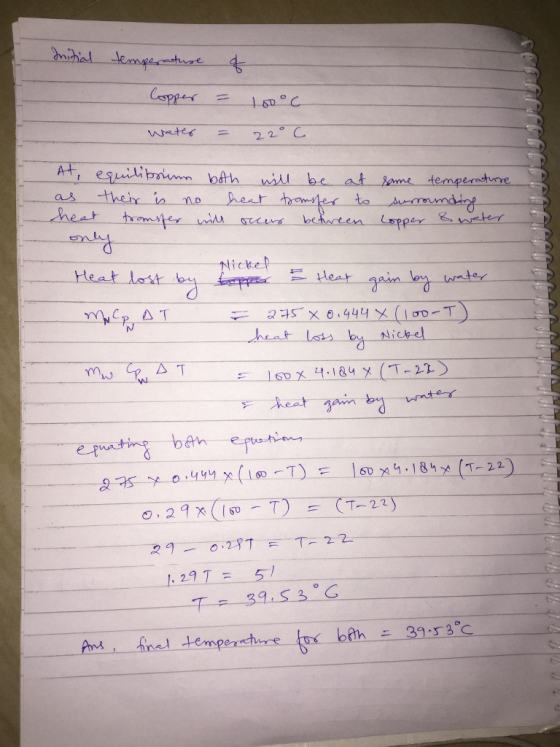
A 275-g sample of nickel at 100.0°C is placed in 100.0 g of water at 22.0°C....
A 275-g sample of nickel at 100.0°C is placed in 100.0 g of water at 22.0°C. What is the final temperature of the water? Assume no heat transfer with the surroundings. The specific heat of nickel is 0.444 J/g·°C and the specific heat of water is 4.184 J/g·°C. Hint: The final temp for both the system and surroundings will be the same.
Homework Answers
Add Answer to:
A 275-g sample of nickel at 100.0°C is placed in 100.0 g of
water at 22.0°C....
QUESTION 6 A 275-9 sample of nickel metal is placed in 1000 g of water at...
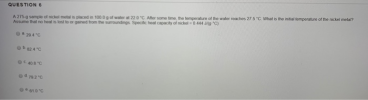 QUESTION 6 A 275-9 sample of nickel metal is placed in 1000 g of water at 220 °C. Ater some time, the temperature of the water reaches 27 5°C What is the initial temperature of the nickel metal? Assume that no heat is lost toorged to the surroundings Specificheat capacity of nickel 0444 C ) * 294 "C 08240 403 od 7020 6100
A 19 g sample of an alloy at 98.0°C is placed into 84.6 g of water at 22.0 °C in an insulated coffee cup with a heat cap...
A 19 g sample of an alloy at 98.0°C is placed into 84.6 g of water at 22.0 °C in an insulated coffee cup with a heat capacity of 9.2 J/K. If the final temperature of the system is 35.0°C, what is the specific heat capacity of the alloy in J/(g.K)? Don't include units. cH2O = 4.184 J/g.K
When a 45.0 g sample of alloy at 100.0°C is dropped into 100.0 g of water...
When a 45.0 g sample of alloy at 100.0°C is dropped into 100.0 g of water at 25°C, the final temperature is 37°C. What is the specific heat of the alloy? (sH2O = 4.184 j/g °C)
A calorimeter contained 81.0 g of water at 16.19°C. A 118-g sample of iron at 65.12°C...
A calorimeter contained 81.0 g of water at 16.19°C. A 118-g sample of iron at 65.12°C was placed in it, giving a final temperature of 19.45°C for the system. Calculate the heat capacity of the calorimeter. Specific heats are 4.184 J/g·°C for and 0.444 J/g·°C for . Heat capacity of the calorimeter = J/°C
A calorimeter contained 79.0 g of water at 15.75°C. A 120.-g sample of iron at 63.82°C...
A calorimeter contained 79.0 g of water at 15.75°C. A 120.-g sample of iron at 63.82°C was placed in it, giving a final temperature of 19.06°C for the system. Calculate the heat capacity of the calorimeter. Specific heats are 4.184 J/g·°C for and 0.444 J/g·°C for . Heat capacity of the calorimeter = ________J/°C
A metal sample weighing 43.5 g at a temperature of 100.0 °C was placed in 39.9...
A metal sample weighing 43.5 g at a temperature of 100.0 °C was placed in 39.9 g of water in a calorimeter at 25.1°C. At equilibrium, the temperature of the water and metal was 33.5°C. What was ΔT for the water? (ΔT = Tfinal - Tinitial) What was ΔT for the metal? Using the specific heat of water (4.184 J/g°C), calculate how much heat flowed into the water. Calculate the specific heat of the metal.
A piece of metal of mass 35.0 g at 100.0°C was placed in 150.0 g of...
 A piece of metal of mass 35.0 g at 100.0°C was placed in 150.0 g of water at 20.0 °C. After stirring, the final temperature of the water and the metal is 23.8°C. What is the specific heat capacity of the metal? (specific heat capacity for H2O = 4.184 J/g °C) O-0.89 J 8°C 19.6 J/g °C 1.96J/g °C O 0.89 J/g °C
A 10.95 g sample of lead at 88.0°C was placed into a styrofoam cup calorimeter which...
A 10.95 g sample of lead at 88.0°C was placed into a styrofoam cup calorimeter which contained 15 mL of water at 22.0°C. The final temperature in the calorimeter reached 23.5°C. Calculate the specific heat of lead. The specific heat of water is 4.184 J/g°C.
A 125 g sample of an unknown substance is heated to 93.6 °C and then dropped...
A 125 g sample of an unknown substance is heated to 93.6 °C and then dropped into 100.0 g of water at 19.0°C in a calorimeter. The temperature of the water rises to 31.0°C. What is the specific heat of the substance? Assume no heat lost to the surroundings. The specific heat of water is 4.184 J/ (g•°C).
A piece of titanium at 100.0°C was dropped into 50.0 g of water at 20.0°C. The...
 A piece of titanium at 100.0°C was dropped into 50.0 g of water at 20.0°C. The final temperature of the system was 22.6°C. What was the mass of the titanium? Specific heat (J/g°C) titanium 0.54 water 4.184
 QUESTION 6 A 275-9 sample of nickel metal is placed in 1000 g of water at 220 °C. Ater some time, the temperature of the water reaches 27 5°C What is the initial temperature of the nickel metal? Assume that no heat is lost toorged to the surroundings Specificheat capacity of nickel 0444 C ) * 294 "C 08240 403 od 7020 6100
 A piece of metal of mass 35.0 g at 100.0°C was placed in 150.0 g of water at 20.0 °C. After stirring, the final temperature of the water and the metal is 23.8°C. What is the specific heat capacity of the metal? (specific heat capacity for H2O = 4.184 J/g °C) O-0.89 J 8°C 19.6 J/g °C 1.96J/g °C O 0.89 J/g °C
 A piece of titanium at 100.0°C was dropped into 50.0 g of water at 20.0°C. The final temperature of the system was 22.6°C. What was the mass of the titanium? Specific heat (J/g°C) titanium 0.54 water 4.184
Most questions answered within 3 hours.
-
Where is the error in this code sequence?
String s1 = "Hello";
String s2 = "ello";...
asked 11 months ago -
Financial data for Joel de Paris, Inc., for last year
follow:
Joel de Paris, Inc.
Balance...
asked 11 months ago -
Consider this reaction:
Al2(SO4)3 (aq)+ BaCl3
(aq) Al2Cl6 (aq)- +
3BaSO4(s) . What is the...
asked 11 months ago -
Suppose that Savneet is considering increasing her
recent random sample from 20 car rentals to 40...
asked 11 months ago -
Trucks arrive at an unloading terminal at an average rate of 120
per hour.
Trucks arrive...
asked 11 months ago -
Why are methanol and ethanol completely soluble in water while
octanol is not very little soluble....
asked 11 months ago -
A facilities manager at a university reads in a research report
that the mean amount of...
asked 11 months ago -
When the CuSO4 is rehydrated by adding water to the anhydrous
compound, is this an endothermic...
asked 11 months ago -
A ray of sunlight is passing from diamond into crown glass; the
angle of incidence is...
asked 11 months ago -
A block of mass 0.249 kg is placed on top of a light, vertical
spring of...
asked 11 months ago -
how do the kidneys compensate in the presences of acidosis
a) trigger hyperventilate
b) reserve acid...
asked 11 months ago -
Question 501 pts
The rental rate of capital to the firm increases. Which of the
following...
asked 11 months ago