
Homework Answers
Add Answer to:
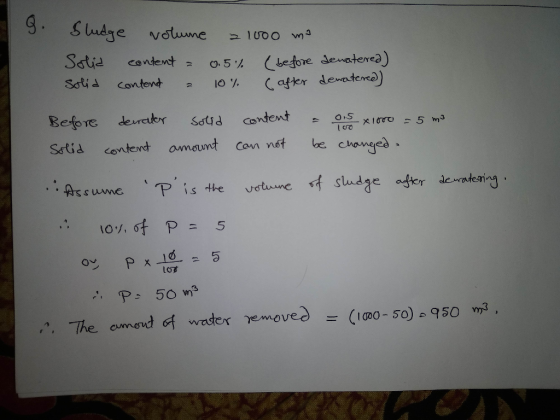
c. A sludge of 1000 m3 is to be dewatered by centrifuge. If the solid content...
Just tell me which one is right A wastewater treatment plant treats 1000 (m3 day) of...
 Just tell me which one is right
A wastewater treatment plant treats 1000 (m3 day) of wastewater. Calculate the amount of excess sludge (kg day l) under steady-state condition, based on the following information: -Influent and effluent BOD concentrations: 200 mg Lland 10 mg L-? -Influent P concentration: 10 mg L-? -Yx/s=0.6; ka=0 (ignore the decay rate) -Content percentage of P in excess sludge: 7% The amount of excess sludge (kg day '); 64 84 114 214 the most anxious...
Just tell me which one is right
A wastewater treatment plant treats 1000 (m3 day) of wastewater. Calculate the amount of excess sludge (kg day l) under steady-state condition, based on the following information: -Influent and effluent BOD concentrations: 200 mg Lland 10 mg L-? -Influent P concentration: 10 mg L-? -Yx/s=0.6; ka=0 (ignore the decay rate) -Content percentage of P in excess sludge: 7% The amount of excess sludge (kg day '); 64 84 114 214 the most anxious...
A wastewater flow of 18,000 m3/day is to be treated in a completely mixed activated sludge...
 A wastewater flow of 18,000 m3/day is to be treated in a completely mixed activated sludge system at a concentration of 3000 mg/L MLSS (mixed liquor suspended solids). The secondary clarifier is designed to thicken the sludge to 12,000 mg/L. Assuming a growth yield coefficient of 0.5 Kg/Kg, an influent BOD of 100 mg/L with a residence time of 8 days, determine the following: a) The volume of the reactor b) The mass of the solids and the wet volume...
A coagulation process has a design flow of 0.75 m3/s and is dosing alum at 35 mg/L. clay is also added at 14 mg/L as an additive to help the coagulation process. The influent suspended solids is 55 m...
A coagulation process has a design flow of 0.75 m3/s and is dosing alum at 35 mg/L. clay is also added at 14 mg/L as an additive to help the coagulation process. The influent suspended solids is 55 mg/L and the effluent is 8 mg/L. The sludge solids content is 2.5% and the specific gravity of the sludge solids is 3.5. What is the volume of sludge to be removed in one week? In one year?
In geology, the moisture content of a solid is computed as θ = Vw / (Vs...
In geology, the moisture content of a solid is computed as θ = Vw / (Vs + Vw + Va), where Vs is the volume of soil, Vw is the volume of water and Va is the air space. The denominator S = Vs + Vw + Va of the moisture content is computed using a function CalcDen that receives, as arguments, Vs, Vw and Va and returns S. The moisture content is computed using a function CalcMos that receives,...
B. The moist weight of 0.028 m3 of a soil is 52 kg. The moisture content...
 B. The moist weight of 0.028 m3 of a soil is 52 kg. The moisture content and the specific gravity of the soil solids are determined in the laboratory to be 11% and 2.7 , respectively. Calculate the following: Moist unit weight (kg/m3) i. Dry unit weight (kg/m3) ii. Void ratio d. Porosity iii. iv. Degree of saturation (%) Volume occupied by water (m3) v. ngle C. For the soil sample in A (above) represent the following on a soil...
Question 2 A complete mix activated sludge process is to be used for biological treatment. Assume...
 Question 2 A complete mix activated sludge process is to be used for biological treatment. Assume the following for the activated sludge process: • Plant influent BODs of 156 mg/L • Sludge age is 8 days Biomass yield (Y) of 0.54 kg biomass / kg BOD • Endogenous decay rate (kd) = 0.05 day! • Ks=10 g BOD/m3 Biomass concentration (X) of 2700 mg/L • recycle biomass concentration (Xr) of 12,000 mg/L The fresh flow rate treated is 1000 m²/day...
2. A 1.5 m3 sample of moist soil weights 2750 kg. The water content is 15.5%. Assume Gs 2.7. With this information, fil...
 2. A 1.5 m3 sample of moist soil weights 2750 kg. The water content is 15.5%. Assume Gs 2.7. With this information, fill in all the blanks on the phase diagram. Also provide the void ratio, porosity and dry density. Show all your calculations Weight Volume Water Solid Air
2. A 1.5 m3 sample of moist soil weights 2750 kg. The water content is 15.5%. Assume Gs 2.7. With this information, fill in all the blanks on the phase diagram....
2. A 1.5 m3 sample of moist soil weights 2750 kg. The water content is 15.5%. Assume Gs 2.7. With this information, fill in all the blanks on the phase diagram. Also provide the void ratio, porosity and dry density. Show all your calculations Weight Volume Water Solid Air
2. A 1.5 m3 sample of moist soil weights 2750 kg. The water content is 15.5%. Assume Gs 2.7. With this information, fill in all the blanks on the phase diagram....
Q2. Copper ores rich in ultra-soluble sulfate minerals are leached using water. Finely grounded solid copper...
 Q2. Copper ores rich in ultra-soluble sulfate minerals are leached using water. Finely grounded solid copper ore with 1000 kg/h, contains 20% CuSO4 (copper sulfate) and 70 % insoluble solids (Feed, F). The rest 10 % is contaminants and ignore their existence in your calculations. (Take only copper sulfate (solute) and solid content of the Feed.) The leaching occurs in a two- stage, counter-current system using 3000 kg/h of water as pure solvent. The ratio of kg insoluble solid to...
Q2. Copper ores rich in ultra-soluble sulfate minerals are leached using water. Finely grounded solid copper...
 Q2. Copper ores rich in ultra-soluble sulfate minerals are leached using water. Finely grounded solid copper ore with 1000 kg/h, contains 20% CuSO4 (copper sulfate) and 70 % insoluble solids (Feed, F). The rest 10 % is contaminants and ignore their existence in your calculations. (Take only copper sulfate (solute) and solid content of the Feed.) The leaching occurs in a two- stage, counter-current system using 3000 kg/h of water as pure solvent. The ratio of kg insoluble solid to...
Q2. Copper ores rich in ultra-soluble sulfate minerals are leached using water. Finely grounded solid copper...
 Q2. Copper ores rich in ultra-soluble sulfate minerals are leached using water. Finely grounded solid copper ore with 1000 kg/h, contains 20% CuSO4 (copper sulfate) and 70 % insoluble solids (Feed, F). The rest 10 % is contaminants and ignore their existence in your calculations. (Take only copper sulfate (solute) and solid content of the Feed.) The leaching occurs in a two- stage, counter-current system using 3000 kg/h of water as pure solvent. The ratio of kg insoluble solid to...
 Just tell me which one is right
A wastewater treatment plant treats 1000 (m3 day) of wastewater. Calculate the amount of excess sludge (kg day l) under steady-state condition, based on the following information: -Influent and effluent BOD concentrations: 200 mg Lland 10 mg L-? -Influent P concentration: 10 mg L-? -Yx/s=0.6; ka=0 (ignore the decay rate) -Content percentage of P in excess sludge: 7% The amount of excess sludge (kg day '); 64 84 114 214 the most anxious...
Just tell me which one is right
A wastewater treatment plant treats 1000 (m3 day) of wastewater. Calculate the amount of excess sludge (kg day l) under steady-state condition, based on the following information: -Influent and effluent BOD concentrations: 200 mg Lland 10 mg L-? -Influent P concentration: 10 mg L-? -Yx/s=0.6; ka=0 (ignore the decay rate) -Content percentage of P in excess sludge: 7% The amount of excess sludge (kg day '); 64 84 114 214 the most anxious...
 A wastewater flow of 18,000 m3/day is to be treated in a completely mixed activated sludge system at a concentration of 3000 mg/L MLSS (mixed liquor suspended solids). The secondary clarifier is designed to thicken the sludge to 12,000 mg/L. Assuming a growth yield coefficient of 0.5 Kg/Kg, an influent BOD of 100 mg/L with a residence time of 8 days, determine the following: a) The volume of the reactor b) The mass of the solids and the wet volume...
 B. The moist weight of 0.028 m3 of a soil is 52 kg. The moisture content and the specific gravity of the soil solids are determined in the laboratory to be 11% and 2.7 , respectively. Calculate the following: Moist unit weight (kg/m3) i. Dry unit weight (kg/m3) ii. Void ratio d. Porosity iii. iv. Degree of saturation (%) Volume occupied by water (m3) v. ngle C. For the soil sample in A (above) represent the following on a soil...
 Question 2 A complete mix activated sludge process is to be used for biological treatment. Assume the following for the activated sludge process: • Plant influent BODs of 156 mg/L • Sludge age is 8 days Biomass yield (Y) of 0.54 kg biomass / kg BOD • Endogenous decay rate (kd) = 0.05 day! • Ks=10 g BOD/m3 Biomass concentration (X) of 2700 mg/L • recycle biomass concentration (Xr) of 12,000 mg/L The fresh flow rate treated is 1000 m²/day...
 2. A 1.5 m3 sample of moist soil weights 2750 kg. The water content is 15.5%. Assume Gs 2.7. With this information, fill in all the blanks on the phase diagram. Also provide the void ratio, porosity and dry density. Show all your calculations Weight Volume Water Solid Air
2. A 1.5 m3 sample of moist soil weights 2750 kg. The water content is 15.5%. Assume Gs 2.7. With this information, fill in all the blanks on the phase diagram....
2. A 1.5 m3 sample of moist soil weights 2750 kg. The water content is 15.5%. Assume Gs 2.7. With this information, fill in all the blanks on the phase diagram. Also provide the void ratio, porosity and dry density. Show all your calculations Weight Volume Water Solid Air
2. A 1.5 m3 sample of moist soil weights 2750 kg. The water content is 15.5%. Assume Gs 2.7. With this information, fill in all the blanks on the phase diagram....
 Q2. Copper ores rich in ultra-soluble sulfate minerals are leached using water. Finely grounded solid copper ore with 1000 kg/h, contains 20% CuSO4 (copper sulfate) and 70 % insoluble solids (Feed, F). The rest 10 % is contaminants and ignore their existence in your calculations. (Take only copper sulfate (solute) and solid content of the Feed.) The leaching occurs in a two- stage, counter-current system using 3000 kg/h of water as pure solvent. The ratio of kg insoluble solid to...
 Q2. Copper ores rich in ultra-soluble sulfate minerals are leached using water. Finely grounded solid copper ore with 1000 kg/h, contains 20% CuSO4 (copper sulfate) and 70 % insoluble solids (Feed, F). The rest 10 % is contaminants and ignore their existence in your calculations. (Take only copper sulfate (solute) and solid content of the Feed.) The leaching occurs in a two- stage, counter-current system using 3000 kg/h of water as pure solvent. The ratio of kg insoluble solid to...
 Q2. Copper ores rich in ultra-soluble sulfate minerals are leached using water. Finely grounded solid copper ore with 1000 kg/h, contains 20% CuSO4 (copper sulfate) and 70 % insoluble solids (Feed, F). The rest 10 % is contaminants and ignore their existence in your calculations. (Take only copper sulfate (solute) and solid content of the Feed.) The leaching occurs in a two- stage, counter-current system using 3000 kg/h of water as pure solvent. The ratio of kg insoluble solid to...
Most questions answered within 3 hours.
-
Where is the error in this code sequence?
String s1 = "Hello";
String s2 = "ello";...
asked 11 months ago -
Financial data for Joel de Paris, Inc., for last year
follow:
Joel de Paris, Inc.
Balance...
asked 11 months ago -
Consider this reaction:
Al2(SO4)3 (aq)+ BaCl3
(aq) Al2Cl6 (aq)- +
3BaSO4(s) . What is the...
asked 11 months ago -
Suppose that Savneet is considering increasing her
recent random sample from 20 car rentals to 40...
asked 11 months ago -
Trucks arrive at an unloading terminal at an average rate of 120
per hour.
Trucks arrive...
asked 11 months ago -
Why are methanol and ethanol completely soluble in water while
octanol is not very little soluble....
asked 11 months ago -
A facilities manager at a university reads in a research report
that the mean amount of...
asked 11 months ago -
When the CuSO4 is rehydrated by adding water to the anhydrous
compound, is this an endothermic...
asked 11 months ago -
A ray of sunlight is passing from diamond into crown glass; the
angle of incidence is...
asked 11 months ago -
A block of mass 0.249 kg is placed on top of a light, vertical
spring of...
asked 11 months ago -
how do the kidneys compensate in the presences of acidosis
a) trigger hyperventilate
b) reserve acid...
asked 11 months ago -
Question 501 pts
The rental rate of capital to the firm increases. Which of the
following...
asked 11 months ago