
Homework Answers
Add Answer to:
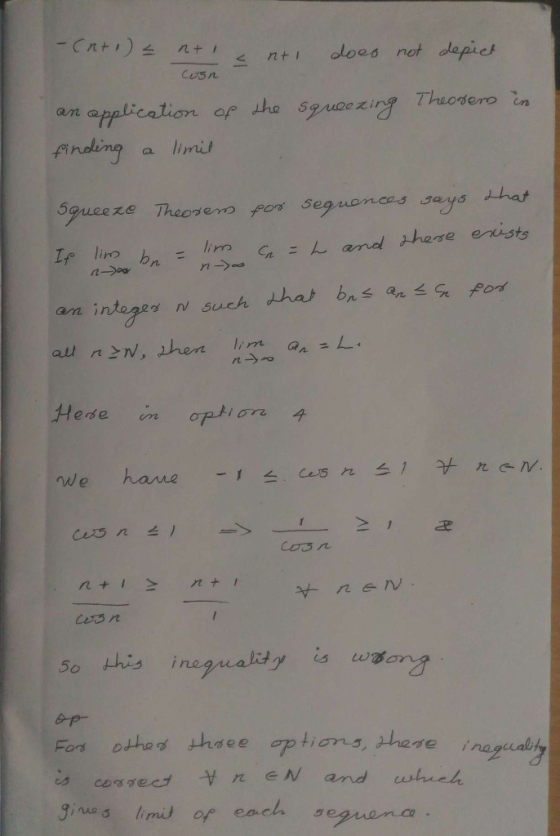
Which one of the following does NOT correctly depict an application of the Squeezing Theorem in...
4. Determine the integral which computes the arc length of the curve y = sin(x) with...
 4. Determine the integral which computes the arc length of the curve y = sin(x) with 0 < x <. TT A '1 + sin2(a)dx so $." .TT B 1 + cos2(x)dx С [* V1 – cos? (7)dx D| None of the above.
Need solution pls... 2. Find the Fourier transform of f() = {6 1 – 12 \t...
 Need solution pls...
2. Find the Fourier transform of f() = {6 1 – 12 \t <1 1t| > 1 Use the first shift theorem to deduce the Fourier transforms of e3jt (1-12) 11 <1 (a) g(t) 1t| > 1 {" (b)h() = {**"1 –1) "151 It| > 1 Answer: 63 4 cos o 4 sin o + -62 -4 cos(w – 3) (a) (0 – 3)2 -4 cos(w – j) (b) (w – j)2 + 4 sin(0 – 3)...
Need solution pls...
2. Find the Fourier transform of f() = {6 1 – 12 \t <1 1t| > 1 Use the first shift theorem to deduce the Fourier transforms of e3jt (1-12) 11 <1 (a) g(t) 1t| > 1 {" (b)h() = {**"1 –1) "151 It| > 1 Answer: 63 4 cos o 4 sin o + -62 -4 cos(w – 3) (a) (0 – 3)2 -4 cos(w – j) (b) (w – j)2 + 4 sin(0 – 3)...
Central limit theorem 9. Suppose that a random variable X has a continuous uniform distribution fx(3)...
 Central limit theorem 9. Suppose that a random variable X has a continuous uniform distribution fx(3) = (1/2,4 <r <6 o elsewhere (a) Find the distribution of the sample mean of a random sample of size n = 40. (b) Calculate the probability that the sample mean is larger than 5.5.
8. Show that Theorem 3.1, the Nested intervals theorem, may be proved as a direct consequence...
 8. Show that Theorem 3.1, the Nested intervals theorem, may be proved as a direct consequence of the Cauchy criterion for convergence (Theorem 3.14). (Hint: Suppose I. = {x: 0, <x<bn} is a nested sequence. Then show that {an} and {b} are Cauchy sequences. Hence they each tend to a limit. Since b.-4, 0, the limits must be the same. Finally, the Sandwiching theorem shows that the limit is in every 1.] Definition. An infinite sequence {n} is called a...
State the quadrant in which lies. sin(8) <0, cos(8) < 0 OII III OIV 8 If...
 State the quadrant in which lies. sin(8) <0, cos(8) < 0 OII III OIV 8 If sin() and 8 is in the 1st quadrant, find the exact value for cos(8). 9 cos(8) - > Next Question State the quadrant in which lies. tan(8) > 0, csc(8) < 0 01 OII O III OIV
Law of Large Number↓ Led tin eperaje Theorem 9.11. (Central limit theorem) Suppose that we have...
 Law of Large Number↓
Led tin eperaje Theorem 9.11. (Central limit theorem) Suppose that we have i.i.d. random variables Xi,X2. X3,... with finite mean EX and finite variance Var(X) = σ2. Let Sn-Xi + . . . + Xn. Then for any fixed - oo<a<b<oo we have lim Pax (9.6) Theorem 4.8. (Law of large numbers for binomial random variables) For any fixed ε > 0 we have (4.7) n-00
Law of Large Number↓
Led tin eperaje Theorem 9.11. (Central limit theorem) Suppose that we have i.i.d. random variables Xi,X2. X3,... with finite mean EX and finite variance Var(X) = σ2. Let Sn-Xi + . . . + Xn. Then for any fixed - oo<a<b<oo we have lim Pax (9.6) Theorem 4.8. (Law of large numbers for binomial random variables) For any fixed ε > 0 we have (4.7) n-00
The answers for part b are sin(A/2) = √26/26, cos(A/2) = -5√26/26, and tan(A/2) = -1/5,...
 The answers for part b are sin(A/2) = √26/26, cos(A/2) =
-5√26/26, and tan(A/2) = -1/5, but I can't figure out how to get
there
lies and (b) find the 24. Iftan A = with 34 < A< 21, then (a) determine the quadrant in which exact value of sin (), cos (), and tan ().
The answers for part b are sin(A/2) = √26/26, cos(A/2) =
-5√26/26, and tan(A/2) = -1/5, but I can't figure out how to get
there
lies and (b) find the 24. Iftan A = with 34 < A< 21, then (a) determine the quadrant in which exact value of sin (), cos (), and tan ().
n=0 4. Using the power series cos(x) = { (-1)",2 (-0<x<0), to find a power (2n)!...
 n=0 4. Using the power series cos(x) = { (-1)",2 (-0<x<0), to find a power (2n)! series for the function f(x) = sin(x) sin(3x) and its interval of convergence. 23 Find the power series representation for the function f(2) and its interval (3x - 2) of convergence. 5. +
Which of the following functions is the unique solution of the IBVP Ut = QUI 0<<...
 Which of the following functions is the unique solution of the IBVP Ut = QUI 0<< t > 0 u(0,t) = u(Tt, t) = 0, t> 0 u(2,0) = 1, 0 <<< Select one: 2((-1)" – 1) O A. u(x, t) = -sin(nt)e-amt nyt T21 00 2(1 - (-1)") O B. u(x,t) = -sin(na)e-an’t nn 11 2(1 – (-1)") O C. u(a,t) -sin(ne)eamt n n=1 00 2((-1)" – 1) O D. u(2,t) = sin(nx)e-ant n 11 20 (1-(-1)") O E....
(6) Fundamental Theorem of Line Integrals F = <M,N> = < 2xy, x² + y2 >...
 (6) Fundamental Theorem of Line Integrals F = <M,N> = < 2xy, x² + y2 > (6a) Show that F is a Conservative Vector Field. (6b) Find the Potential Function f(x,y) for the Vector Field F. (60) Evaluate W = | Mdx + Ndy from (5,0) to (0,4) over the path C: È + K3 = 1 с
 4. Determine the integral which computes the arc length of the curve y = sin(x) with 0 < x <. TT A '1 + sin2(a)dx so $." .TT B 1 + cos2(x)dx С [* V1 – cos? (7)dx D| None of the above.
 Need solution pls...
2. Find the Fourier transform of f() = {6 1 – 12 \t <1 1t| > 1 Use the first shift theorem to deduce the Fourier transforms of e3jt (1-12) 11 <1 (a) g(t) 1t| > 1 {" (b)h() = {**"1 –1) "151 It| > 1 Answer: 63 4 cos o 4 sin o + -62 -4 cos(w – 3) (a) (0 – 3)2 -4 cos(w – j) (b) (w – j)2 + 4 sin(0 – 3)...
Need solution pls...
2. Find the Fourier transform of f() = {6 1 – 12 \t <1 1t| > 1 Use the first shift theorem to deduce the Fourier transforms of e3jt (1-12) 11 <1 (a) g(t) 1t| > 1 {" (b)h() = {**"1 –1) "151 It| > 1 Answer: 63 4 cos o 4 sin o + -62 -4 cos(w – 3) (a) (0 – 3)2 -4 cos(w – j) (b) (w – j)2 + 4 sin(0 – 3)...
 Central limit theorem 9. Suppose that a random variable X has a continuous uniform distribution fx(3) = (1/2,4 <r <6 o elsewhere (a) Find the distribution of the sample mean of a random sample of size n = 40. (b) Calculate the probability that the sample mean is larger than 5.5.
 8. Show that Theorem 3.1, the Nested intervals theorem, may be proved as a direct consequence of the Cauchy criterion for convergence (Theorem 3.14). (Hint: Suppose I. = {x: 0, <x<bn} is a nested sequence. Then show that {an} and {b} are Cauchy sequences. Hence they each tend to a limit. Since b.-4, 0, the limits must be the same. Finally, the Sandwiching theorem shows that the limit is in every 1.] Definition. An infinite sequence {n} is called a...
 State the quadrant in which lies. sin(8) <0, cos(8) < 0 OII III OIV 8 If sin() and 8 is in the 1st quadrant, find the exact value for cos(8). 9 cos(8) - > Next Question State the quadrant in which lies. tan(8) > 0, csc(8) < 0 01 OII O III OIV
 Law of Large Number↓
Led tin eperaje Theorem 9.11. (Central limit theorem) Suppose that we have i.i.d. random variables Xi,X2. X3,... with finite mean EX and finite variance Var(X) = σ2. Let Sn-Xi + . . . + Xn. Then for any fixed - oo<a<b<oo we have lim Pax (9.6) Theorem 4.8. (Law of large numbers for binomial random variables) For any fixed ε > 0 we have (4.7) n-00
Law of Large Number↓
Led tin eperaje Theorem 9.11. (Central limit theorem) Suppose that we have i.i.d. random variables Xi,X2. X3,... with finite mean EX and finite variance Var(X) = σ2. Let Sn-Xi + . . . + Xn. Then for any fixed - oo<a<b<oo we have lim Pax (9.6) Theorem 4.8. (Law of large numbers for binomial random variables) For any fixed ε > 0 we have (4.7) n-00
 The answers for part b are sin(A/2) = √26/26, cos(A/2) =
-5√26/26, and tan(A/2) = -1/5, but I can't figure out how to get
there
lies and (b) find the 24. Iftan A = with 34 < A< 21, then (a) determine the quadrant in which exact value of sin (), cos (), and tan ().
The answers for part b are sin(A/2) = √26/26, cos(A/2) =
-5√26/26, and tan(A/2) = -1/5, but I can't figure out how to get
there
lies and (b) find the 24. Iftan A = with 34 < A< 21, then (a) determine the quadrant in which exact value of sin (), cos (), and tan ().
 n=0 4. Using the power series cos(x) = { (-1)",2 (-0<x<0), to find a power (2n)! series for the function f(x) = sin(x) sin(3x) and its interval of convergence. 23 Find the power series representation for the function f(2) and its interval (3x - 2) of convergence. 5. +
 Which of the following functions is the unique solution of the IBVP Ut = QUI 0<< t > 0 u(0,t) = u(Tt, t) = 0, t> 0 u(2,0) = 1, 0 <<< Select one: 2((-1)" – 1) O A. u(x, t) = -sin(nt)e-amt nyt T21 00 2(1 - (-1)") O B. u(x,t) = -sin(na)e-an’t nn 11 2(1 – (-1)") O C. u(a,t) -sin(ne)eamt n n=1 00 2((-1)" – 1) O D. u(2,t) = sin(nx)e-ant n 11 20 (1-(-1)") O E....
 (6) Fundamental Theorem of Line Integrals F = <M,N> = < 2xy, x² + y2 > (6a) Show that F is a Conservative Vector Field. (6b) Find the Potential Function f(x,y) for the Vector Field F. (60) Evaluate W = | Mdx + Ndy from (5,0) to (0,4) over the path C: È + K3 = 1 с
Most questions answered within 3 hours.
-
Where is the error in this code sequence?
String s1 = "Hello";
String s2 = "ello";...
asked 10 months ago -
Financial data for Joel de Paris, Inc., for last year
follow:
Joel de Paris, Inc.
Balance...
asked 10 months ago -
Consider this reaction:
Al2(SO4)3 (aq)+ BaCl3
(aq) Al2Cl6 (aq)- +
3BaSO4(s) . What is the...
asked 10 months ago -
Suppose that Savneet is considering increasing her
recent random sample from 20 car rentals to 40...
asked 10 months ago -
Trucks arrive at an unloading terminal at an average rate of 120
per hour.
Trucks arrive...
asked 10 months ago -
Why are methanol and ethanol completely soluble in water while
octanol is not very little soluble....
asked 10 months ago -
A facilities manager at a university reads in a research report
that the mean amount of...
asked 10 months ago -
When the CuSO4 is rehydrated by adding water to the anhydrous
compound, is this an endothermic...
asked 10 months ago -
A ray of sunlight is passing from diamond into crown glass; the
angle of incidence is...
asked 10 months ago -
A block of mass 0.249 kg is placed on top of a light, vertical
spring of...
asked 10 months ago -
how do the kidneys compensate in the presences of acidosis
a) trigger hyperventilate
b) reserve acid...
asked 10 months ago -
Question 501 pts
The rental rate of capital to the firm increases. Which of the
following...
asked 10 months ago