
Homework Answers
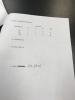
| Event | C | D | Total |
| A | 4 | 2 | 6 |
| B | 1 | 3 | 4 |
| Total | 5 | 5 | 10 |
P(A U D) = 2/10 = 0.2
P(B) = 4/10
P(A/D) = N(A of D) / N(D) = 2/5
P(C/B) = N(C of B) / N(B) = 1/4
Add Answer to:
Refer to the table below, find the following probability. Event D Total 42 с B 3...
4. Refer to the following table below. Second Event A First Event Az As Total Bi...
 4. Refer to the following table below. Second Event A First Event Az As Total Bi B2 Total 10 a) Determine P(A) b) What is P(BA) ?(n, ba c) what is )
Answer all. Refer to the following table. Second Event First Event A1 A2 A3 4 1...
 Answer all.
Refer to the following table. Second Event First Event A1 A2 A3 4 1 5 | 4 4 4 Total 10 12 Total 8 5 9 22 a. Determine P1A2). (Round your answer to 2 decimal places.) P(A2) b. Determine PB1A3). (Round your answer to 2 decimal places.) P(B41A3) c. Determine PCB2 and A3). (Round your answer to 2 decimal places.) P(B2 and A3) < Prey 4 of 5 !!! Nex Compute the mean and variance of the...
Answer all.
Refer to the following table. Second Event First Event A1 A2 A3 4 1 5 | 4 4 4 Total 10 12 Total 8 5 9 22 a. Determine P1A2). (Round your answer to 2 decimal places.) P(A2) b. Determine PB1A3). (Round your answer to 2 decimal places.) P(B41A3) c. Determine PCB2 and A3). (Round your answer to 2 decimal places.) P(B2 and A3) < Prey 4 of 5 !!! Nex Compute the mean and variance of the...
Refer to the following table. First Event Second Event A1 A2 A3 Total B1 4 9...
Refer to the following table. First Event Second Event A1 A2 A3 Total B1 4 9 11 24 B2 10 16 9 35 Total 14 25 20 59 Determine P(A1). (Round your answer to 2 decimal places.) Determine P(B1| A2). (Round your answer to 2 decimal places.) Determine P(A2 and B2). (Round your answer to 2 decimal places.)
Use the contingency table to complete A) through D) EVENT A EVENT B EVENT C 29...
Use the contingency table to complete A) through D) EVENT A EVENT B EVENT C 29 29 EVENT D 2 15 EVENT E 24 1 DETERMINE THE probability A) P(A/C)= B) P(C/A)= C) P(B/E)= D) P(E/B)=
Refer to the data table from question 4. Let A denote the event that a product...
 Refer to the data table from question 4. Let A denote the event that a product was produced on 1st shift, and let B denote the event that the product passes the quality inspection. Let C denote the event that a product was produced on 2nd shift. If a sample is selected at random, determine the following probabilities: 5. a. P(B) b. P(A U B UC) c. P(CnB) d. P(B |(A UC) Operating Shift Fail l Pass 93 81 87...
Help with a b and c -0 COUNTING AND Outcomes and event probability: Addition rule A...
 Help with a b and c
-0 COUNTING AND Outcomes and event probability: Addition rule A 6-sided die with faces labeled 1 to 6 will be rolled once. The 6 possible outcomes are listed in the table below. Note that each outcome has the same probability. Complete parts (a) through (c). Write the probabilities as fractions. (a) Check the outcomes for each event in the table. Then, in the last column, enter the probability of t event. Outcomes Probability 6...
Help with a b and c
-0 COUNTING AND Outcomes and event probability: Addition rule A 6-sided die with faces labeled 1 to 6 will be rolled once. The 6 possible outcomes are listed in the table below. Note that each outcome has the same probability. Complete parts (a) through (c). Write the probabilities as fractions. (a) Check the outcomes for each event in the table. Then, in the last column, enter the probability of t event. Outcomes Probability 6...
The probability of event A is P(A) = 0.5 and the probability of event B is...
The probability of event A is P(A) = 0.5 and the probability of event B is P(B) = 0.3. (Express all answers as decimals; do not include unnecessary decimal places--i.e. answers should be in the form 0.2 or .2, and NOT 0.20, 2/10 or 20%.) a) Find P(A and B) if A and B are disjoint. b) Find P(A or B) if A and B are disjoint. c) Find P(A or B) if P(A and B) = 0.2. d) Find...
4.2.1 Sep Use the contingency table to complete parts a) through d) below Event A Event...
 4.2.1 Sep Use the contingency table to complete parts a) through d) below Event A Event B Event Event D Event E a) Determine the probability of P(A and C). PIA and C)- (Round to two decimal places as needed)
Yes No Girls 42 ,110 Boys 95, 53 a. If b represents the event of selecting...
Yes No Girls 42 ,110 Boys 95, 53 a. If b represents the event of selecting a response from a boy, find the complement of b [P(Ђ)]. 148/300=0.493 1-0.493=0.507 ? b. Find the probability that the selected answer was no [P(no)]. ? c. If g represents the event of selecting a response from a girl, find the complement of g [P (ḡ)]. 0.493? d. Find the probability that the selected answer was yes [P(yes)].?
1 Find the probability by referring to the tree diagram C P(A) 5 D Start С...
 1 Find the probability by referring to the tree diagram C P(A) 5 D Start С D P(A) = (Simplify your answer.)
 4. Refer to the following table below. Second Event A First Event Az As Total Bi B2 Total 10 a) Determine P(A) b) What is P(BA) ?(n, ba c) what is )
 Answer all.
Refer to the following table. Second Event First Event A1 A2 A3 4 1 5 | 4 4 4 Total 10 12 Total 8 5 9 22 a. Determine P1A2). (Round your answer to 2 decimal places.) P(A2) b. Determine PB1A3). (Round your answer to 2 decimal places.) P(B41A3) c. Determine PCB2 and A3). (Round your answer to 2 decimal places.) P(B2 and A3) < Prey 4 of 5 !!! Nex Compute the mean and variance of the...
Answer all.
Refer to the following table. Second Event First Event A1 A2 A3 4 1 5 | 4 4 4 Total 10 12 Total 8 5 9 22 a. Determine P1A2). (Round your answer to 2 decimal places.) P(A2) b. Determine PB1A3). (Round your answer to 2 decimal places.) P(B41A3) c. Determine PCB2 and A3). (Round your answer to 2 decimal places.) P(B2 and A3) < Prey 4 of 5 !!! Nex Compute the mean and variance of the...
 Refer to the data table from question 4. Let A denote the event that a product was produced on 1st shift, and let B denote the event that the product passes the quality inspection. Let C denote the event that a product was produced on 2nd shift. If a sample is selected at random, determine the following probabilities: 5. a. P(B) b. P(A U B UC) c. P(CnB) d. P(B |(A UC) Operating Shift Fail l Pass 93 81 87...
 Help with a b and c
-0 COUNTING AND Outcomes and event probability: Addition rule A 6-sided die with faces labeled 1 to 6 will be rolled once. The 6 possible outcomes are listed in the table below. Note that each outcome has the same probability. Complete parts (a) through (c). Write the probabilities as fractions. (a) Check the outcomes for each event in the table. Then, in the last column, enter the probability of t event. Outcomes Probability 6...
Help with a b and c
-0 COUNTING AND Outcomes and event probability: Addition rule A 6-sided die with faces labeled 1 to 6 will be rolled once. The 6 possible outcomes are listed in the table below. Note that each outcome has the same probability. Complete parts (a) through (c). Write the probabilities as fractions. (a) Check the outcomes for each event in the table. Then, in the last column, enter the probability of t event. Outcomes Probability 6...
 4.2.1 Sep Use the contingency table to complete parts a) through d) below Event A Event B Event Event D Event E a) Determine the probability of P(A and C). PIA and C)- (Round to two decimal places as needed)
 1 Find the probability by referring to the tree diagram C P(A) 5 D Start С D P(A) = (Simplify your answer.)
Most questions answered within 3 hours.
-
Where is the error in this code sequence?
String s1 = "Hello";
String s2 = "ello";...
asked 10 months ago -
Financial data for Joel de Paris, Inc., for last year
follow:
Joel de Paris, Inc.
Balance...
asked 10 months ago -
Consider this reaction:
Al2(SO4)3 (aq)+ BaCl3
(aq) Al2Cl6 (aq)- +
3BaSO4(s) . What is the...
asked 10 months ago -
Suppose that Savneet is considering increasing her
recent random sample from 20 car rentals to 40...
asked 10 months ago -
Trucks arrive at an unloading terminal at an average rate of 120
per hour.
Trucks arrive...
asked 10 months ago -
Why are methanol and ethanol completely soluble in water while
octanol is not very little soluble....
asked 10 months ago -
A facilities manager at a university reads in a research report
that the mean amount of...
asked 10 months ago -
When the CuSO4 is rehydrated by adding water to the anhydrous
compound, is this an endothermic...
asked 10 months ago -
A ray of sunlight is passing from diamond into crown glass; the
angle of incidence is...
asked 10 months ago -
A block of mass 0.249 kg is placed on top of a light, vertical
spring of...
asked 10 months ago -
how do the kidneys compensate in the presences of acidosis
a) trigger hyperventilate
b) reserve acid...
asked 10 months ago -
Question 501 pts
The rental rate of capital to the firm increases. Which of the
following...
asked 10 months ago