
Homework Answers
Answer:
46. Option c (min)
In class diagram, the class has three parts i) class name ii) attributes (data members) iii) operations (member functions)
The second part has attributes or members of the class. So, 'min' is one of the data members of the class Clock.
47. Option b (setTime(int,int,int))
Any method which doesn't return anything is 'void' type.
In the given options, setTime(int,int,int):void means setTime(int,int,int) returns nothing.
48. option a (public Clock() { setTime(0,0,0);}
49. Option c (class)
Constructors have same name as the class
50. Option c (the operator new)
new operator is used to allocate the memory for instance variables of objects of a class.
Add Answer to:
Cloekt Cloek ( int, int, int) etTire(int, int, intjt void getHour printTime voia int int teqran...
D Question 6 4 pts Figure 1: clock Type |-hr: int -min: int -sec; int setTime...
 D Question 6 4 pts Figure 1: clock Type |-hr: int -min: int -sec; int setTime (int, int, int): void get Time (inte, int&, int&) const: void printTime() const: void increment seconds(): int +incrementMinutes(): int +increment Hours(): int -equalTime (const clockType.) const: bool Consider the UML class diagram shown in the accompanying figure. According to the UML class diagram, how many private members are in the class? none zero two three D Question 4 4 pts Consider the following class...
[Java] We have learned the class Clock, which was designed to implement the time of day...
[Java] We have learned the class Clock, which was designed to implement the time of day in a program. Certain application in addition to hours, minutes, and seconds might require you to store the time zone. Please do the following: Derive the class ExtClock from the class Clock by adding a data member to store the time zone. Add necessary methods and constructors to make the class functional. Also write the definitions of the methods and constructors. Write a test...
C++ class Time { public: Time(); Time(int hrs, int min, int sec); private: int hours; int...
C++ class Time { public: Time(); Time(int hrs, int min, int sec); private: int hours; int minutes; int seconds; }; 1. Write the class definition for ExtendedTime which derives from Time via public inheritance. Add private data member time_zone which is an enum type TimeZone (enum TimeZone { PACIFIC, MOUNTAIN, CENTRAL, EASTERN } ). Add a default and alternate constructors to ExtendedTime to initialize all class (including the base class) data; use the base member initialization list. NOTE: This implies...
C++ Please! Given this definition of a Time class: class Time { private: int hour, min,...
C++ Please! Given this definition of a Time class: class Time { private: int hour, min, sec; public: Time() { hour = 0; min = 0; sec = 0; } Time(int h, int m, int s) { hour = h; min = m; sec = s; } int getHour() const { return hour; } int getMin() const { return minute; } int getSec() const { return sec; } }; Derive a class MilTime from the Time...
Write in C++ please In Chapter 10, the class clockType was designed to implement the time...
Write in C++ please In Chapter 10, the class clockType was designed to implement the time of day in a program. Certain applications, in addition to hours, minutes, and seconds, might require you to store the time zone. Derive the class extClockType from the class clockTypeby adding a member variable to store the time zone. Add the necessary member functions and constructors to make the class functional. Also, write the definitions of the member functions and the constructors. Finally, write...
which is incorrect? struct myStruct { int i; double d; }; class myClass { public: int...
which is incorrect? struct myStruct { int i; double d; }; class myClass { public: int i; double d; }; myStruct a; a.i = 3; myClass b; b.i = 3; a) All these statements will compile with no problem. b) A structure member is accessed using the index operator [ ], with the member name as index. [ ] c) A class is a type similar to a structure type that normally has member functions as well as member variables....
void card:: setNum(int n) { assert(n >= 1 && n <= 13); num = n; }...
 void card:: setNum(int n) {
assert(n >= 1 && n <= 13);
num = n;
}
void card::setSuit(char s) {
assert(s == 'C' || s == 'D' || s == 'H' || s == 'S');
suit = s;
}
int card::getNum() {
assert(num >= 1 && num <= 13);
return num;
}
char card::getSuit() {
assert(suit == 'C' || suit == 'D' || suit == 'H' || suit ==
'S');
return suit;
}
string card:: read() {
string output="";
if...
void card:: setNum(int n) {
assert(n >= 1 && n <= 13);
num = n;
}
void card::setSuit(char s) {
assert(s == 'C' || s == 'D' || s == 'H' || s == 'S');
suit = s;
}
int card::getNum() {
assert(num >= 1 && num <= 13);
return num;
}
char card::getSuit() {
assert(suit == 'C' || suit == 'D' || suit == 'H' || suit ==
'S');
return suit;
}
string card:: read() {
string output="";
if...
4. class Person { 2} public void printValue(int i, int j) {/*…*/ } 3} public void...
4. class Person { 2} public void printValue(int i, int j) {/*…*/ } 3} public void printValue(int i){/*...*/ } 4} } 5) public class Teacher extends Person { 6} public void printValue() {/*...*/ } 7} public void printValue(int i) {/*...*/} 8} public static void main(String args[]){ 9} Person t = new Teacher(); 10} t.printValue(10); 11} } 12} } Which method will the statement on line 10 call? A. on line 2 B. on line 3 C. on line 6 D....
c++ question 1. C++ string Class What does the output look like after executing the following...
c++ question 1. C++ string Class What does the output look like after executing the following statements? std::string numstr = "12"; numstr += "3"; std::cout << numstr << '\n'; A. None of these. B. The snippet has syntax errors. C. 15 D.123 // 2. Let S be a class that allows integers to be stored in its objects like an array. For example, if obj is an object of S, one can write statements like obj[0] = 100; or int...
looking for a UML diagram for this program in cpp a. Member variables and member functions...
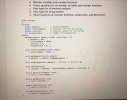 looking for a UML diagram for this program in cpp
a. Member variables and member functions b. Access specifiers for all member variables and member functions C. Data types for all member variables d. Data types for all parameters e. Return types for all member functions, constructors, and destructors class Account { private: double balance; // Account balance double interest Rate; // Interest rate for the period double interest; // Interest earned for the period int transactions; // Number of...
looking for a UML diagram for this program in cpp
a. Member variables and member functions b. Access specifiers for all member variables and member functions C. Data types for all member variables d. Data types for all parameters e. Return types for all member functions, constructors, and destructors class Account { private: double balance; // Account balance double interest Rate; // Interest rate for the period double interest; // Interest earned for the period int transactions; // Number of...
 D Question 6 4 pts Figure 1: clock Type |-hr: int -min: int -sec; int setTime (int, int, int): void get Time (inte, int&, int&) const: void printTime() const: void increment seconds(): int +incrementMinutes(): int +increment Hours(): int -equalTime (const clockType.) const: bool Consider the UML class diagram shown in the accompanying figure. According to the UML class diagram, how many private members are in the class? none zero two three D Question 4 4 pts Consider the following class...
 void card:: setNum(int n) {
assert(n >= 1 && n <= 13);
num = n;
}
void card::setSuit(char s) {
assert(s == 'C' || s == 'D' || s == 'H' || s == 'S');
suit = s;
}
int card::getNum() {
assert(num >= 1 && num <= 13);
return num;
}
char card::getSuit() {
assert(suit == 'C' || suit == 'D' || suit == 'H' || suit ==
'S');
return suit;
}
string card:: read() {
string output="";
if...
void card:: setNum(int n) {
assert(n >= 1 && n <= 13);
num = n;
}
void card::setSuit(char s) {
assert(s == 'C' || s == 'D' || s == 'H' || s == 'S');
suit = s;
}
int card::getNum() {
assert(num >= 1 && num <= 13);
return num;
}
char card::getSuit() {
assert(suit == 'C' || suit == 'D' || suit == 'H' || suit ==
'S');
return suit;
}
string card:: read() {
string output="";
if...
 looking for a UML diagram for this program in cpp
a. Member variables and member functions b. Access specifiers for all member variables and member functions C. Data types for all member variables d. Data types for all parameters e. Return types for all member functions, constructors, and destructors class Account { private: double balance; // Account balance double interest Rate; // Interest rate for the period double interest; // Interest earned for the period int transactions; // Number of...
looking for a UML diagram for this program in cpp
a. Member variables and member functions b. Access specifiers for all member variables and member functions C. Data types for all member variables d. Data types for all parameters e. Return types for all member functions, constructors, and destructors class Account { private: double balance; // Account balance double interest Rate; // Interest rate for the period double interest; // Interest earned for the period int transactions; // Number of...
Most questions answered within 3 hours.
-
Where is the error in this code sequence?
String s1 = "Hello";
String s2 = "ello";...
asked 11 months ago -
Financial data for Joel de Paris, Inc., for last year
follow:
Joel de Paris, Inc.
Balance...
asked 11 months ago -
Consider this reaction:
Al2(SO4)3 (aq)+ BaCl3
(aq) Al2Cl6 (aq)- +
3BaSO4(s) . What is the...
asked 11 months ago -
Suppose that Savneet is considering increasing her
recent random sample from 20 car rentals to 40...
asked 11 months ago -
Trucks arrive at an unloading terminal at an average rate of 120
per hour.
Trucks arrive...
asked 11 months ago -
Why are methanol and ethanol completely soluble in water while
octanol is not very little soluble....
asked 11 months ago -
A facilities manager at a university reads in a research report
that the mean amount of...
asked 11 months ago -
When the CuSO4 is rehydrated by adding water to the anhydrous
compound, is this an endothermic...
asked 11 months ago -
A ray of sunlight is passing from diamond into crown glass; the
angle of incidence is...
asked 11 months ago -
A block of mass 0.249 kg is placed on top of a light, vertical
spring of...
asked 11 months ago -
how do the kidneys compensate in the presences of acidosis
a) trigger hyperventilate
b) reserve acid...
asked 11 months ago -
Question 501 pts
The rental rate of capital to the firm increases. Which of the
following...
asked 11 months ago