Determine whether each of these functions = O(x^3 ) Justify your answer f(x) = x^3 +...
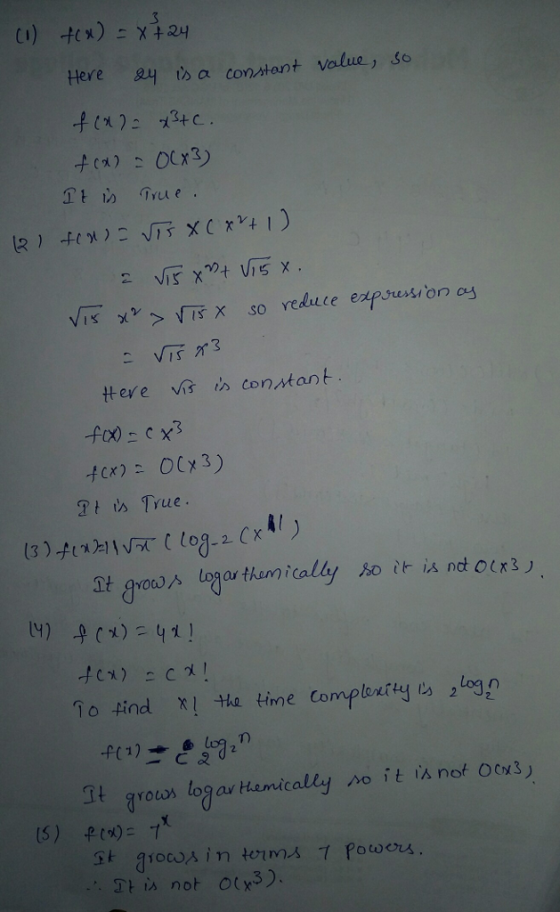
Determine whether each of these functions = O(x^3 )
Justify your answer
f(x) = x^3 + 24.
f(x)=√15x (x^2+1)
f(x)=11√x log_2(x^11 )
f(x)= 4x!
f(x)=7^x
PROBLEM 4
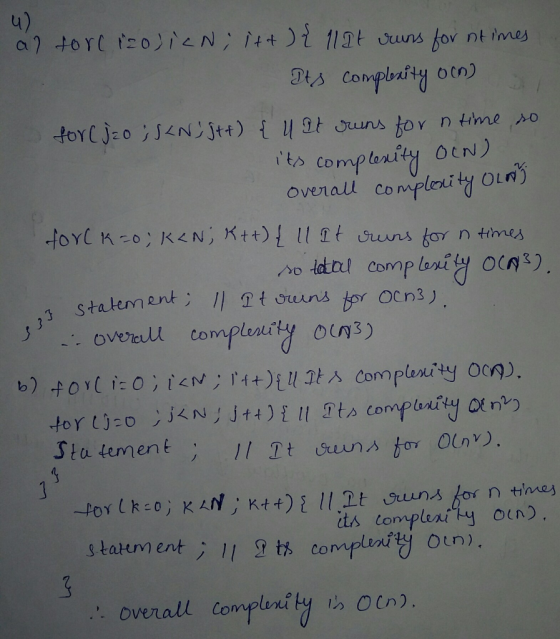
Given the pseudocode, estimate its running time complexity in terms of Big-O (give tight bound).
a)
for ( i = 0; i < N; i++ ) {
for ( j = 0; j < N; j++ ) {
for ( k = 0; k < N; j++ ) {
statement;// printing stuff
}
}
}
b)
for ( i = 0; i < N; i++ ) {
for ( j = 0; j < N; j++ ) {
statement;// printing stuff
}
}
for ( k = 0; k < N; j++ ){
statement;// printing stuff
}
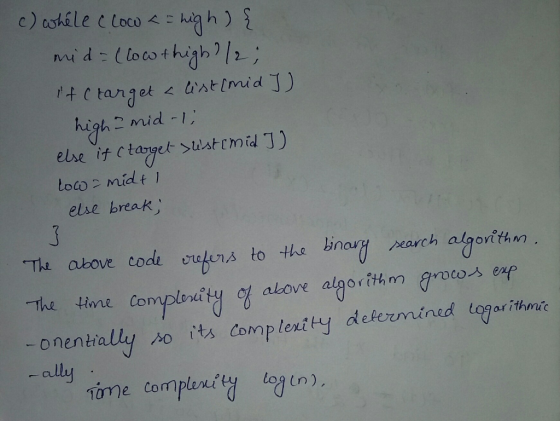
c)
while ( low <= high ) {
mid = ( low + high ) / 2;
if ( target < list[mid] )
high = mid - 1;
else if ( target > list[mid] )
low = mid + 1;
else break;
}
Homework Answers
Add Answer to:
Determine whether each of these functions = O(x^3 )
Justify your answer
f(x) = x^3 +...
1. Determine the appropriate big-o expression for each of the following functions, and put your answer...
 1. Determine the appropriate big-o expression for each of the following functions, and put your answer in the table we have provided in section 2-1 of ps5_parti. We've included the answer for the first function. (Note: We're using the “ symbol to represent exponentiation.) a (n) = 5n + 1 b. b(n) = 5 - 10n - n^2 o c(n) = 4n + 2log (n) d. e. d(n) = 6nlog (n) + n^2 e(n) = 2n^2 + 3n^3 - 7n...
Determine the Big-O value for the following functions. The valid Big-O options are: 'O(1)' 'O(N)' 'O(LOG2(N))'...
Determine the Big-O value for the following functions. The valid Big-O options are: 'O(1)' 'O(N)' 'O(LOG2(N))' 'O(N * LOG2(N))' 'O(N^2)' 'O(inf)' # This is Big-O of infinity def function_one(list_): for pass_ in range(len(list_) - 1, 0, -1): for i in range(pass_): if list_[i] > list_[i+1]: temp = list_[i] list_[i] = list_[i+1] list_[i+1] = temp def function_two(list_): if len(list_) > 1: midpoint_index = len(list_) // 2 left_half = list_[:midpoint_index] right_half = list_[midpoint_index:] function_two(left_half) function_two(right_half) left_half_pos = 0 right_half_pos = 0 new_position...
without coding Give the Big O run-time of the following algorithms. Binary Search: def binary-search (arr,...
 without coding
Give the Big O run-time of the following algorithms. Binary Search: def binary-search (arr, low, high, x): # Check base case if low > high : return None else: mid = (high + low) // 2 element arr[mid] == X: if element return mid elif element > X: return binary-search(arr, low, mid 1, x) else: return binary_search(arr, mid + 1, high, x) Selection Sort: def selection_sort (arr): for i in range (len(arr)): smallest index = i smallest value...
without coding
Give the Big O run-time of the following algorithms. Binary Search: def binary-search (arr, low, high, x): # Check base case if low > high : return None else: mid = (high + low) // 2 element arr[mid] == X: if element return mid elif element > X: return binary-search(arr, low, mid 1, x) else: return binary_search(arr, mid + 1, high, x) Selection Sort: def selection_sort (arr): for i in range (len(arr)): smallest index = i smallest value...
PROBLEM 1 (24 points): For each of the recursive functions below and on the next page,...
 PROBLEM 1 (24 points): For each of the recursive functions below and on the next page, give a correct recurrence relation expressing its runtime and then a tight runtime bound for the recurrence relation. Functions that take parameters lo and hi: n=hi-lo+1 RECURRENCE RELATION: int foo(int a[], int lo, int hi) { int x, i, j, m; X = 0; if(lo==hi) return a[10]; for(i=lo; i<=hi; i++) { for(j=i+1; j<=hi; j++) { if(a[i] % 2) x += a[i]; else x -=...
Merge Sort: Time Complexity: O(n log(n)) #include "stdafx.h" #include <iostream> #include <time.h> #include <stdlib.h> using namespace...
Merge Sort: Time Complexity: O(n log(n)) #include "stdafx.h" #include <iostream> #include <time.h> #include <stdlib.h> using namespace std; void combine(int *a, int low, int high, int mid) { int i, j, k, c[100000]; i = low; k = low; j = mid + 1; while (i <= mid && j <= high) { if (a[i] < a[j]) { c[k] = a[i]; k++; i++; } else { ...
Show your work Count the number of operations and the big-O time complexity in the worst-case...
Show your work Count the number of operations and the big-O time complexity in the worst-case and best-case for the following code int small for ( i n t i = 0 ; i < n ; i ++) { i f ( a [ i ] < a [ 0 ] ) { small = a [ i ] ; } } Show Work Calculate the Big-O time complexity for the following code and explain your answer by showing...
Analyze the runtime of c functions below and give a tight runtime bound for each. ....
 Analyze the runtime of c functions below and give a tight runtime bound for each. . . Both functions have the same best-case and worst-case runtime (so this is not an issue). Since we want a "tight" runtime bound, your final answer should be in big-m form. Show your work! "The runtime of foo() is e(< something >)" is not sufficient even if <something> happens to be correct. In other words, convince the reader of the correctness of your answer....
1(5 pts): For each code fragment below, give the complexity of the algorithm (O or Θ)....
 1(5 pts): For each code fragment below, give the complexity of the algorithm (O or Θ). Give the tightest possible upper bound as the input size variable increases. The input size variable in these questions is exclusively n. Complexity Code public static int recursiveFunction (int n)f f( n <= 0 ) return 0; return recursiveFunction (n - 1) 1; for(int i 0i <n; i+) j=0; for ( int j k=0; i; k < < j++) for (int j; m <...
Convert the following pseudocode to Java. Use the same variable names as those in the pseudocode....
Convert the following pseudocode to Java. Use the same variable names as those in the pseudocode. You may assume that the incoming array contains int values and that a swap method exists elsewhere. The variables low and high represent indices in the array. In a comment before the sort method, list which sorting algorithm is used here and what its runtime complexity is in Big-O notation. This is the only comment required for this code. SUBROUTINE sort(ARRAY a[0..n], low, high)...
Show the Big O Complexity of the following functions and loop constructions: (Please show work and...
Show the Big O Complexity of the following functions and loop constructions: (Please show work and explain) a. f(n) = 2n + (blog(n+1)) b. f(n) = n * (log(n-1))/2 c. int sum = 0; for (int i=0; i<n; i++) sum++; for (int j=n; j>0; j /= 2) sum++; d. int sum = 0; for (int i=n; i>0; i--) for (int j=i; j<n; j *= 2) sum++;
 1. Determine the appropriate big-o expression for each of the following functions, and put your answer in the table we have provided in section 2-1 of ps5_parti. We've included the answer for the first function. (Note: We're using the “ symbol to represent exponentiation.) a (n) = 5n + 1 b. b(n) = 5 - 10n - n^2 o c(n) = 4n + 2log (n) d. e. d(n) = 6nlog (n) + n^2 e(n) = 2n^2 + 3n^3 - 7n...
 without coding
Give the Big O run-time of the following algorithms. Binary Search: def binary-search (arr, low, high, x): # Check base case if low > high : return None else: mid = (high + low) // 2 element arr[mid] == X: if element return mid elif element > X: return binary-search(arr, low, mid 1, x) else: return binary_search(arr, mid + 1, high, x) Selection Sort: def selection_sort (arr): for i in range (len(arr)): smallest index = i smallest value...
without coding
Give the Big O run-time of the following algorithms. Binary Search: def binary-search (arr, low, high, x): # Check base case if low > high : return None else: mid = (high + low) // 2 element arr[mid] == X: if element return mid elif element > X: return binary-search(arr, low, mid 1, x) else: return binary_search(arr, mid + 1, high, x) Selection Sort: def selection_sort (arr): for i in range (len(arr)): smallest index = i smallest value...
 PROBLEM 1 (24 points): For each of the recursive functions below and on the next page, give a correct recurrence relation expressing its runtime and then a tight runtime bound for the recurrence relation. Functions that take parameters lo and hi: n=hi-lo+1 RECURRENCE RELATION: int foo(int a[], int lo, int hi) { int x, i, j, m; X = 0; if(lo==hi) return a[10]; for(i=lo; i<=hi; i++) { for(j=i+1; j<=hi; j++) { if(a[i] % 2) x += a[i]; else x -=...
 Analyze the runtime of c functions below and give a tight runtime bound for each. . . Both functions have the same best-case and worst-case runtime (so this is not an issue). Since we want a "tight" runtime bound, your final answer should be in big-m form. Show your work! "The runtime of foo() is e(< something >)" is not sufficient even if <something> happens to be correct. In other words, convince the reader of the correctness of your answer....
 1(5 pts): For each code fragment below, give the complexity of the algorithm (O or Θ). Give the tightest possible upper bound as the input size variable increases. The input size variable in these questions is exclusively n. Complexity Code public static int recursiveFunction (int n)f f( n <= 0 ) return 0; return recursiveFunction (n - 1) 1; for(int i 0i <n; i+) j=0; for ( int j k=0; i; k < < j++) for (int j; m <...
Most questions answered within 3 hours.
-
Where is the error in this code sequence?
String s1 = "Hello";
String s2 = "ello";...
asked 10 months ago -
Financial data for Joel de Paris, Inc., for last year
follow:
Joel de Paris, Inc.
Balance...
asked 10 months ago -
Consider this reaction:
Al2(SO4)3 (aq)+ BaCl3
(aq) Al2Cl6 (aq)- +
3BaSO4(s) . What is the...
asked 10 months ago -
Suppose that Savneet is considering increasing her
recent random sample from 20 car rentals to 40...
asked 10 months ago -
Trucks arrive at an unloading terminal at an average rate of 120
per hour.
Trucks arrive...
asked 10 months ago -
Why are methanol and ethanol completely soluble in water while
octanol is not very little soluble....
asked 10 months ago -
A facilities manager at a university reads in a research report
that the mean amount of...
asked 10 months ago -
When the CuSO4 is rehydrated by adding water to the anhydrous
compound, is this an endothermic...
asked 10 months ago -
A ray of sunlight is passing from diamond into crown glass; the
angle of incidence is...
asked 10 months ago -
A block of mass 0.249 kg is placed on top of a light, vertical
spring of...
asked 10 months ago -
how do the kidneys compensate in the presences of acidosis
a) trigger hyperventilate
b) reserve acid...
asked 10 months ago -
Question 501 pts
The rental rate of capital to the firm increases. Which of the
following...
asked 10 months ago